
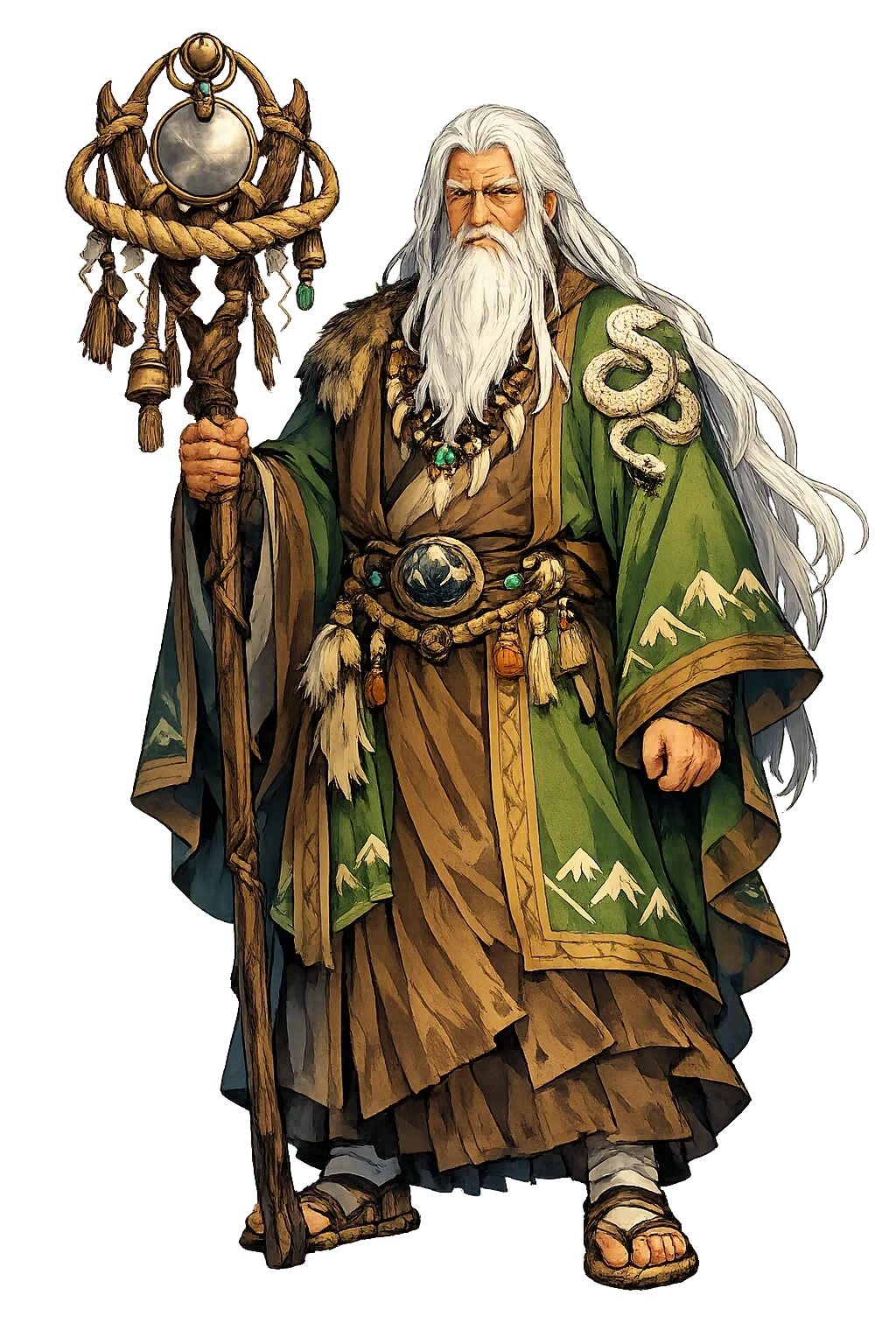
The appointments Omononushi made — and who is keeping them
The mistake is reading myths as entertainment. Omononushi's cycle reads more like a charter — each story assigning a duty the modern world still pays for.
At a Glance
- Temple: Omononushi
- Pantheon: Japanese
- Domain of influence: Mountains, Deity of Miwa
- Pattern seats: 3
- Sectors touched: Society & Spirit · Energy & Natural World
- Strongest seat: Faith & Spiritual Organizations
- Series: The Resonance Files, No. 365 of 548
The Cycle, Read Forward
Faith & Spiritual Organizations — through The Serpent Husband of Ikutamayori
A maiden named Ikutamayori was visited each night by a beautiful man who came unseen. When she bore his child, her parents demanded to know the father.
The atlas states the seat in one line: The great thing lord of Miwa; one of the oldest kami cults in Japan. The story above is the long version of the same sentence. The trade thinks it is optimizing a process. It is re-enacting a charter.
Forestry, Conservation & Outdoor Industries — through The Oracle of the Land
When the heavenly emissary Takemikazuchi descended to demand the land from the earthly god Ōnamuji (Ōkuninushi), Ōnamuji consulted his children. Kotoshironushi, away at Cape Miwa, answered that resistance to the heavenly grandson was hopeless — and then all eyes turned to the mountain.
The atlas states the seat in one line: The mountain kami of Miwa; the forested peak is his shrine and his body. The story above is the long version of the same sentence. The trade thinks it is optimizing a process. It is re-enacting a charter.
Agriculture, Food & Harvest — through The Bride of Miwa
Ōmononushi took as wife Seyadatarahime, daughter of his own son Kotoshironushi by Ikutamayori — and their child was the princess Himetataraisuzuhime. She became the consort of Emperor Sujin and bore the future Emperor Suinin: the serpent-god of Mount Miwa thus entered the imperial genealogy itself, the god's line becoming grandmother to the next sovereign.
The atlas states the seat in one line: The mountain deity of Miwa; upland rice and sacred earth answer to him. The story above is the long version of the same sentence. The trade thinks it is optimizing a process. It is re-enacting a charter.
The Theme That Runs the Cycle
Ōmononushi's mythology is preserved in strange, archaic tales of snakes, possession, and oracles — the Kojiki's strangest marriage, the constitution of Japan's sovereignty, and a shrine with no god-house, because the mountain is the god.
The Method, Stated Plainly
Skeptical? Good — the system is built for you. Every seat in this file carries its why-line and its weight, the full derivation is public at the methodology page, and the challenge process is part of the design. Falsifiable is not a posture here; it is the mechanism.
For the Ones Who Work There
If you work in faith & spiritual organizations, forestry, conservation & outdoor industries, or any trade this temple holds a seat in, this is the honest version of what a placement means: your industry beside the story it has been re-telling all along — on the temple floor itself, before an audience that came specifically to read it. The patron tier and the advertising terms describe the mechanics; the resonance above describes the fit.
The File Continues
One of 548 Resonance Files — the series where the pantheon goes to work. Read the founding dispatch for the name, the Restoration File for the spelling, or the whole archive end to end.
Continue the series — previous: Oṃ (read it) · next: Omphalós (read it).
The Resonance Files are argued from the same canonical record as the pattern atlas itself: the lexicon, the lore catalog, and the cited sources. Every seat can be challenged at the methodology page — and the challenge is the point.