Stories of Olódùmarè
Olódùmarè's mythology is theology: the origin of the world, the distribution of destiny, and the hierarchy between the high god and the orishas who serve him.
At the beginning the world was water below and sky above, and Olódùmarè resolved to make a place for life. He charged Ọbatalá (Orishanla) with the task: descend the golden chain from heaven carrying a snail shell filled with sand, a five-toed hen, and a chameleon to test the ground. But at the threshold the trickster Ẹṣù offered Ọbatalá palm wine; he drank, grew drowsy, and slept. His younger brother Odùduwà seized the chain, the shell, and the hen, scattered the sand on the primordial flood, and the hen scratched it into the ridges of the earth (Ifá corpus; retold by E. Bolaji Idowu, Olódùmarè: God in Yoruba Belief, 1962). When Ọbatalá awoke and descended, the work was done; humbled, he accepted as his own share the moulding of human bodies from clay. The myth divides creation into command, execution, and embodiment: Olódùmarè wills the world, others build it, and the god whom failure humbled receives the clay of humanity.
Before birth, every soul kneels in heaven to choose a destiny — àkúnlẹ̀yàn, 'that which is chosen kneeling' — from the moulds of Àjàlá, the divine potter of heads (orí). Ifá verses do not flatter the potter: Àjàlá is a drunkard whose wares are badly fired, and some heads are cracked, some crooked, while only the patient find the sound ones. The choice made, Olódùmarè himself ratifies it and breathes the éémí, the life-force, into the chosen head — and because the seal is his, destiny can be softened by sacrifice and wisdom but never revoked (Idowu 1962; Abimbola, Ifá: An Exposition of Ifá Literary Corpus, 1976). Idowu reads the myth as Yoruba theodicy in miniature: the world is not unjust because Olódùmarè is cruel, but because choosing is the price of being human — and heaven itself keeps a careless potter.
Early accounts of Yoruba cosmogony record a flood sent by Olódùmarè when humanity grew numerous, neglected sacrifice, and forgot the source of its breath (J. Olumide Lucas, The Religion of the Yorubas, 1948; Idowu 1962). The waters rose until only a remnant remained; in the most told form a man, a woman, and a faithful dog endured, and from them the earth was repeopled. The tale belongs to the universal flood type, yet it answers a specifically Yoruba question: why does the most generous god become the most terrible? Because sustenance is a loan, not a possession — when gratitude fails entirely, the owner reclaims the universe he lent. The flood myth also explains Olódùmarè's remoteness as a mercy: a god this absolute cannot be approached directly, and the orishas exist precisely to stand between his justice and human fragility.
Yoruba theologians explain the high god's cultlessness by turning it into doctrine: no carver can depict him, no drumbeat can summon him, and no sacrifice can add anything to him (Idowu 1962). Prayer reaches him through the sky itself; his witnesses are the sun and the rainbow-serpent, and his éémí already fills every living body. Idowu notes that the absence of a priesthood is the theology — Olódùmarè is complete in himself, and a god who needs nothing from mortals cannot be bargained with. Yet this absence structures the entire religion: because the owner of the universe will not come down, the orishas must. Every orisha festival thus honours him secondhand, and every breath of éémí is a liturgy no priest need perform. The mythology of his remoteness is thus the charter of Yoruba polytheism itself — one absolute source, and a world governed by delegates.
Supreme Creator, Destiny, and Final Authority
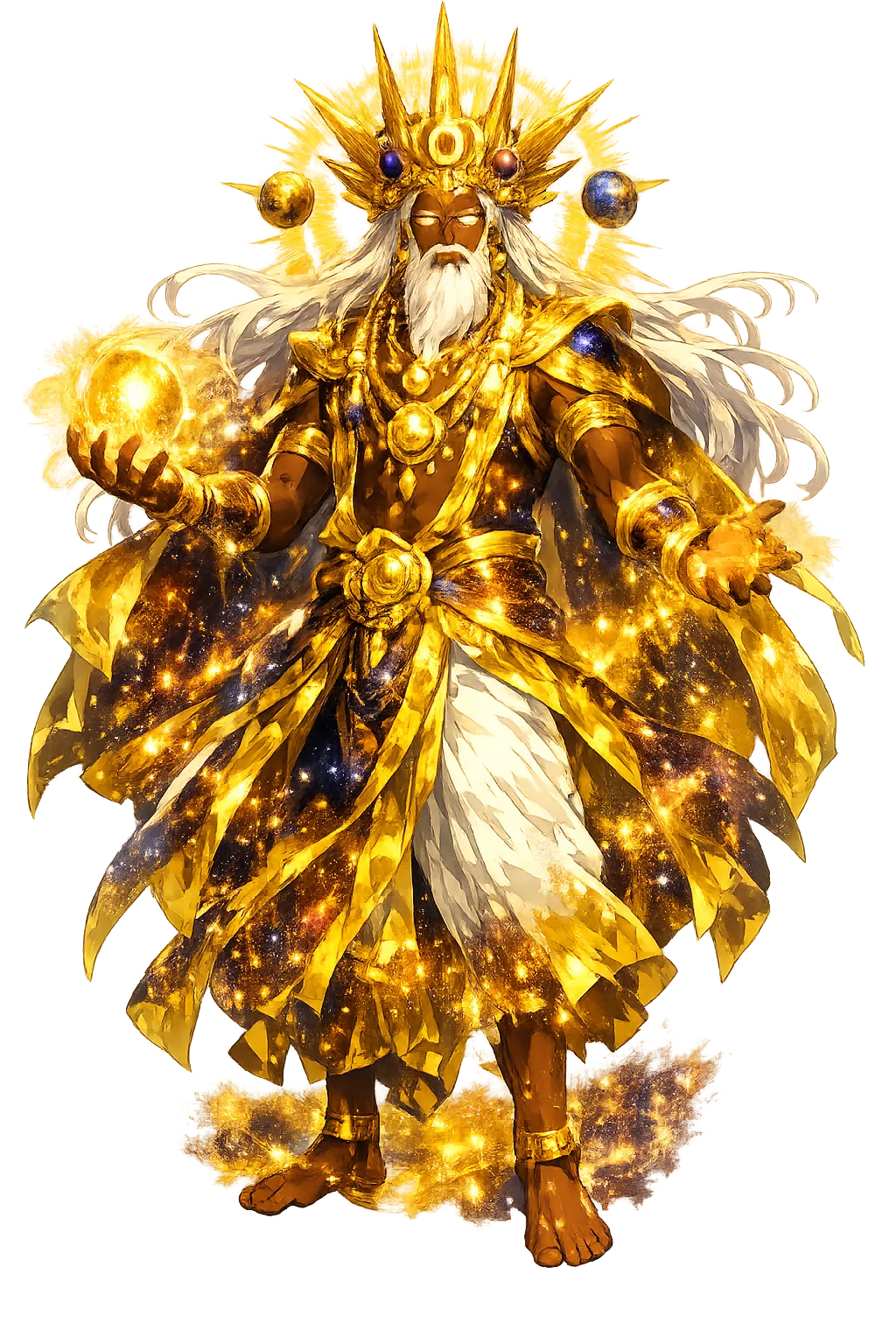
Olódùmarè is the high god of Yoruba religion — the sole creator and owner of heaven, earth, and every breath that moves within them. Remote and self-sufficient, he receives no images and depends on no offerings; the orishas govern the world, but only as his delegates. He assigns destiny and stands beyond all appeal.
He alone creates ex nihilo; the orishas shape and govern what he has made.
He assigns àkúnlẹ̀yàn, the destiny chosen by each soul before birth, and ratifies it with the breath of life.
No orisha can override his decree; even Ọrúnmìlà interprets rather than changes fate.
He needs no temple image; he is worshipped through the sky, the sun, and the breath of life.
From the original script to the living URL
Olódùmarè
The name survives only in scholarly transliteration. Olódùmarè is the standard Yoruba romanisation, documented in academic sources — “Owner of the universe”. Its acute stress marks preserve distinctions lost in plain ASCII.
No indigenous writing system is securely attested for individual yoruba names. The form shown is a modern scholarly transliteration.
olodumare
Reduced to plain olodumare, the name loses everything that made it specific: acute stress marks. What remains is an ASCII string that machines can parse but that no longer speaks with its original voice.
Olódùmarè
The Unicode restoration recovers what ASCII flattened. Olódùmarè restores acute stress marks, returning the name to its original written dignity. The domain encodes to Punycode, but the browser displays the truth.
Olódùmarè.com → xn--oldmar-8ua7frc.com
The non-ASCII characters in Olódùmarè are encoded while the ASCII remains visible. To the DNS, it is Punycode. To humanity, it is Olódùmarè.
Owned, ideal, and ASCII forms of Olódùmarè
Olódùmarè
The live temple domain — olódùmarè.com.
olodumare
The plain ASCII fallback — what DNS and legacy systems see.
How Olódùmarè was spoken
How Olódùmarè is preserved in writing
No indigenous writing system is securely attested for individual yoruba names. The form shown is a modern scholarly transliteration.
Contribute scholarly provenance →The lore you have read is the living myth. Extended Lore opens the scholarly vault beneath it: the cult and its material remains, a history of the image, the name after antiquity, a meditation on what the name still means, and the full scholarly apparatus — etymology, orthography, sources.
Enter Extended Lore