PuniCodex

Extended Lore

Olódùmarè

Etymology · Orthography · Cult · Iconography · Reception · Sources

Tier 1 Olódùmarè.com
Olódùmarè — Supreme Creator
01

Quick Facts

Essential information about Olódùmarè, Supreme Creator

Scholarly TransliterationOlódùmarè
Unicode RestorationOlódùmarè
Reconstructed Pronunciation/o.ló.dù.ma.rè/
PantheonYoruba
DomainSupreme Creator
MeaningOwner of the universe
ClassificationTier 1
Primary DomainOlódùmarè.com
Sacred SymbolsThe sky (ọ̀run), The rainbow-serpent (ọ̀ṣùmàrè), Cool wind and breath (éémí), White light
02

Etymology & Word Family

From original script to Unicode restoration

Scholarly Transliteration Olódùmarè Olódùmarè — "Owner of the universe"
Unicode Restoration Olódùmarè Restored stress, length, and script
Modern ASCII olodumare Plain-ASCII fallback

The name Olódùmarè carries the orthographic signature of the yoruba tradition. Unicode restoration recovers what ASCII flattens.

03

Unicode Character Breakdown

Character-by-character philological analysis

CharacterUnicodeNameBlockPhonetic Role
OU+004FLatin Capital Letter OBasic LatinSame, capitalized
lU+006CLatin Small Letter LBasic LatinSame
óU+00F3Latin Small Letter O with AcuteLatin-1 SupplementAcute on o
dU+0064Latin Small Letter DBasic LatinSame
ùU+00F9Latin Small Letter U with GraveLatin-1 SupplementGrave on u
mU+006DLatin Small Letter MBasic LatinSame
aU+0061Latin Small Letter ABasic LatinSame
rU+0072Latin Small Letter RBasic LatinSame
èU+00E8Latin Small Letter E with GraveLatin-1 SupplementGrave on e

The Tier 1 classification reflects how much of the original phonology this restoration preserves — stress and vowel length for Greek names, distinctive letters and diacritics for every other tradition.

04

Cult & Worship

How the sacred was kept — rites, sanctuaries, remains

The Cult

Olódùmarè is worshipped most where he is least approached: his cult is deliberately a non-cult. Yoruba theologians explain that the owner of the universe needs no temple, no image, no priesthood, no sacrifice — nothing can be added to him and nothing taken (Idowu 1962). Prayer reaches him through the sky; his witnesses are the sun and the rainbow; his éémí, the breath of life, is already in every body he made, so that breathing is itself the liturgy no priest performs. Early accounts describe open-air, sky-facing observance without idols. What exists of cult exists by indirection: every orisha festival honours him secondhand, every blessing ending 'Olódùmarè willing' names him, and in the diaspora his place is an empty seat above the altar — the transcendent made present by absence. The thinness of the evidence is the doctrine itself: a god who needs nothing cannot be bargained with, and a religion of delegates begins precisely here.

In the Earth

As a transcendent deity without anthropomorphic cult images, Olódùmarè leaves few direct archaeological traces, and that absence is itself the primary evidence of the theology. Sky-oriented prayer sites across Yorubaland — open-air enclosures without idols, oriented to the sunrise — match Idowu's description of a god worshipped through light and breath. His presence is inferred from the cosmological vocabulary of Ifá verses recorded by Bascom and Abimbola and from the white-cloth, empty-throne symbolism placed above orisha altars in Cuban Santería and Brazilian Candomblé houses, where the transcendent Creator is represented precisely by what is absent: an unoccupied seat under the sky.

05

Iconography

How Olódùmarè was imaged across the ages

The Image

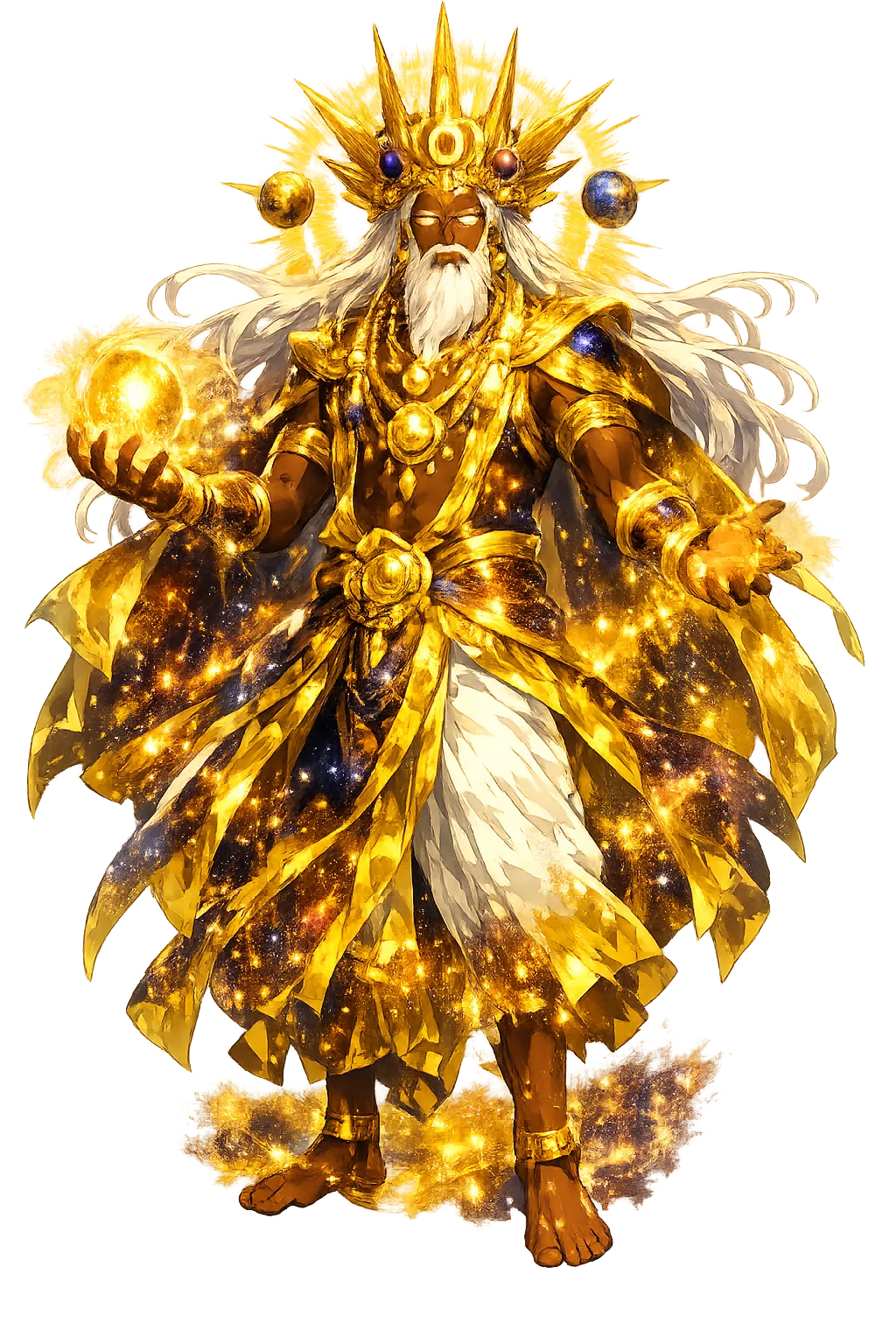
Olódùmarè has no iconography because his theology forbids one: no carver may depict him, and early missionaries and scholars alike noted that no idol of the high god stood in any Yoruba town. The visual tradition built itself around the vacancy. In Cuban Santería and Brazilian Candomblé his place is marked by an empty throne or an unoccupied space above the orisha altars — white cloth, nothing seated — a liturgical image of the unrepresentable, and arguably the most eloquent 'portrait' in the Afro-Atlantic repertoire. His textual attributes are atmospheric rather than bodily: sky, sunlight, the rainbow-serpent Ọ̀ṣùmarè as his sign. Colonial writers, unable to read a god without a statue, sometimes concluded the Yoruba had no supreme god at all — a misreading the twentieth-century scholarship of Lucas (1948) and Idowu (1962) corrected by taking the absence seriously, as iconoclasm turned inside out: the image of Olódùmarè is the space where an image cannot go.

06

Reception & Transformation

The name after its own age — transmission, translation, survival

Afterlives

Olódùmarè's transmission runs from mission vocabulary to world theology. Nineteenth-century linguistics first fixed his name in print: Samuel Ajayi Crowther, the Yoruba bishop and translator, recorded the high god in his grammar and vocabulary of the 1850s, and missionary reports sketched a 'supreme being' standing behind the orishas. The scholarly tradition proper begins with J. Olumide Lucas's The Religion of the Yorubas (1948) and reaches its landmark with E. Bolaji Idowu's Olódùmarè: God in Yoruba Belief (1962), whose very title made the high god the test case of African theology — rigorous, transcendent, neither idol nor abstraction. Idowu's framing fed the mid-century debate over African monotheism carried on by John Mbiti and others, in which Olódùmarè served as the standard Yoruba evidence that high-god traditions are philosophically articulate. Ifá scholarship — Bascom (1969), Abimbola (1976) — set his myths in the recorded corpus, while the diaspora carried his name into Lukumí liturgy and back again. A god with no temples now has one of the longest bibliographies of any figure in African religion.

Identifications Across Traditions

Because Olódùmarè is a remote, imageless high god, he was readily mapped onto the Christian God by enslaved Yoruba people and their descendants. In Cuban Santería and Brazilian Candomblé, Olódumare is identified with the transcendent Creator, while the orishas correspond to saints and angels. In the scholarship this is called parallelismo rather than simple substitution: each orisha kept its own name, colours, and drum while accepting a Catholic 'cover'. The theological structure — one high god above a host of intermediaries — let the Yoruba pantheon survive inside monotheistic frameworks without losing its polytheistic texture, and in recent decades the diaspora has exported the model back to Nigeria itself.

Modern Legacy

Olódùmarè remains the theological centre of Yoruba religion and its diaspora. The idiom 'Olódùmarè willing' structures daily speech, and the doctrine that destiny is chosen but ratified by the high god shapes Yoruba ethics of responsibility and sacrifice. In African philosophy he is a key figure in debates over monotheism and polytheism, destiny and freedom — Idowu's classic study made him a proof that African theology possesses a doctrine of God as rigorous as any. His name echoes through reggae, Afrobeat, and global spirituality as a byword for the supreme source, a standing reminder that African theology has always made room for the One beyond the many.

07

The Meditation

What Olódùmarè means — beyond the dictionary

Olódùmarè is the god who needs nothing. He does not eat sacrifices the way the orishas do; he does not possess dancers or demand festivals. He simply is — the owner of the universe, the breath in every body, the sky above every shrine. This makes him easy to overlook and impossible to escape.

In a religious landscape full of colourful, approachable deities, Olódùmarè is the silence behind the drum. He asks us to distinguish between what we need and what we want, between the god who answers prayers and the source from which prayer itself arises. To remember him is to remember that the orishas, however powerful, are not ultimate. Something older owns even them — and breathes, at this moment, in you.

08

Frequently Asked Questions

Common questions about Olódùmarè, Supreme Creator, and Unicode restoration

01How do you pronounce Olódùmarè?

In reconstructed pronunciation, Olódùmarè is /o.ló.dù.ma.rè/ — approximately aw-loh-doo-MAH-reh — low 'aw', high 'loh', low 'doo', high 'MAH', low 'reh'.

02What does Olódùmarè mean?

Olódùmarè means Owner of the universe in the yoruba tradition.

03What are the symbols of Olódùmarè?

Olódùmarè is associated with The sky (ọ̀run) (His visible throne; the firmament is his temple and his garment.), The rainbow-serpent (ọ̀ṣùmàrè) (The celestial serpent-arch whose appearance seals the passage between heaven and earth; revered as an orisha in its own right and a sign of Olódùmarè's covenant with the sky.), Cool wind and breath (éémí) (The invisible life-force he breathes into the bodies shaped by Ọbatalá; the felt proof of the remote god in every living chest.), White light (Pure, imageless presence; Olódùmarè has no anthropomorphic cult statue anywhere in Yorubaland.).

04Why restore Olódùmarè in Unicode?

Plain ASCII olodumare strips the stress, length, and script that make the name specific. Unicode restoration returns the name to its original written dignity.

05What is the most important myth about Olódùmarè?

“The Chain from Heaven” — the Cosmogony story that anchors the mythology of Olódùmarè, told in full on the lore page.

09

Scholarly Sources

The philological foundations of this restoration

Every claim on this page is grounded in established scholarship. The orthographic restorations follow disciplinary convention. The etymological chain follows the best available reference works. This is not invention — it is resurrection through scholarship.

◈

Lexicography & Philology

  • Abraham
◎

Primary Texts

  • The Ifá divination corpus; ọ̀rọ̀ àṣà and oríkì traditions; Abraham’s Dictionary of Modern Yoruba.
◉

Archaeology & Art History

  • Material evidence — iconography, inscriptions, and temple archaeology — for Olódùmarè and related cults.
✦

Religious Studies

  • Idowu, Olódùmarè: God in Yoruba Belief (1962)
  • Bascom, Ifa Divination: Communication Between Gods and Men in West Africa (1969)
  • Abimbola, Ifá: An Exposition of Ifá Literary Corpus (1976)
  • Lucas, The Religion of the Yorubas (1948)
  • Abraham, Dictionary of Modern Yoruba (1958)
  • Mason, Four New World Yoruba Rituals
Return

The Surface Awaits

You have traced the name from its earliest attestation to its Unicode restoration. Now return to the myth. The story is where the name lives.

Back to Lore
Olódùmarè mascot