
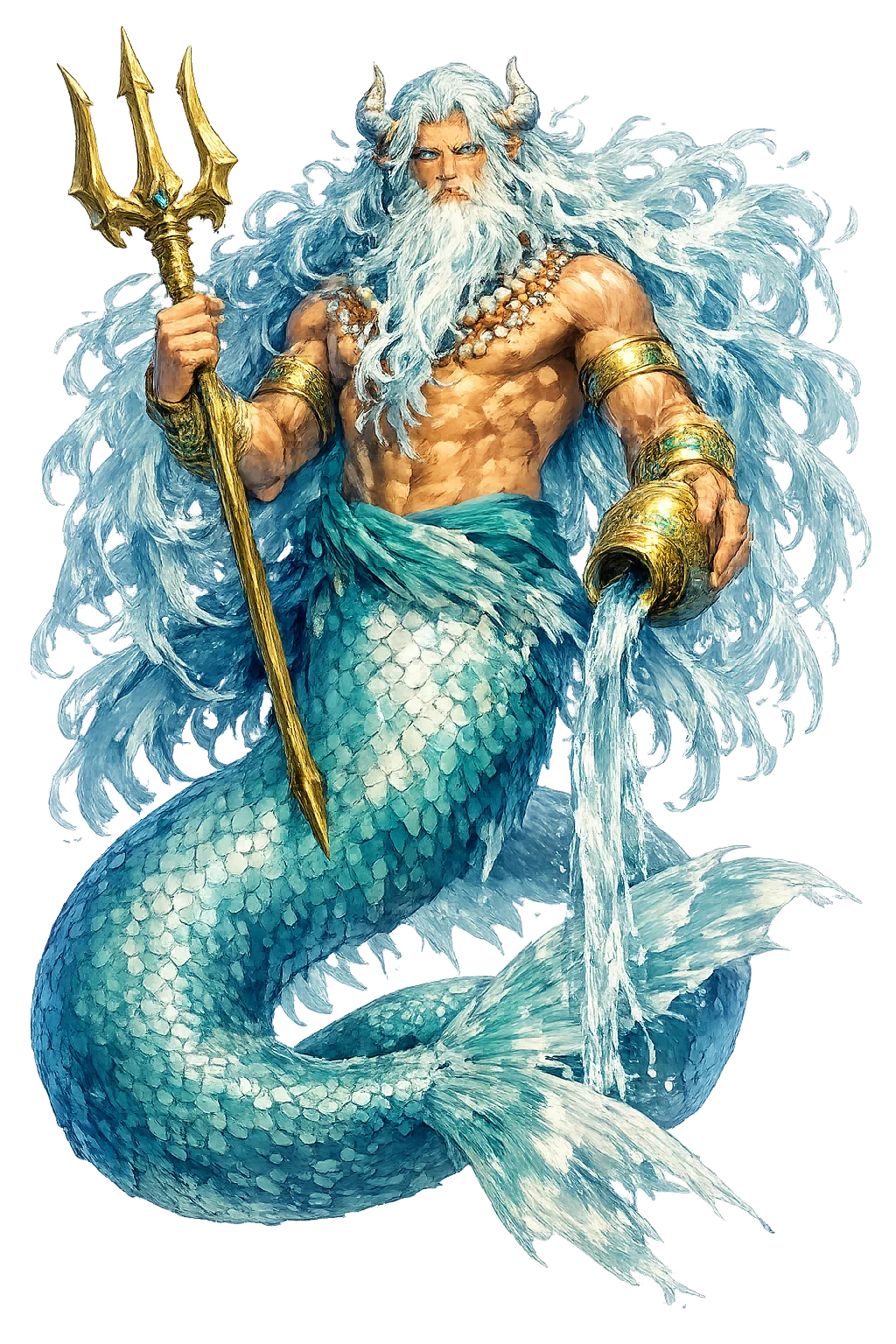
The provenance file on Ōkeanós
Provenance record 358 · Ōkeanós · one temple, fully accounted for.
Provenance
1. The attestation. Ὠκεανός — "The great river encircling the world". On record: LSJ, Beekes, Pape-Benseler, Hesiod, Theogony 133–136, 337–370, 389–401.
2. The preserved evidence. o → Ō (Macron: long omega); o → ó (Acute accent) — absent from the ASCII form okeanos, present in the restoration, verifiable against the sources above.
3. The narrative record. Eldest of the Titans — Hesiod opens the roll of the Titans with a marriage: after Gaia bears the twelve, 'she bore to her firstborn, deep-swirling Ōkeanos, Tethys, the fair-eyed, to be his wife' (Theogony 133–136). He is the eldest child of Ouranos and Gaia — the water that existed before the mountains, before the gods who rule from Olympus. The Source of the Gods — In Iliad 14. 200–210, Hēra comes to Zeus on Mount Ida with a carefully engineered lie: she is going, she says, to visit 'Ōkeanos, the genesis of the gods, and mother Tethys, who received me from Rhea and reared me kindly in their halls when wide-seeing Zeus cast Kronos down.
4. The physical record. Roman-era floor mosaics from Antioch-on-the-Orontes, Zeugma, and the Bardo Museum depict Okeanos as a reclining bearded god holding a rudder or sea creature, surrounded by Nereids and ichthyocentaurs. Nilotic mosaics from Pompeii and Roman villas in North Africa extend the iconography of encircling waters. In Greek art, the sixth-century BCE François Vase places Okeanos among the gods at the wedding of Peleus and Thetis.
5. The current holding. The temple at /okeanos/, classified Tier 1. The restoration preserves more than the ASCII form can express — stress, length, or a letter the Latin keyboard lost — which places it, mechanically, in Tier-1.
6. The documented resonances. Mapping & Geospatial, Maritime, Shipping & Ocean Industries, Freshwater & Hydrology — seats argued and weighted in the pattern atlas, read through the myths in this temple's Resonance File.
7. The primary sources. Theogony, Homeric Hymns, Works and Days — the library this file answers to, open at the Sacred Texts collection.
8. The continuing record. Ōkeanos gave his name to the ocean itself — one of the most universal words on the planet. The idea of a single world-encircling sea, though geographically naive, anticipated the modern understanding of interconnected oceans; climate science now speaks routinely of a single global ocean, and the water that evaporates over the Pacific falls as rain in Athens, exactly as the one-river theology implied.
At a Glance
- Restored name: Ōkeanós
- ASCII form: okeanos
- Meaning: "The great river encircling the world"
- Domain of influence: Ocean, Fresh Water
- Pantheon: Greek
- Classification: Tier 1
- Original script: Ὠκεανός
- Series: The Restoration Files, No. 358 of 546
The File Continues
Read the founding dispatch for the name's full story, the Resonance File for the archetype at work — or the whole archive in one sitting.
Continue the series — previous file: Oidípous (read it here) · next file: Ōkuninushi (read it here).
The Restoration Files are written from the same canonical record as the temples themselves: the lexicon, the lore catalog, the pattern atlas, and the cited scholarly sources. If a file ever disagrees with its temple, the temple is right — tell us, and the file will be corrected.