
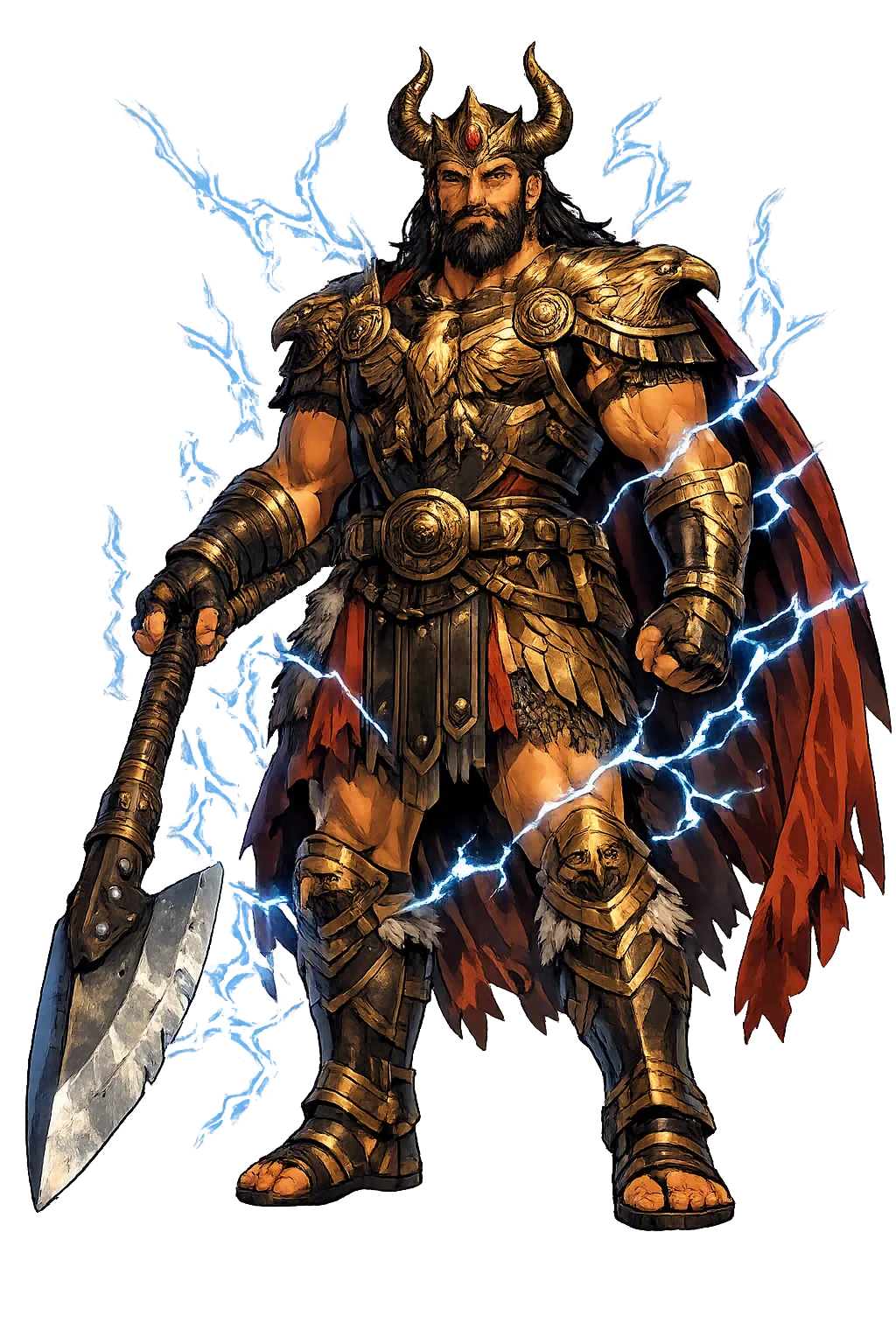
The appointments Ninurta made — and who is keeping them
The mistake is reading myths as entertainment. Ninurta's cycle reads more like a charter — each story assigning a duty the modern world still pays for.
At a Glance
- Temple: Ninurta
- Pantheon: Mesopotamian
- Domain of influence: War, Agriculture, Storms
- Pattern seats: 4
- Sectors touched: Energy & Natural World · Commerce & Governance · Technology & Innovation
- Strongest seat: Agriculture, Food & Harvest
- Series: The Resonance Files, No. 343 of 548
The Cycle, Read Forward
Agriculture, Food & Harvest — through The Theft of the Tablet of Destinies
In the Akkadian Anzû Epic, the storm-bird Anzû steals the ṭuppi šīmāti, the Tablet of Destinies, from Enlīl while the high god bathes. Without it, the gods lose their power to decree fates.
The atlas states the seat in one line: Ninurta is 'lord of the earth' and the divine ploughman; the long catalog of stones in Lugal-e assigns flint to the sickle and makes cultivation possible only after his victory. The story above is the long version of the same sentence. Industries do not invent their archetypes; they inherit them and call them best practice.
Defense, Military & Security — through Ninurta and the Hostile Stones
The Sumerian poem Lugal-e ('O king, storm of all the lands') recounts Ninurta's campaign against the demon Asag and his stone army in the mountain land of the Kur. Asag has seized the territory and paralyzed cultivation.
The atlas states the seat in one line: The slayer of Anzû and Asag, bearer of the speaking mace Sharur, and the warrior the great gods dispatch when cosmic order is stolen. The story above is the long version of the same sentence. Industries do not invent their archetypes; they inherit them and call them best practice.
Manufacturing, Craft & Automation — through The Return to Nippur
In Angimdimma ('Ninurta's return to Nippur'), the victorious god returns to the Ekur, Enlīl's temple, and is praised by the assembled deities. The poem rehearses his titles — warrior of Enlīl, master of the mace, ploughman of the gods — and asserts that his victories are not personal glory but the enforcement of cosmic order.
The atlas states the seat in one line: In Lugal-e he names each defeated stone and assigns it to temple, forge, and tool — a charter myth for mineral extraction and craft. The story above is the long version of the same sentence. That is the cycle working: story becomes duty, duty becomes trade.
Meteorology & Weather Intelligence — through Ninurta and Ningirsu
In the city-state of Lagaš, the local warrior-god Ningirsu ('lord of Girsu') was venerated as the divine patron of the ruling dynasty and the protector of the irrigation system. Gudea, the ensi of Lagaš, rebuilt Ningirsu's temple and recorded the god's commands in his famous cylinder inscriptions.
The atlas states the seat in one line: The thunder-storm and the hurricane winds are his weapons; his mythology is rooted in the meteorological violence of the Mesopotamian plain. The story above is the long version of the same sentence. That is the cycle working: story becomes duty, duty becomes trade.
The Theme That Runs the Cycle
Ninurta's myths are myths of restorative force: a threat appears, the younger warrior-god is dispatched, and the aftermath is not merely victory but the reorganization of the world. He is the patron of the campaign that ends in a treaty with matter itself.
The Method, Stated Plainly
Skeptical? Good — the system is built for you. Every seat in this file carries its why-line and its weight, the full derivation is public at the methodology page, and the challenge process is part of the design. Falsifiable is not a posture here; it is the mechanism.
For the Ones Who Work There
If you work in agriculture, food & harvest, defense, military & security, or any trade this temple holds a seat in, this is the honest version of what a placement means: your industry beside the story it has been re-telling all along — on the temple floor itself, before an audience that came specifically to read it. The patron tier and the advertising terms describe the mechanics; the resonance above describes the fit.
The File Continues
One of 548 Resonance Files — the series where the pantheon goes to work. Read the founding dispatch for the name, the Restoration File for the spelling, or the whole archive end to end.
Continue the series — previous: Ninlil (read it) · next: Nirmātā (read it).
The Resonance Files are argued from the same canonical record as the pattern atlas itself: the lexicon, the lore catalog, and the cited sources. Every seat can be challenged at the methodology page — and the challenge is the point.