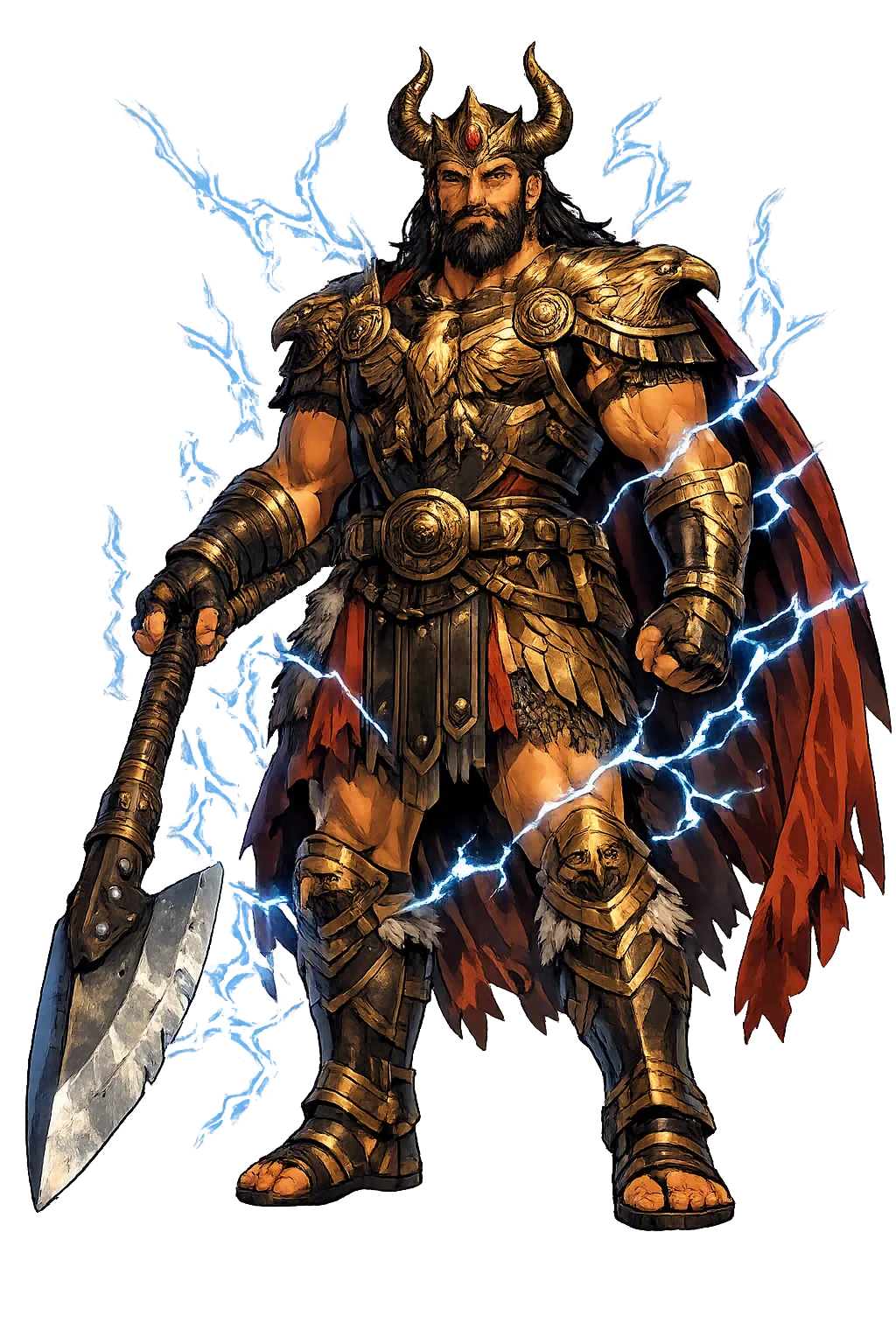
Stories of Ninurta
Ninurta's myths are myths of restorative force: a threat appears, the younger warrior-god is dispatched, and the aftermath is not merely victory but the reorganization of the world. He is the patron of the campaign that ends in a treaty with matter itself.
In the Akkadian Anzû Epic, the storm-bird Anzû steals the ṭuppi šīmāti, the Tablet of Destinies, from Enlīl while the high god bathes. Without it, the gods lose their power to decree fates. Anu first asks Adad, then Girra, then Shara to recover it; each refuses when he sees Anzû wearing the tablet. Ninurta alone accepts. He rides to battle on his storm-chariot, hurls winds and arrows, and finally sends his enchanted mace Sharur to strike Anzû's heart. The tablet is restored to Enlīl, and Ninurta's supremacy among the warrior gods is proclaimed. The story is preserved in the Standard Babylonian version from Nineveh (Tablet I–III) and older Akkadian fragments.
The Sumerian poem Lugal-e ('O king, storm of all the lands') recounts Ninurta's campaign against the demon Asag and his stone army in the mountain land of the Kur. Asag has seized the territory and paralyzed cultivation. Ninurta defeats him, shatters the rebel stones, and then — in a long catalog — names each stone and assigns it a purpose: lapis lazuli for the temple, flint for the sickle, limestone for the mason, carnelian for the seal-cutter. The poem is thus a mythic encyclopedia of Mesopotamian mineralogy and a charter for the extraction of raw materials.
In Angimdimma ('Ninurta's return to Nippur'), the victorious god returns to the Ekur, Enlīl's temple, and is praised by the assembled deities. The poem rehearses his titles — warrior of Enlīl, master of the mace, ploughman of the gods — and asserts that his victories are not personal glory but the enforcement of cosmic order. The text underlines the theological pattern of Mesopotamian kingship: the young hero acts, then presents his triumph to the father-god.
In the city-state of Lagaš, the local warrior-god Ningirsu ('lord of Girsu') was venerated as the divine patron of the ruling dynasty and the protector of the irrigation system. Gudea, the ensi of Lagaš, rebuilt Ningirsu's temple and recorded the god's commands in his famous cylinder inscriptions. Over time Ningirsu was identified with Ninurta, so that by the first millennium BCE the two names often refer to a single deity. The Girsu tradition emphasizes Ninurta's agricultural and hydraulic role: the warrior who secures the floodplain and makes the fields bear.
War · Agriculture · Storms
Ninurta is the Mesopotamian deity in whom the weapons of war and the tools of the field are not opposites but a single office. His name is usually interpreted as 'lord of the earth' (Sumerian nin 'lord/lady' + urta/urša 'earth'), and his cult spans the storm-mace, the plough, and the stone quarry. In the Sumerian poems Lugal-e and Angimdimma, and in the Akkadian Anzû Epic, he is the champion the great gods summon when order has been stolen or the mountain rebels.
Unlike the remote sovereignty of Anû or the atmospheric kingship of Enlīl, Ninurta acts. He hunts the rebel Anzû through the mountains, recovers the Tablet of Destinies, and afterward assigns every defeated stone its place in the human economy. His mythology is therefore a charter myth for metallurgy, agriculture, and kingship alike: the god who breaks the enemy also names the useful rock.
His enchanted weapon that speaks, flies, and guides the god to the heart of the enemy.
Agriculture as an extension of kingship; the furrow opened by the god's command.
The defeat of Anzû, the storm-bird who stole the Tablet of Destinies from Enlīl.
In Lugal-e he names the defeated rocks and assigns them to temple, field, and forge.
From the original script to the living URL
𒀭𒊩𒌆𒅁
The name in its original Mesopotamian form. Ninurta (𒀭𒊩𒌆𒅁) is attested in the source tradition — “Lord of the earth”. Its original diacritics and script distinctions carry the full phonetic and orthographic weight of the source tradition.
ninurta
The plain ninurta form is identical to the Unicode restoration. Because this name is already written in Latin letters, no diacritics, stress, or script information were lost — only capitalization differs.
Ninurta
The Unicode restoration does not need to recover lost marks for Ninurta. Its value is canonical spelling and consistent cataloguing, not the reconstruction of erased orthography. The domain is readable as-is to both DNS and humanity.
Ninurta.com
This restoration is written entirely in ASCII letters — no Punycode encoding stands between Ninurta and the DNS. The domain reads identically to machines and to human eyes.
Owned, ideal, and ASCII forms of Ninurta
Ninurta
Restores 𒀭𒊩𒌆𒅁. The full Unicode restoration. ninurta.com is not in the PuniCodex collection — it is watched for release; if it drops, this temple upgrades to an owned flagship.
How Ninurta was spoken
How Ninurta travels from ancient script to the modern URL
Sumerian NIN.URTA, perhaps “lord of the earth" or “lord of barley"; a warrior and agricultural deity.
The lore you have read is the living myth. Extended Lore opens the scholarly vault beneath it: the cult and its material remains, a history of the image, the name after antiquity, a meditation on what the name still means, and the full scholarly apparatus — etymology, orthography, sources.
Enter Extended Lore