
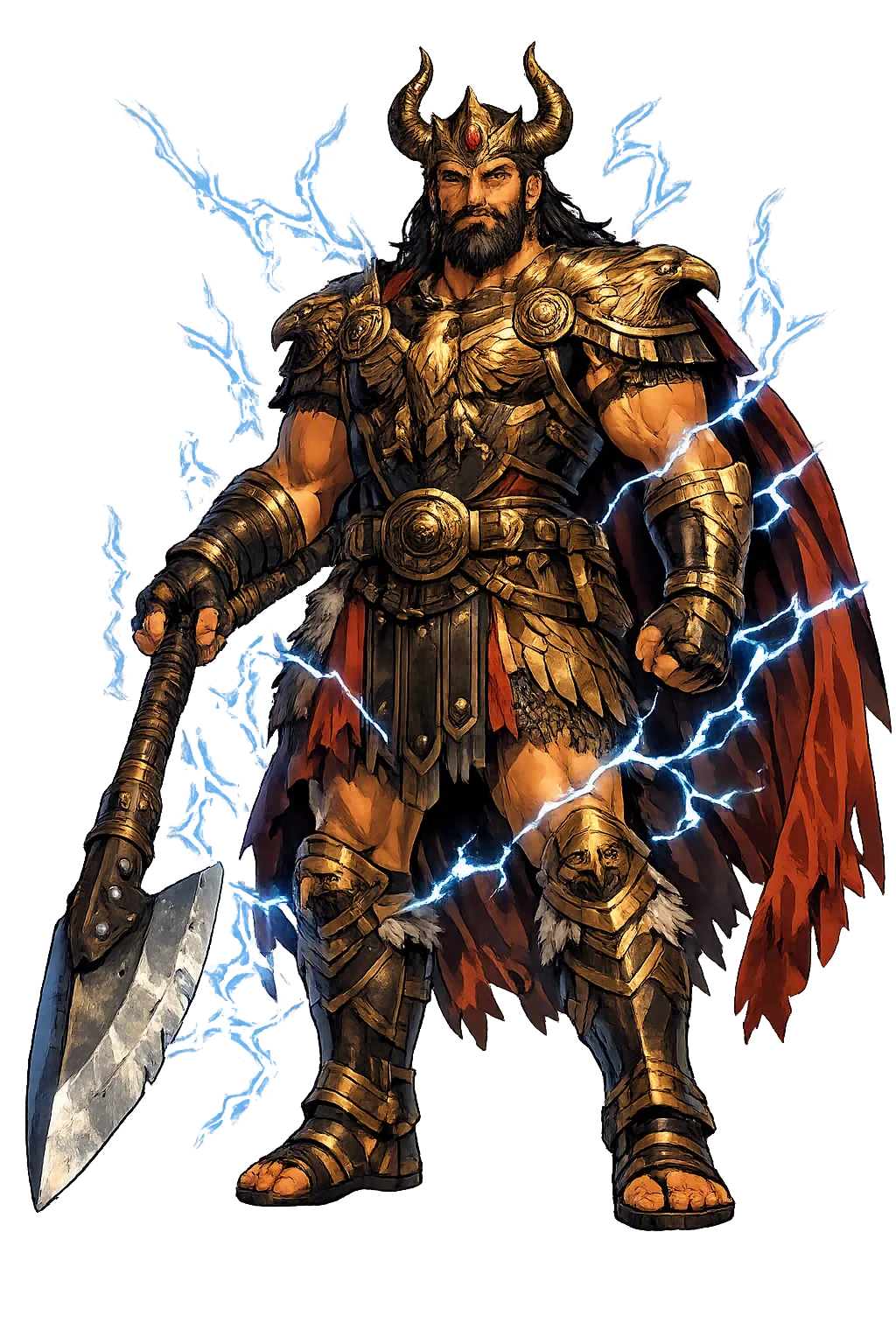
Pronouncing Ninurta: a guide for the curious
Saying Ninurta aloud is harder than reading it on a screen, and more rewarding. The restored spelling is a compressed pronunciation guide: every accent and macron is an instruction. This post unpacks those instructions — the reconstructed sound, the phoneme-by-phoneme record, the kindred forms in neighboring languages — and then zooms out to the full record around the name: its Cuneiform writing, its mythology, its cult, and its modern life as a Unicode domain. Whether you arrive as a linguist, a reader of myth, or a domainer, you will leave able to say the name the way the evidence suggests it was said — and able to type it the way it was written.
At a Glance
- Restored name: Ninurta
- ASCII form: ninurta
- Meaning: "Lord of the earth"
- Domain of influence: War, Agriculture, Storms
- Pantheon: Mesopotamian
- Classification: Tier 2
- Original script: 𒀭𒊩𒌆𒅁 (Cuneiform)
Overview
Ninurta (ninurta) — War, Agriculture, Storms · Lord of the earth — belongs to the Mesopotamian tradition, where it is catalogued under the domain "War, Agriculture, Storms". The name means "Lord of the earth".
Ninurta is the Mesopotamian deity in whom the weapons of war and the tools of the field are not opposites but a single office. His name is usually interpreted as 'lord of the earth' (Sumerian nin 'lord/lady' + urta/urša 'earth'), and his cult spans the storm-mace, the plough, and the stone quarry. In the Sumerian poems Lugal-e and Angimdimma, and in the Akkadian Anzû Epic, he is the champion the great gods summon when order has been stolen or the mountain rebels.
Unlike the remote sovereignty of Anû or the atmospheric kingship of Enlīl, Ninurta acts. He hunts the rebel Anzû through the mountains, recovers the Tablet of Destinies, and afterward assigns every defeated stone its place in the human economy. His mythology is therefore a charter myth for metallurgy, agriculture, and kingship alike: the god who breaks the enemy also names the useful rock.
PuniCodex restores the name as Ninurta and serves its temple at its temple. The restoration needs no distinctive letters or diacritics its ASCII form would lose, which places the name in Tier 2. The plain ASCII form ninurta survives as a modern convenience imposed by the early domain-name system; the restoration, not the fallback, is the form the project defends as philologically complete.
The Name
The name is attested in Cuneiform as 𒀭𒊩𒌆𒅁. Etymologically it means "Lord of the earth".
The ASCII form ninurta survives only because the early domain-name system could not carry diacritics; it is a technological compromise, not an ancient spelling. The Unicode restoration Ninurta recovers the full diacritic detail of the scholarly transliteration directly in the address bar. The restoration needs no distinctive letters or diacritics its ASCII form would lose, which places the name in Tier 2.
The letter-by-letter transformation runs:
- n → N — Same, capitalized
- i → i — Same
- n → n — Same
- u → u — Same
- r → r — Same
- t → t — Same
- a → a — Same
The Original Script
The name is preserved in Cuneiform as 𒀭𒊩𒌆𒅁 — Sumero-Akkadian cuneiform, attested Sumerian / Old Babylonian – Neo-Assyrian, c. 2600–600 BCE, in Mesopotamia. The script is written left-to-right / top-to-bottom.
The scholarly transliteration is Ninurta (Sumerian logogram + Akkadian scholarly), giving the normalized reading /ˈnin.ur.ta/.
The rendering proceeds step by step:
- Sumerogram NIN.URTA (𒊩𒌆𒅁)
- Prefixed with divine determinative 𒀭
- God of war, agriculture, and the south wind
Pronunciation
The reconstructed pronunciation of the name is /niˈnur.ta/ — Sumerian/Akkadian Reconstruction.
Phoneme by phoneme:
- Ni- — Close front vowel [i] following a light alveolar nasal [n]; the first syllable carries secondary stress in the Akkadian rendering.
- -nur- — Voiced alveolar nasal [n], close back rounded vowel [u], and alveolar tap or trill [r]; the accented core of the name.
- -ta — Voiceless alveolar stop [t] plus open vowel [a]; the final syllable closes the theonym.
For the modern speaker, the closest approximation is: 'nee-NOOR-tah' — stress the second syllable; the final a is open and level, not drawn out.
Kindred and historical forms of the name:
- Sumerian — 𒀭𒊩𒌆𒅁 (Ninurta), 'lord of the earth' — warrior, storm, and agricultural deity of the Sumerian south
- Akkadian — Ninurta, the name borrowed eastward and retained in the cuneiform god-lists
- Variant — 𒀭𒄈𒋢𒊏 (Nin-girsu), 'lord of Girsu' — local warrior-god of the state of Lagaš, later syncretized with Ninurta
Ninurta is Tier 2: the Unicode restoration N-I-N-U-R-T-A preserves only the capitalized ASCII form and carries no distinctive diacritic or non-ASCII letter that the ASCII form loses. It is a straightforward philological capitalization, not a phonological reconstruction hub. Standard Assyriology writes Ninurta; the PuniCodex form simply gives the name its proper noun shape.
Mythology
Ninurta's myths are myths of restorative force: a threat appears, the younger warrior-god is dispatched, and the aftermath is not merely victory but the reorganization of the world. He is the patron of the campaign that ends in a treaty with matter itself.
The Theft of the Tablet of Destinies (Anzû Epic)
In the Akkadian Anzû Epic, the storm-bird Anzû steals the ṭuppi šīmāti, the Tablet of Destinies, from Enlīl while the high god bathes. Without it, the gods lose their power to decree fates. Anu first asks Adad, then Girra, then Shara to recover it; each refuses when he sees Anzû wearing the tablet. Ninurta alone accepts. He rides to battle on his storm-chariot, hurls winds and arrows, and finally sends his enchanted mace Sharur to strike Anzû's heart. The tablet is restored to Enlīl, and Ninurta's supremacy among the warrior gods is proclaimed. The story is preserved in the Standard Babylonian version from Nineveh (Tablet I–III) and older Akkadian fragments.
Ninurta and the Hostile Stones (Lugal-e)
The Sumerian poem Lugal-e ('O king, storm of all the lands') recounts Ninurta's campaign against the demon Asag and his stone army in the mountain land of the Kur. Asag has seized the territory and paralyzed cultivation. Ninurta defeats him, shatters the rebel stones, and then — in a long catalog — names each stone and assigns it a purpose: lapis lazuli for the temple, flint for the sickle, limestone for the mason, carnelian for the seal-cutter. The poem is thus a mythic encyclopedia of Mesopotamian mineralogy and a charter for the extraction of raw materials.
The Return to Nippur (Angimdimma)
In Angimdimma ('Ninurta's return to Nippur'), the victorious god returns to the Ekur, Enlīl's temple, and is praised by the assembled deities. The poem rehearses his titles — warrior of Enlīl, master of the mace, ploughman of the gods — and asserts that his victories are not personal glory but the enforcement of cosmic order. The text underlines the theological pattern of Mesopotamian kingship: the young hero acts, then presents his triumph to the father-god.
Ninurta and Ningirsu (Syncretism)
In the city-state of Lagaš, the local warrior-god Ningirsu ('lord of Girsu') was venerated as the divine patron of the ruling dynasty and the protector of the irrigation system. Gudea, the ensi of Lagaš, rebuilt Ningirsu's temple and recorded the god's commands in his famous cylinder inscriptions. Over time Ningirsu was identified with Ninurta, so that by the first millennium BCE the two names often refer to a single deity. The Girsu tradition emphasizes Ninurta's agricultural and hydraulic role: the warrior who secures the floodplain and makes the fields bear.
Symbols & Iconography
The iconography associated with Ninurta concentrates in a small set of recurring attributes, each a compressed statement about the name:
- Mace Sharur — The talking weapon that seeks out the enemy; divine intelligence married to force.
- Thunderbolt and storm-wind — The meteorological aspect of the warrior; the south wind and the hurricane are his.
- Plough and furrow — The transformation of war into agriculture; the same hand that breaks stone opens the field.
- Mountain and stone — The Kur, the hostile mountain, defeated and catalogued into useful minerals.
- Lion or bird-griffin (Anzû) — The defeated chaos-bird becomes his emblem; the lion marks his martial sovereignty.
Archaeology & Evidence
Archaeological evidence for Ninurta centers on temples at Nippur (the Ekur complex, where he is Enlīl's warrior son), Girsu/Telloh (the sanctuary of Ningirsu, patron of the Lagaš state), and Kalhu/Nimrud, where Ashurnasirpal II dedicated a major Ninurta temple whose reliefs show the god as an archer. Foundation figurines, votive mace-heads, and royal inscriptions of kings from Gudea to the Assyrian emperors invoke Ninurta as the source of martial success and agricultural prosperity.
Realm & Domain
Ninurta is the Mesopotamian deity in whom the weapons of war and the tools of the field are not opposites but a single office. His name is usually interpreted as 'lord of the earth' (Sumerian nin 'lord/lady' + urta/urša 'earth'), and his cult spans the storm-mace, the plough, and the stone quarry. In the Sumerian poems Lugal-e and Angimdimma, and in the Akkadian Anzû Epic, he is the champion the great gods summon when order has been stolen or the mountain rebels.
Unlike the remote sovereignty of Anû or the atmospheric kingship of Enlīl, Ninurta acts. He hunts the rebel Anzû through the mountains, recovers the Tablet of Destinies, and afterward assigns every defeated stone its place in the human economy. His mythology is therefore a charter myth for metallurgy, agriculture, and kingship alike: the god who breaks the enemy also names the useful rock.
The Mace Sharur
His enchanted weapon that speaks, flies, and guides the god to the heart of the enemy.
The Plough
Agriculture as an extension of kingship; the furrow opened by the god's command.
Thunderbird Slayer
The defeat of Anzû, the storm-bird who stole the Tablet of Destinies from Enlīl.
The Ordered Stones
In Lugal-e he names the defeated rocks and assigns them to temple, field, and forge.
Across Cultures
Ninurta's profile overlaps with several Mesopotamian and neighboring deities, sometimes as identity, sometimes as delegated function.
In the south, Ningirsu of Girsu was gradually merged with Ninurta, while retaining a distinct local cult well into the second millennium BCE. In the north, the Assyrian national god Aššur absorbed many of Ninurta's martial traits, so that temple hymns from Assur praise Aššur as the slayer of Anzû. Marduk of Babylon later inherited Ninurta's storm-combat role in the Enuma Elish, where Marduk defeats Tiamat with winds and bonds — a victory that parallels Ninurta's over Asag. The Hittite storm-god Teššub and the Canaanite Baꜥal share the same Indo-Mediterranean storm-warrior type. There is no direct Greek equivalent, though Árēs overlaps in war and Hēphaistos in craft; Ninurta's combination of battlefield and forge is distinctively Mesopotamian.
Kindred figures in the PuniCodex cross-tradition index include Adad, Baꜥal, Enlīl, Keraunós, Marduk, and Ọya, each linked through thunder / storm sovereignty.
Cultural Legacy
Ninurta's legacy survives in the idea of the ordered earth as the fruit of conflict.
The long catalog of stones in Lugal-e is one of the earliest surviving examples of a learned encyclopedic text in cuneiform — a precursor to later Mesopotamian lexical lists and perhaps to the genre of technical handbook. His association with the plough and irrigation underlies the Mesopotamian doctrine that kingship secures fertility: the king wages war so that the peasant may plough. In modern fantasy and games, Ninurta appears as a storm-warrior or earth-shaker, often conflated with generic 'Thunderbird Slayer' archetypes. PuniCodex preserves the name in its simple ASCII form as a Tier-2 display, honoring the fact that for this theonym the canonical tradition has passed down a plain Latin transliteration without a recoverable distinctive mark. The name still means: the lord who turns battle into harvest.
The Scholarly Record
The account of Ninurta given in this edition rests on the witnesses and reference works listed below. Lexica and etymological dictionaries secure the form and meaning of the name; the literary and religious texts supply the narrative evidence.
- Electronic Text Corpus of Sumerian Literature, Oxford Oriental Institute, 1998. Full text
- The Assyrian Dictionary of the Oriental Institute of the University of Chicago, 21 vols., Oriental Institute, Chicago (completed 2010), 1956. Full text
- Akkadisches Handwörterbuch, 3 vols., Harrassowitz, Wiesbaden (completed 1981), 1965.
- Black & Green, Gods, Demons and Symbols of Ancient Mesopotamia.
- Jacobsen, The Treasures of Darkness.
- Anzû Epic (Standard Babylonian version from Nineveh).
- Lugal-e (ETCSL 4.27.2: Ninurta's exploits against Asag and the stones).
- Angimdimma (ETCSL 4.27.3: Ninurta's return to Nippur).
- Gudea Cylinder A and B (inscriptions of the ensi of Lagaš on the rebuilding of Ningirsu's temple).
- Enuma Elish (Marduk's assumption of Ninurta-type storm-combat functions).
A Meditation
Ninurta is the god of the aftermath. He does not only kill the demon; he inventories the stones. He does not only recover the Tablet of Destinies; he restores the power of the gods to decree fate. His mythology is a charter for every civilization that must transform raw violence into durable order — the army that becomes a police force, the mine that becomes a temple, the flood that becomes irrigation.
To name Ninurta is to remember that agriculture itself was once a conquest: the forest cleared, the stone broken, the river channelled. The plough is a weapon that has learned peace. The mace is a tool that remembers war. In Ninurta the two are held together without contradiction, because for the Mesopotamians the earth's abundance was not a given but the result of divine labor imposed upon chaos.
The Unicode Restoration
Ninurta is classified as Tier 2: the restoration needs no distinctive letters or diacritics its ASCII form would lose. The ASCII fallback ninurta still resolves everywhere, but it is the restored form that carries the name's full information. That is the whole thesis of this temple: the marks are the message.
Character by Character
The journey from ninurta to Ninurta, one character at a time:
- n → N — Same, capitalized
- i → i — Same
- n → n — Same
- u → u — Same
- r → r — Same
- t → t — Same
- a → a — Same
The Mesopotamian Pantheon
Ninurta is one of 30 entries the PuniCodex lexicon catalogues under the Mesopotamian pantheon. The Pantheon page gathers the tradition's major figures in one place, and the Lexicon lets you filter all 980 restorations by tradition, tier, or script — the fastest way to see where this name sits among its kin.
Frequently Asked Questions
What does Ninurta mean? The traditional gloss is "Lord of the earth."
Which tradition does Ninurta belong to? Ninurta is catalogued in the Mesopotamian pantheon of the PuniCodex lexicon.
Why is Ninurta classified as Tier 2? Because the restoration needs no distinctive letters or diacritics its ASCII form would lose — and the marks in the restored spelling preserve exactly that evidence.
Can I use Ninurta in a normal browser? Yes. The DNS resolves the punycode form automatically, and the type tool on this site converts ninurta to Ninurta for copying and pasting.
Where does the scholarly information come from? The entry is built from lexica, inscriptional evidence, and reviewed scholarly sources listed in the Scholarly Edition. Every claim is traceable to a canonical source.
Typing Ninurta
You do not need a special keyboard to use this restoration. The PuniCodex Type Tool converts the ASCII form ninurta into Ninurta as you type, and the browser extension offers the same conversion inside any text field. Copy the restored form, paste it into the address bar, and the DNS does the rest.
Why This Restoration Matters
Pronunciation turns out to be the heart of the matter. The marks in Ninurta are instructions for the voice, and a web that strips them is a web that mispronounces the past at scale. The restoration hands the instructions back: say it as the evidence suggests, type it as the tradition wrote it, and let the punycode machinery do the quiet translation in between. That is all the PuniCodex project asks of the infrastructure — and everything it asks of you, the reader, is to use the whole name.
Explore Further
This post is one doorway into the temple. The home page carries the full character breakdown and the ambient canvas; the lore page tells the myths in long form; the Scholarly Edition preserves the sources, pronunciation data, and revision history; and the patron wall supports the restoration directly. For the wider map, browse the Lexicon, explore the Pantheon, or return to the PuniCodex blog.
Related Names
Sources
The full scholarly apparatus — every citation, revision, and review — lives in the Scholarly Edition. Key references for this post:
- Electronic Text Corpus of Sumerian Literature, Oxford Oriental Institute, 1998.
- The Assyrian Dictionary of the Oriental Institute of the University of Chicago, 21 vols., Oriental Institute, Chicago (completed 2010), 1956.
- Akkadisches Handwörterbuch, 3 vols., Harrassowitz, Wiesbaden (completed 1981), 1965.
- Annus, The God Ninurta.
- Black & Green, Gods, Demons and Symbols of Ancient Mesopotamia.
- CAD, Ninurta.
- Lexicon authorities for this entry: ETCSL, Black-Green.