
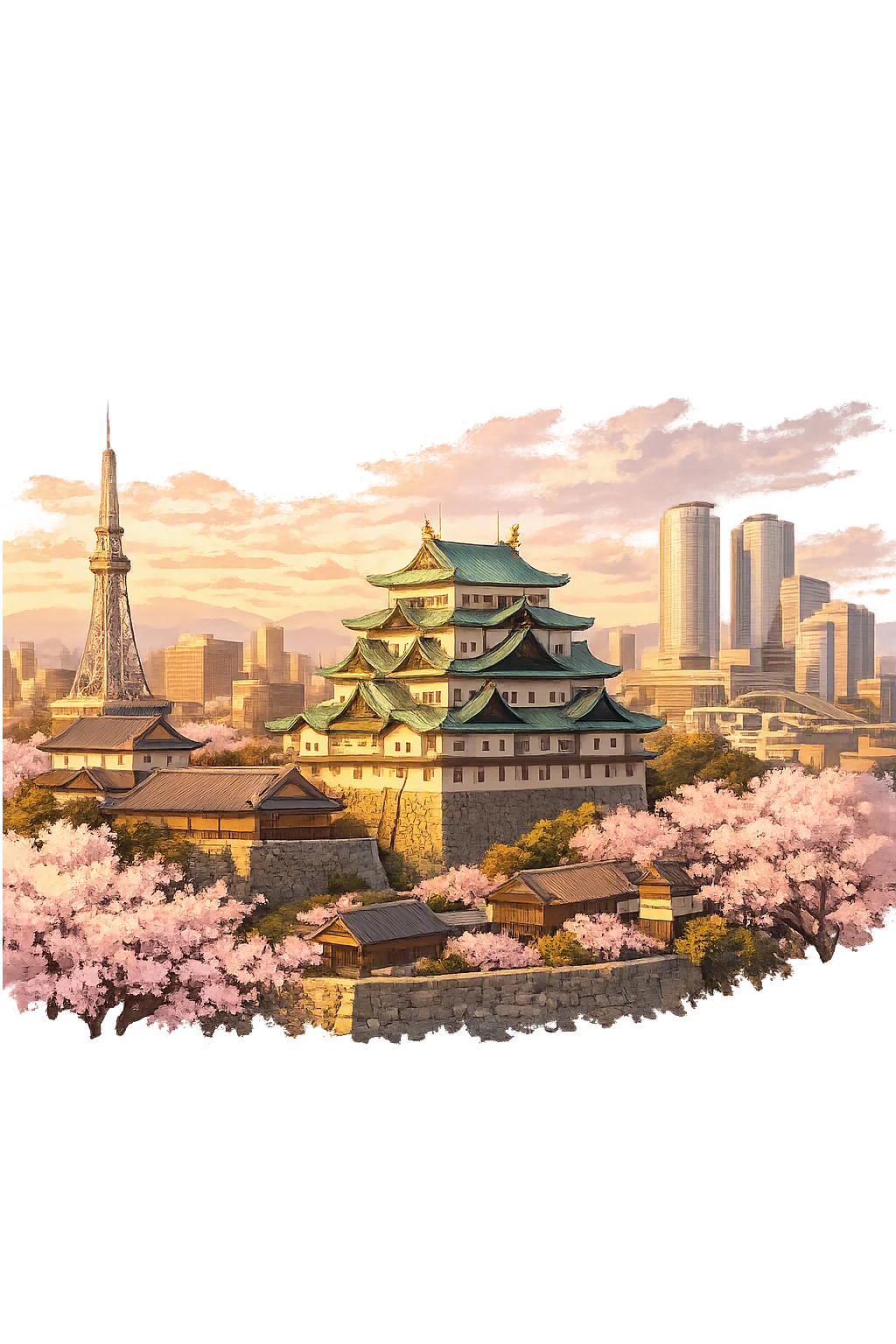
Why Nagoya is spelled that way — and what it costs to get it right
There is no broken version of this name to repair. There is a record to preserve: Nagoya, exactly as the scholarly convention supports it.
Nagoya's mythology is more historical than divine: a crossroads named for a 'peaceful ancient house,' a castle built to end the age of war, a conference that settled Japan's succession, and a merchant city that traded the sword for the loom and then for the assembly line.
At a Glance
- Canonical name: Nagoya
- ASCII form: nagoya
- Meaning: "Peaceful ancient house"
- Domain of influence: Industrial Hub, Chūbu
- Pantheon: Japanese
- Restoration: ASCII-equivalent form
- Original script: 名古屋
- Series: The Restoration Files, No. 355 of 597
The Name, Plain and Exact
The name is attested as 名古屋, in the attestation The Cambridge History of Japan, vol. 4: Early Modern Japan (Cambridge, 1991) and Totman, Conrad, Tokugawa Ieyasu: Shogun (Heian, 1983) give us. On the evidence, it means "Peaceful ancient house".
Spoken, the name runs `/na.ɡo.ja/` — 'NAH-goh-yah' — three even syllables, with the middle vowel open and short.
The Temple That Stands Now
The canonical name is not a plaque; it is an address. The temple of Nagoya lives at /nagoya/, with its mythology in the lore halls, its peer-reviewed record in the Scholarly Edition, and its place in the pattern atlas on the patterns floor.
The displayed form is ASCII-equivalent.
Where the Name Stood First
The Honmaru Palace of Nagoya Castle survived in measured drawings and photographs until its destruction in 1945; excavations of its buried foundations (2009–2010) allowed a faithful wooden reconstruction, opened in 2018 — one of Japan's most celebrated modern traditional builds — while the 1959 concrete keep awaits its own re-evaluation. Excavation at Kiyosu Castle (2009) uncovered the buried stone bases of Nobunaga-era tenshu. The city's older sacred stratum survives at Atsuta Jingū, the great shrine south of the center that houses the Kusanagi sword and has drawn pilgrims for well over a millennium; the Tokugawa-en garden preserves the Owari lordly residence grounds. And the castle town's grid itself — one of Japan's classic jōkamachi plans — is the largest standing artifact. The temple on the web is the newest of these addresses — the first one that fits in a pocket.
The Archetype at Work
The pattern atlas seats this temple in 3 industries, each match argued and weighted: Automotive & Mobility (toyota City and the Chūbu automotive belt; the world learned lean manufacturing here.); Manufacturing, Craft & Automation (japan's industrial heartland; Toyota and the Chūbu manufacturing belt make things at scale.); Aviation & Aerospace (japan's aerospace capital; the Chūbu manufacturing belt builds the country's wings.). The Resonance File reads those seats through the myths themselves.
In the Sacred Texts
The Japanese tradition is not a vibe; it is a library. The Sacred Texts collection holds Kojiki and Nihon Shoki — the primary sources the temple's scholarship is built on. The temple is the argument; the texts are the evidence.
The File Continues
The temple's founding dispatch tells the name's story; its Resonance File reads the myths into the industries; the blog index holds the whole archive.
Continue the series — previous file: Nafanua (read it here) · next file: Nakula (read it here).
The Restoration Files are written from the same canonical record as the temples themselves: the lexicon, the lore catalog, the pattern atlas, and the cited scholarly sources. If a file ever disagrees with its temple, the temple is right — tell us, and the file will be corrected.