PuniCodex

Extended Lore

名古屋 Nagoya

Etymology · Orthography · Cult · Iconography · Reception · Sources

Tier 2 Nagoya
Nagoya — Industrial Hub, Chūbu
01

Quick Facts

Essential information about Nagoya, Industrial Hub, Chūbu

Original Script名古屋
Unicode RestorationNagoya
Reconstructed Pronunciation/na.ɡo.ja/
PantheonJapanese
DomainIndustrial Hub, Chūbu
MeaningPeaceful ancient house
ClassificationTier 2
Primary DomainNagoya
Sacred SymbolsShachihoko, Nagoya Castle keep, Red miso (aka-dashi), Ceramics and cloisonné
02

Etymology & Word Family

From original script to Unicode restoration

Original Script 名古屋 Nagoya — "Peaceful ancient house"
Unicode Restoration Nagoya Canonical scholarly spelling — ASCII-identical
Modern ASCII nagoya Plain-ASCII fallback

The name Nagoya reaches the modern world through scholarly transliteration of the japanese tradition. Because the conventional spelling uses only Latin letters, its Unicode and ASCII forms coincide — the tradition it carries is in the name itself, not in diacritics.

03

Unicode Character Breakdown

Character-by-character philological analysis

CharacterUnicodeNameBlockPhonetic Role
NU+004ELatin Capital Letter NBasic LatinSame
aU+0061Latin Small Letter ABasic LatinSame
gU+0067Latin Small Letter GBasic LatinSame
oU+006FLatin Small Letter OBasic LatinSame
yU+0079Latin Small Letter YBasic LatinSame
aU+0061Latin Small Letter ABasic LatinSame

The Tier 2 classification here reflects fidelity to the attested tradition, not recovered diacritics: every character of Nagoya already survives in ASCII. What the restoration preserves is the canonical spelling itself — the form scholarship standardised.

04

Cult & Worship

How the sacred was kept — rites, sanctuaries, remains

The Cult

The city's oldest cult is older than the city. Atsuta Jingū, the great shrine south of the center, has drawn pilgrims for well over a millennium and guards the Kusanagi sword — the grass-cutting blade of the imperial regalia — whose presence made the surrounding town a place of lodgings on every pilgrimage road. Its rites are Shinto of the oldest register: daily offerings by hereditary priests, the great Atsuta Festival of 30 June closing with fireworks, and centuries of patronage from the Owari lords whose castle stood within walking distance. Beside the shrine stood the samurai cult: the Nagoya Tōshōgū, built in 1619, enshrined the deified Tokugawa Ieyasu in gongen-zukuri splendor. The modern city added a civic liturgy of its own — the great Nagoya Festival, first held in 1955 — in which castle, floats, and founding houses process through the grid Ieyasu's surveyors drew.

In the Earth

The Honmaru Palace of Nagoya Castle survived in measured drawings and photographs until its destruction in 1945; excavations of its buried foundations (2009–2010) allowed a faithful wooden reconstruction, opened in 2018 — one of Japan's most celebrated modern traditional builds — while the 1959 concrete keep awaits its own re-evaluation. Excavation at Kiyosu Castle (2009) uncovered the buried stone bases of Nobunaga-era tenshu. The city's older sacred stratum survives at Atsuta Jingū, the great shrine south of the center that houses the Kusanagi sword and has drawn pilgrims for well over a millennium; the Tokugawa-en garden preserves the Owari lordly residence grounds. And the castle town's grid itself — one of Japan's classic jōkamachi plans — is the largest standing artifact.

05

Iconography

How Nagoya was imaged across the ages

The Image

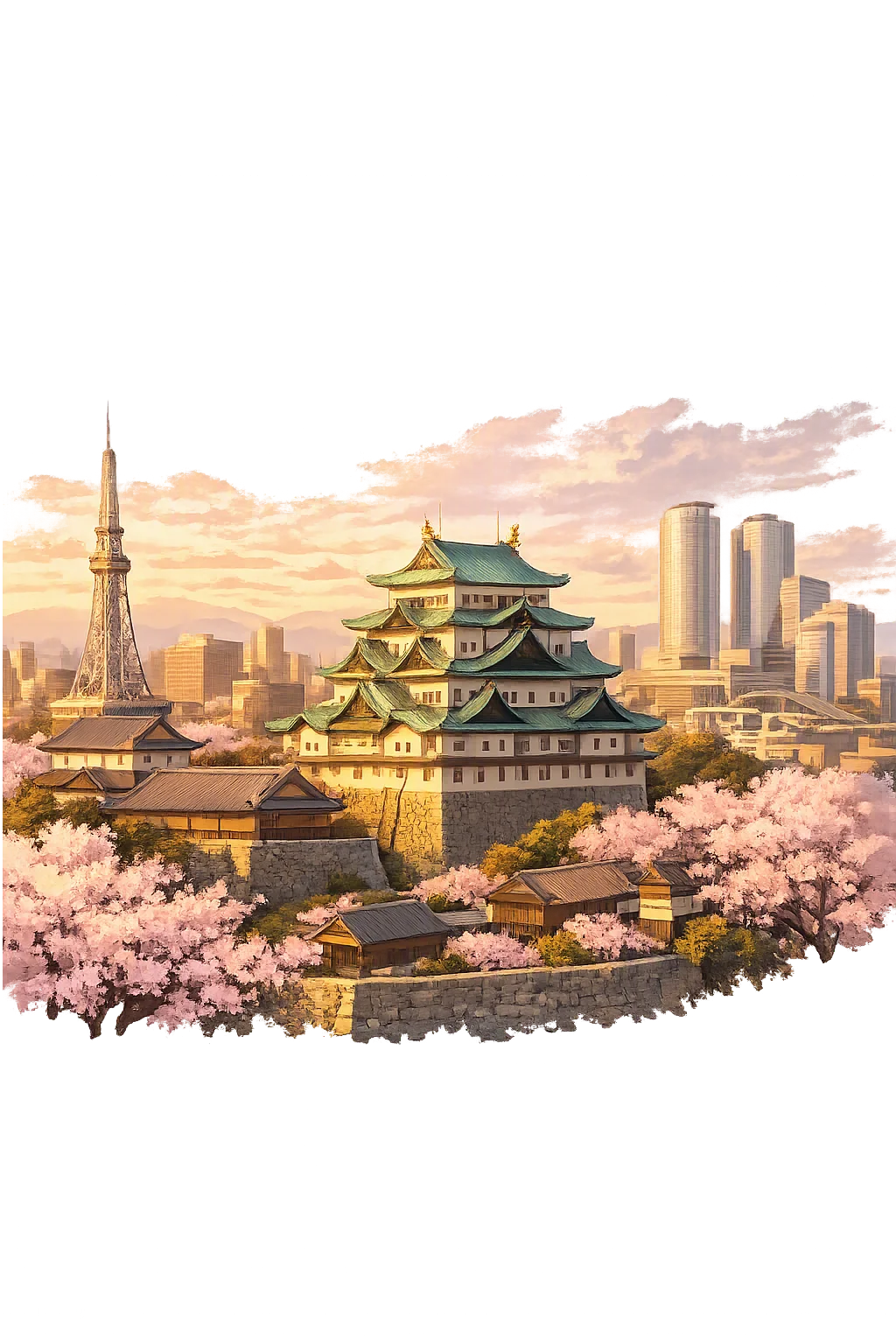
Nagoya's image is a roofline. The golden shachihoko — tiger-headed carp, water beasts conscripted as fire insurance — set on the keep's ridge in 1612 gave the city its emblem, reproduced on manhole covers, station signs, and souvenirs; the pair that crowns the keep today are the 1959 successors of the originals, taken down and melted in 1943. Inside, the lost Honmaru Palace survived in another medium: its Kano-school wall paintings, tigers and leopards making each audience room an allegory of lordly power, were fixed in Meiji photographs and measured drawings, then reborn in the 2018 wooden reconstruction. Older imaging still: the Tokugawa Art Museum holds the twelfth-century Genji Monogatari handscroll, supreme masterpiece of Japanese narrative painting. A city that sells itself on practicality keeps its treasures painted.

06

Reception & Transformation

The name after its own age — transmission, translation, survival

Afterlives

The 'peaceful ancient house' entered world notice as a warlord's message: the castle of 1610–1612 announced that the Tokugawa peace could raise an unneeded fortress at the country's crossroads, and Edo-period guidebooks and meisho-e — pictures of famous places — soon made the golden roof ornaments one of the recognized sights of the Tōkaidō corridor. The Meiji transformation made the message historical: gazetteers gave way to the great municipal history Nagoya-shi shi, and the castle town became the textbook case of a jōkamachi turning industrial. The twentieth century wrote the hard chapters — the 1945 incendiary raids that burned keep and palace, the 1959 concrete tower raised as a defiant civic icon — and the twenty-first began the reassessment: working from excavated foundations and Meiji photographs, the city rebuilt the Honmaru Palace in wood, opened in 2018, a landmark contribution to the international debate on the authenticity of reconstruction. Historians from Totman's Ieyasu to Berry's Hideyoshi keep the Kiyosu Conference, upstream in memory, as the hinge it was.

Identifications Across Traditions

Nagoya's identity is a three-layer alloy. The first layer is samurai: the Owari Tokugawa, the 'senior branch' (gosanke) held in reserve to supply a shogun should the main line fail, cultivated a deliberate persona of shitsujitsu gōken — sober, sturdy, unshowy — to reassure the shogunate and everyone else. The second layer is merchant: with the stipends gone, the castle town's energies flowed into the chōnindō, the way of the townsman, whose creed of thrift, calculation, and craft made Nagoya famous for quality rather than fashion. The third layer is industrial: Toyota and its satellites made the region synonymous with Japanese manufacturing and its methods. A city that began as a political message became an economic one; the shachihoko on the keep now watch over a supply chain.

Modern Legacy

Nagoya's reputation is food first: miso-katsu, tebasaki chicken wings, kishimen flat noodles, and the beloved 'morning' custom in which a coffee order arrives with toast, egg, and ogura toast. The Tokugawa Art Museum, on the castle grounds, holds the Genji Monogatari scrolls and the heirlooms of the Owari house. Toyota Motor Corporation — and with it the whole Chūkyō industrial zone — anchors an economy that still supplies a large share of Japan's exports; Central Japan Airport (Centrair), the 2005 World Exposition site, and the SCMaglev test line through the mountains behind the city all read as the modern descendants of the Tōkaidō junction Ieyasu chose in 1610. The castle, with its rebuilt wooden palace, remains the emblem — a message of peace that has outlasted every war it was built to prevent.

07

The Meditation

What Nagoya means — beyond the dictionary

Not every sacred place begins holy. Some become important simply by being where roads meet — and Nagoya is the purest case in Japan. There was no ancient shrine city here, no imperial capital, no mythic island: a plain at the crossroads, a name meaning 'peaceful ancient house,' and a shogun's decision to build an unnecessary fortress. Yet crossroads accumulate meaning the way rivers accumulate silt. The castle made a market; the market made a merchant culture; the merchants made an industrial belt; the industry made a global city. The golden shachihoko swimming on the keep's ridge beam are the perfect emblem of the whole process — mythical beasts pressed into service as fire insurance, wonder made practical. Nagoya suggests that holiness, in the long run, may be nothing more mysterious than a place where human attention has gathered long enough to compound.

08

Frequently Asked Questions

Common questions about Nagoya, Industrial Hub, Chūbu, and Unicode restoration

01How do you pronounce Nagoya?

In reconstructed pronunciation, Nagoya is /na.ɡo.ja/ — approximately 'NAH-goh-yah' — three even syllables, with the middle vowel open and short.

02What does Nagoya mean?

Nagoya means Peaceful ancient house in the japanese tradition.

03What are the symbols of Nagoya?

Nagoya is associated with Shachihoko (The golden tiger-headed carp roof ornaments of Nagoya Castle — water beasts pressed into service as fire insurance, and the city's emblem on everything from manhole covers to baseball caps.), Nagoya Castle keep (The fortress that was never attacked in war: a 1612 message in stone, a 1959 concrete reconstruction, and since 2018 a document-faithful wooden Honmaru Palace rebuilt beside it.), Red miso (aka-dashi) (The dark, salty miso paste of the region, central to miso-katsu, miso-nikomi udon, and the local conviction that flavor should be deep rather than showy.), Ceramics and cloisonné (The long craft tradition of the Seto–Nagoya region — Noritake porcelain, Shippo-yaki cloisonné, and the Owari guild instincts that made 'made in Nagoya' a quiet synonym for quality.).

04Why restore Nagoya in Unicode?

Nagoya is written entirely in ASCII letters, so its restoration is about canonical fidelity rather than recovered diacritics: the temple fixes the name in its scholarly standard spelling, attested in the source tradition, instead of leaving it to drift.

05What is the most important myth about Nagoya?

“The Peaceful Ancient House” — the Name origin story that anchors the mythology of Nagoya, told in full on the lore page.

09

Scholarly Sources

The philological foundations of this restoration

Every claim on this page is grounded in established scholarship. The orthographic restorations follow disciplinary convention. The etymological chain follows the best available reference works. This is not invention — it is resurrection through scholarship.

◈

Lexicography & Philology

  • Hepburn
◎

Primary Texts

◉

Archaeology & Art History

  • Material evidence — iconography, inscriptions, and temple archaeology — for Nagoya and related cults.
✦

Religious Studies

  • The Cambridge History of Japan, vol. 4: Early Modern Japan (Cambridge, 1991)
  • Totman, Conrad, Tokugawa Ieyasu: Shogun (Heian, 1983)
  • Berry, Mary Elizabeth, Hideyoshi (Harvard, 1982)
  • Nagoya-shi shi (History of the City of Nagoya), municipal history series
  • Kokushi taikei, standard editions of Owari-domain and Tōkaidō chronicles
Return

The Surface Awaits

You have traced the name from its earliest attestation to its Unicode restoration. Now return to the myth. The story is where the name lives.

Back to Lore
Nagoya mascot