
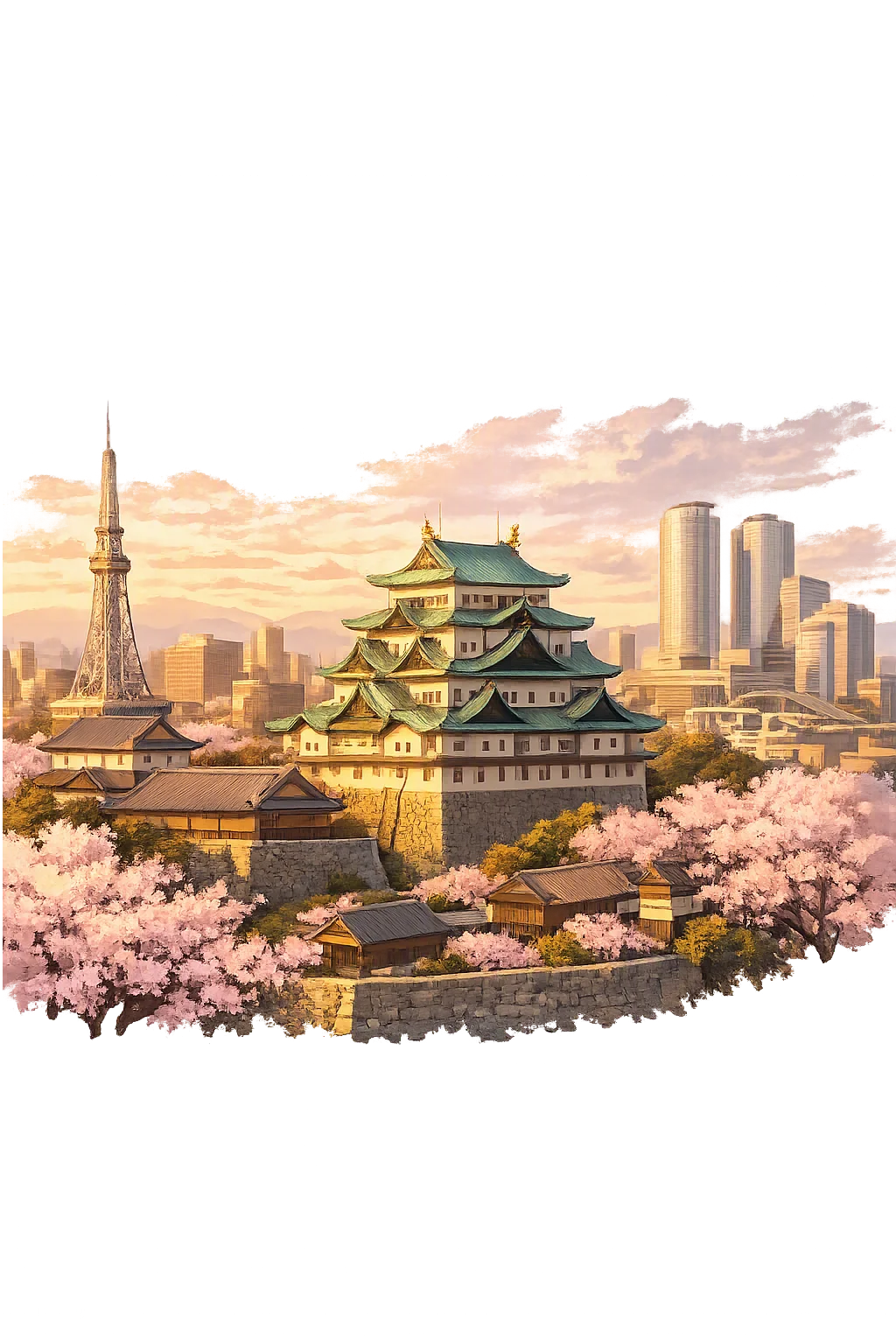
Why Nagoya is spelled that way — and what it costs to get it right
There is a version of this name the early internet had to settle for: nagoya. This is the file on how Nagoya replaced it.
Nagoya's mythology is more historical than divine: a crossroads named for a 'peaceful ancient house,' a castle built to end the age of war, a conference that settled Japan's succession, and a merchant city that traded the sword for the loom and then for the assembly line.
At a Glance
- Restored name: Nagoya
- ASCII form: nagoya
- Meaning: "Peaceful ancient house"
- Domain of influence: Industrial Hub, Chūbu
- Pantheon: Japanese
- Classification: Tier 2
- Original script: 名古屋
- Series: The Restoration Files, No. 328 of 548
The Name Before the Marks
The name is attested as 名古屋, in the attestation The Cambridge History of Japan, vol. 4: Early Modern Japan (Cambridge, 1991) and Totman, Conrad, Tokugawa Ieyasu: Shogun (Heian, 1983) give us. On the evidence, it means "Peaceful ancient house".
Spoken, the name runs `/na.ɡo.ja/` — 'NAH-goh-yah' — three even syllables, with the middle vowel open and short.
The Temple That Stands Now
The restored name is not a plaque; it is an address. The temple of Nagoya lives at /nagoya/, with its mythology in the lore halls, its peer-reviewed record in the Scholarly Edition, and its place in the pattern atlas on the patterns floor.
The restoration keeps one feature the ASCII form drops. One is enough to matter, and the label says so plainly: Tier-2.
Where the Name Stood First
The Honmaru Palace of Nagoya Castle survived in measured drawings and photographs until its destruction in 1945; excavations of its buried foundations (2009–2010) allowed a faithful wooden reconstruction, opened in 2018 — one of Japan's most celebrated modern traditional builds — while the 1959 concrete keep awaits its own re-evaluation. Excavation at Kiyosu Castle (2009) uncovered the buried stone bases of Nobunaga-era tenshu. The city's older sacred stratum survives at Atsuta Jingū, the great shrine south of the center that houses the Kusanagi sword and has drawn pilgrims for well over a millennium; the Tokugawa-en garden preserves the Owari lordly residence grounds. And the castle town's grid itself — one of Japan's classic jōkamachi plans — is the largest standing artifact. The temple on the web is the newest of these addresses — the first one that fits in a pocket.
The Archetype at Work
The pattern atlas seats this temple in 3 industries, each match argued and weighted: Automotive & Mobility (toyota City and the Chūbu automotive belt; the world learned lean manufacturing here.); Manufacturing, Craft & Automation (japan's industrial heartland; Toyota and the Chūbu manufacturing belt make things at scale.); Aviation & Aerospace (japan's aerospace capital; the Chūbu manufacturing belt builds the country's wings.). The Resonance File reads those seats through the myths themselves.
In the Sacred Texts
The Japanese tradition is not a vibe; it is a library. The Sacred Texts collection holds Kojiki and Nihon Shoki — the primary sources the temple's scholarship is built on. The temple is the argument; the texts are the evidence.
The File Continues
The temple's founding dispatch tells the name's story; its Resonance File reads the myths into the industries; the blog index holds the whole archive.
Continue the series — previous file: Nafanua (read it here) · next file: Namtar (read it here).
The Restoration Files are written from the same canonical record as the temples themselves: the lexicon, the lore catalog, the pattern atlas, and the cited scholarly sources. If a file ever disagrees with its temple, the temple is right — tell us, and the file will be corrected.