PuniCodex

Extended Lore

Morana

Etymology · Orthography · Cult · Iconography · Reception · Sources

Tier 2 Morana
Morana — Winter, Death
01

Quick Facts

Essential information about Morana, Winter, Death

Scholarly TransliterationMorana
Unicode RestorationMorana
Reconstructed Pronunciation/morana/
PantheonSlavic
DomainWinter, Death
MeaningDeath
ClassificationTier 2
Primary DomainMorana
Sacred SymbolsThe straw effigy, Frozen water, The last sheaf, The night-hag (mora), The spring bonfire
02

Etymology & Word Family

From original script to Unicode restoration

Scholarly Transliteration Morana Morana — "Death"
Unicode Restoration Morana Canonical scholarly spelling — ASCII-identical
Modern ASCII morana Plain-ASCII fallback

The name Morana reaches the modern world through scholarly transliteration of the slavic tradition. Because the conventional spelling uses only Latin letters, its Unicode and ASCII forms coincide — the tradition it carries is in the name itself, not in diacritics.

03

Unicode Character Breakdown

Character-by-character philological analysis

CharacterUnicodeNameBlockPhonetic Role
MU+004DLatin Capital Letter MBasic LatinSame, capitalized
oU+006FLatin Small Letter OBasic LatinSame
rU+0072Latin Small Letter RBasic LatinSame
aU+0061Latin Small Letter ABasic LatinSame
nU+006ELatin Small Letter NBasic LatinSame
aU+0061Latin Small Letter ABasic LatinSame

The Tier 2 classification here reflects fidelity to the attested tradition, not recovered diacritics: every character of Morana already survives in ASCII. What the restoration preserves is the canonical spelling itself — the form scholarship standardised.

04

Cult & Worship

How the sacred was kept — rites, sanctuaries, remains

The Cult

Morana's cult survives as a calendar of drownings. In Moravia and Slovakia the Morena doll — straw and rags dressed as a woman — is carried out on 30 April and thrown into the stream while the children cry that Morena should carry winter out of the village with her; Bohemia knows the rite as the 'carrying out of Death'. Polish cousins drown Marzanna in the Lenten season, and Ukrainian Kupala songs preserve the drowned maiden, Morenka, mourned in funeral verse. The written evidence begins with the church's enemies-list: synodal condemnations across the Polish lands for centuries, and sixteenth-century chroniclers describing an effigy rite they could not stop. There is no priesthood and no shrine — the votaries are children, girls, and the procession of the whole settlement — and the surviving 'votive objects' are the effigies themselves, collected by ethnographic museums. Modern Rodnovery now builds altars to her, but the attested cult is the riverbank rite, documented unbroken from the Middle Ages to this spring.

In the Earth

No temple, statue, or inscription of Morana is known: Slavic paganism built perishable shrines and wrote almost nothing, and the goddess's pre-Christian material trace is effectively nil. Her real archaeology is ethnographic. The rite of drowning the effigy is documented in writing from the sixteenth century onward — Siennik, Stryjkowski, and the complaints of church synods — and was then recorded in detail by nineteenth- and twentieth-century ethnographers across Poland, Moravia, Slovakia, and Slovenia: the straw doll, the procession, the riverbank, the songs. The surviving artifacts are humble and contemporary: the effigies themselves, photographed and collected by regional ethnographic museums, and the festival riverbanks still used each spring. Where other goddesses left ruins, Morana left a custom.

05

Iconography

How Morana was imaged across the ages

The Image

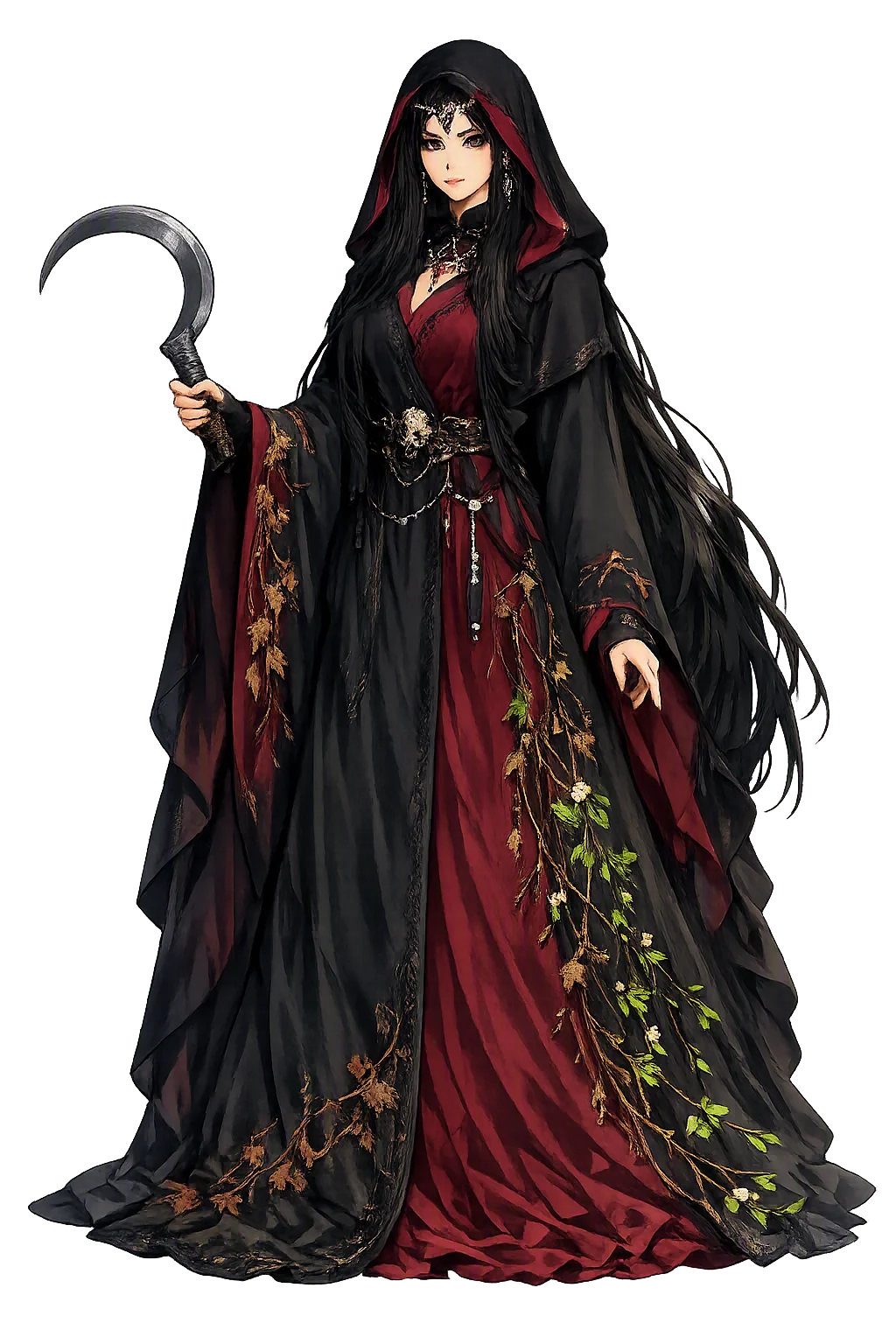
Morana has no ancient portrait — no statue, no fresco, no carved hag survives from the Slavic Middle Ages — and her iconography is, characteristically, made to sink. The canonical image is the Morena doll: a straw body dressed in rags, sometimes crowned, carried shoulder-high on a litter like a corpse or a bride, and consigned to water or fire at the ritual's end; the Czech and Slovak rite dresses her with a broom or a straw cross, the Polish Marzanna with shawl and crown. Every version is deliberately perishable — winter is imaged so that it can be destroyed. The earliest visual records are therefore the nineteenth-century ethnographic drawings and photographs of the processions, and the museum effigies fished from rivers by curators. The attributes folklore assigns her are meteorological rather than anatomical: frost, snow, the gray face of the hungry months, a body of straw because straw is what winter leaves.

06

Reception & Transformation

The name after its own age — transmission, translation, survival

Afterlives

Morana's reception is the story of scholarship inventing a goddess out of a rite — and of the rite outlasting the scholarship. Her first appearance in writing is a schoolboy's gloss: the fifteenth-century Medulla Grammatice equates Latin mors with Polish morana, preserving her name as the plain word for death. Sixteenth-century chroniclers reported the drowning; the synods condemned it. The nineteenth century made her an object of science: Potebnia read the Ukrainian Kupala dirges as the death of a year-maid, and Faminzyn's Bozhestva drevnikh slavian (1884) gave the Slavic pantheon its first monograph, treating Morena from folk rite rather than from texts. Brückner's skeptical classic (1918) argued the evidence would not bear the weight of a great goddess; Ivanov and Toporov's structuralist reconstruction (1974) answered with a full seasonal myth; Łowmiański's critical history (1979) and Szyjewski's synthesis (2003) remain the standard accounts. Each generation has rewritten her from the same handful of songs and straw — and every spring, independently of the writing, the village still drowns her.

Identifications Across Traditions

Living between Catholic Poland and Orthodox Russia, Morana was reinterpreted by every regime that met her. The medieval Church read the drowned effigy as a Lenten allegory of sin drowned in baptismal water and tolerated the rite once it was moved onto the fourth Sunday of Lent; Reformation-era moralists simply condemned it. Nineteenth-century Romantic nationalism made her a figure of the eternal Slavic soul, while sober philologists connected her to the same word-family as Greek Moros and Latin Mors. She is often paired with the Baltic goddess Māra, who presides over earth, birth, and death in Latvian folk religion; the resemblance is real but the names are not cognate, and the comparison is typological rather than genealogical. Under communism the rite was folklorized; since 1989, Rodnovery groups have reclaimed Morana as a sovereign goddess of the dark half of the year. Each age rewrites her, and the drowning continues.

Modern Legacy

Morana is the rare pagan goddess who never left. Polish schoolchildren still drown Marzanna on the fourth Sunday of Lent in a custom older than the schools; Czech and Slovak villages still carry Morena to the stream at the end of April; Slovene spring songs still remember Morana's expulsion in verse. In the living languages her name became ordinary vocabulary — zmora, mòra, the nightmare — and Romantic poetry adopted 'Morana' as a poetic word for winter itself. Modern fantasy, games, and Rodnovery liturgy have given her the temples history withheld. For Slavic cultures she performs a service few mythologies preserve so vividly: she lets winter be mourned like a person, and killed like one.

07

The Meditation

What Morana means — beyond the dictionary

What is remarkable about Morana is not what was written about her — almost nothing was — but what was done. A goddess with no epic, no temple, no priesthood survives five centuries of written history because a village decided, every year, to dress a straw doll and drown it. The rite is her entire biography, and it is enough. In it we see how religion actually works: not as doctrine but as a repeated, embodied agreement about what time is doing to us. Winter arrives, winter oppresses, winter is beautiful and lethal, and winter is carried to the water and drowned by the people it starved. Morana teaches that the seasons are relationships, not weather. She is the one goddess every Slavic child meets personally — in their own hands, at their own riverbank — and she asks the oldest question in myth: if you cannot banish the cold, can you at least give it a face, and drown the face?

08

Frequently Asked Questions

Common questions about Morana, Winter, Death, and Unicode restoration

01How do you pronounce Morana?

In reconstructed pronunciation, Morana is /morana/ — approximately Say 'mo-RAH-nah' in the Polish fashion, or 'MO-rah-nah' in the Czech and Slovak; all three syllables are open and plain.

02What does Morana mean?

Morana means Death in the slavic tradition.

03What are the symbols of Morana?

Morana is associated with The straw effigy (The doll of straw and rags dressed as a woman, ritually drowned or burned at winter's end — attested in Polish sources since the sixteenth century), Frozen water (Her signature element: the locked rivers and iced-over wells that bind the countryside until she is drowned in turn), The last sheaf (In harvest custom the final sheaf of grain was bound into a female figure and kept until spring — the field's own 'death' doll), The night-hag (mora) (The demon that crushes sleepers shares her name and her root *morà — plague, nightmare, and death in one word), The spring bonfire (The fire that consumes her effigy, releasing the new season and closing the year's account with winter).

04Why restore Morana in Unicode?

Morana is written entirely in ASCII letters, so its restoration is about canonical fidelity rather than recovered diacritics: the temple fixes the name in its scholarly standard spelling, attested in the source tradition, instead of leaving it to drift.

05What is the most important myth about Morana?

“A Goddess between the Lines” — the Attestation story that anchors the mythology of Morana, told in full on the lore page.

09

Scholarly Sources

The philological foundations of this restoration

Every claim on this page is grounded in established scholarship. The orthographic restorations follow disciplinary convention. The etymological chain follows the best available reference works. This is not invention — it is resurrection through scholarship.

◈

Lexicography & Philology

  • Folklore
  • Ivanov-Toporov
◎

Primary Texts

  • The Primary Chronicle (Povest’ vremennykh let); the Hypatian Codex; East Slavic chronicle tradition and South Slavic folk invocations.
◉

Archaeology & Art History

  • Material evidence — iconography, inscriptions, and temple archaeology — for Morana and related cults.
✦

Religious Studies

  • Potebnia, A. A., Obiasneniia malorusskikh i srodnykh narodnykh pesen (Warsaw, 1883) — the earliest philological discussion of the Ukrainian Моренка (Morenka) Kupala songs, in which the drowned maiden is read as an embodiment of death.
  • Faminzyn, A. S., Bozhestva drevnikh slavian (St Petersburg, 1884) — the first monographic study of the Slavic pantheon, treating Morena/Marzanna on the basis of folk rite rather than written myth.
  • Kolberg, Oskar, Dzieła wszystkie (Complete Works, 2nd ed. 1961–90), ethnographic volumes on Polish seasonal custom — the principal nineteenth-century documentation of the drowning and burning of the Marzanna effigy.
  • Brückner, Aleksander, Mitologia słowiańska i polska (Warsaw, 1918; repr. PWN 1985) — the classic critical survey, whose sceptical treatment of Marzanna remains the starting point for all modern discussion.
  • Ivanov, V. V., and V. N. Toporov, Issledovaniia v oblasti slavianskikh drevnostei: Letne-osennii prazdnichnyi kompleks drevnikh slavian (Moscow, 1974) — structural analysis of the spring rite complex, including the Morena effigy rite.
  • Łowmiański, Henryk, Religia Słowian i jej upadek (VI–XII w.) (Warsaw, 1979) — the standard modern history of Slavic religion, with a full discussion of the Marzanna rite and its pre-Christian antecedents.
  • Szyjewski, Andrzej, Religia Słowian (Kraków, 2003) — concise modern synthesis, treating Morana within the spring-festival cycle and the problem of the Slavic female divinities.
Return

The Surface Awaits

You have traced the name from its earliest attestation to its Unicode restoration. Now return to the myth. The story is where the name lives.

Back to Lore
Morana mascot