
Why Moirai is spelled that way — and what it costs to get it right
There is a version of this name the early internet had to settle for: moirai. This is the file on how Moirai replaced it.
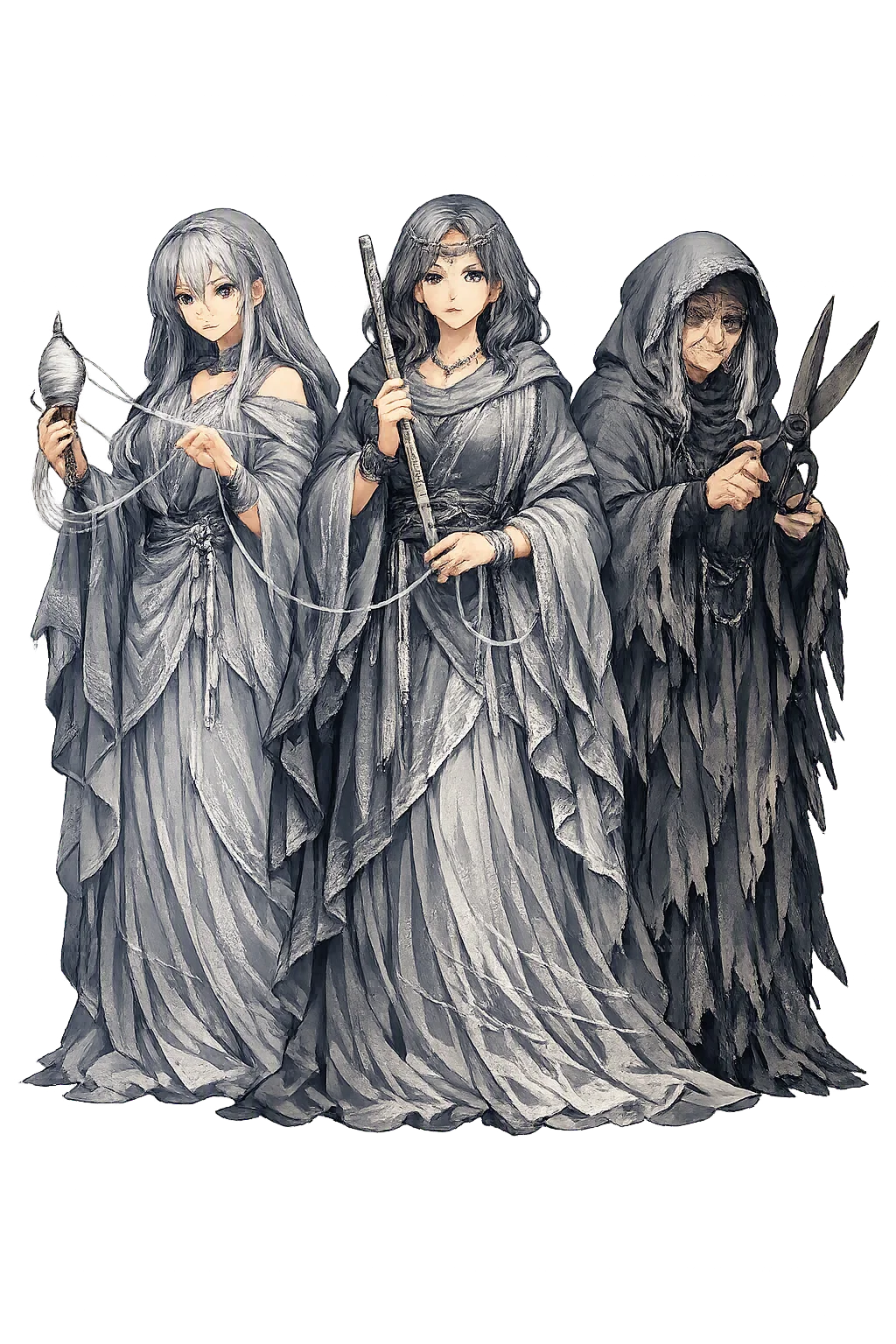
The Moirai’s mythology is scattered across the whole of Greek epic and philosophy — a genealogy told twice, two births they attend out of jealousy and pity, a loophole a god must pay for, and a final Platonic vision that hands fate back to the chooser. Their stories are always about the same question: who, in the end, is responsible for a life?
At a Glance
- Restored name: Moirai
- ASCII form: moirai
- Meaning: "Apportioners (from μείρομαι)"
- Domain of influence: Fate, Destiny, Thread
- Pantheon: Greek
- Classification: Tier 1
- Original script: Μοῖραι
- Series: The Restoration Files, No. 320 of 548
The Name Before the Marks
The name is attested as Μοῖραι, as Hesiod, Theogony 217–222 and 901–906 (the two genealogies) and Homer, Iliad 19.91–133 (Herakles); 9.529–599 (Meleager); 20.127–128; 22.209–213 (the scales of Zeus) record. On the evidence, it means "Apportioners (from μείρομαι)".
Spoken, the name runs `/môi̯.rai/` — 'MOY-rye' — one long falling note on the first syllable, then a bright quick ending; the plural of μοῖρα, 'portion.'
The Temple That Stands Now
The restored name is not a plaque; it is an address. The temple of Moirai lives at /moirai/, with its mythology in the lore halls, its peer-reviewed record in the Scholarly Edition, and its place in the pattern atlas on the patterns floor.
Tier-1 is not a compliment; it is a measurement. This restoration keeps something the ASCII form provably loses, and the measurement is repeatable.
Where the Name Stood First
The Moirai are creatures of text and vase more than of cult: no great temple is theirs, though Pausanias records their sanctuary at Sicyon beside Zeus Moiragetes (2.11.3) and they shared altars at Delphi. In art they appear from the late sixth century BCE as three working women — spinners with distaff and wool basket, deliberately ordinary, the fates dressed like the neighbors. Attic and South Italian vase painters show them at the births of gods and heroes; on Apulian funerary vases of the fourth century they attend Hades and Persephonē, shears in hand, turning a household craft into the machinery of death. Epigraphy extends their metaphor into administration: the Greek city distributed land and office by lot (klēros, the same language of “portion”), so that the polis lived institutionally inside the Moirai’s image of the allotted share. The temple on the web is the newest of these addresses — the first one that fits in a pocket.
The Archetype at Work
The pattern atlas seats this temple in 3 industries, each match argued and weighted: Education, Research & Knowledge (primary seat: Moirai embodies fate, destiny, thread — the core of education.); Mythic Name Restoration (resonant seat: Moirai shares symbolic territory with mythic restoration.); Writing, Publishing & Media (resonant seat: Moirai shares symbolic territory with publishing media.). The Resonance File reads those seats through the myths themselves.
In the Sacred Texts
The Greek tradition is not a vibe; it is a library. The Sacred Texts collection holds Theogony, Homeric Hymns, and Works and Days — the primary sources the temple's scholarship is built on. The temple is the argument; the texts are the evidence.
The File Continues
The temple's founding dispatch tells the name's story; its Resonance File reads the myths into the industries; the blog index holds the whole archive.
Continue the series — previous file: Móði (read it here) · next file: Monókerōs (read it here).
The Restoration Files are written from the same canonical record as the temples themselves: the lexicon, the lore catalog, the pattern atlas, and the cited scholarly sources. If a file ever disagrees with its temple, the temple is right — tell us, and the file will be corrected.