
Why Moirai belongs in your address bar
Every address bar is a choice. When you type Moirai, you are not typing a novelty; you are restoring a name that the early DNS, built for English typewriters, could not carry. The plain ASCII form moirai is a leftover of that constraint, not the name itself. This post is the long version of the restoration: where the name comes from, how the Greek tradition wrote it, how it is pronounced, what the myths and the material record preserve, and why its Unicode form now lives as a working domain. The claim throughout is simple — the original spelling is not decoration. It is the name.
At a Glance
- Restored name: Moirai
- ASCII form: moirai
- Meaning: "Apportioners (from μείρομαι)"
- Domain of influence: Fate, Destiny, Thread
- Pantheon: Greek
- Classification: Tier 1
- Original script: Μοῖραι (Greek)
Overview
Moirai (moirai) — Fate, Destiny, Thread · Apportioners (from μείρομαι) — belongs to the Greek tradition, where they are catalogued under the domain "Fate, Destiny, Thread." The name is the plural of Μοῖρα, itself derived from the verb μείρομαι, "to receive as one's portion." The Moirai are therefore not merely "the fates" in the abstract; they are the apportioners, the ones who divide out the shares of life, death, and destiny to gods and mortals alike. Even Zeus, in some passages, is said to receive his portion from them.
PuniCodex restores the name as Moirai and serves its temple at its temple. The original carries both stress and vowel length, and exactly one historically valid Unicode restoration exists, which places the name in Tier 1. The plain ASCII form moirai survives as a modern convenience imposed by the early domain-name system; the restoration, not the fallback, is the form the project defends as philologically complete.
Etymology and the Language of Apportionment
The name is attested in Greek as Μοῖραι. Etymologically it means "Apportioners (from μείρομαι)." The root verb μείρομαι means "to receive a share" or "to be allotted," and the noun μοῖρα means "portion," "share," "lot," and by extension "fate." In Homer, a person's μοῖρα is not only their destiny but their rightful measure of life: so much food, so much honor, so many days. The Moirai are the divine administrators of this economy. They do not invent fate; they distribute it according to a order older than the gods.
The Greek form Μοῖραι shows the circumflex on the first syllable, which in classical pronunciation combined a rise and fall in pitch on a long vowel. The diphthong οι is pronounced like the vowel in "boy," and the final -αι marks the nominative plural. These details matter because they shape how the name was heard in ritual, poetry, and prayer. The Moirai were not whispered hastily; their name was pronounced with the weight of what it named. A Greek speaker hearing the word would have heard the long vowel and the falling pitch as signs of solemnity.
The ASCII form moirai survives only because the early domain-name system could not carry diacritics; it is a technological compromise, not an ancient spelling. The Unicode restoration Moirai recovers the circumflex and the long vowel, returning to the name the sonic gravity it had in Greek. Without the mark, the word floats; with it, the word falls into its proper place. The circumflex is especially important because it combines stress and length in a single sign, making the restoration compact but complete.
Moira in Homer
In the Iliad and the Odyssey, μοῖρα appears as a powerful but not fully personified force. Heroes speak of their portion, their allotted span of life, the day that has been measured for them. Achilles knows that his μοῖρα is short but glorious; Hector knows that Troy's μοῖρα is fixed. The word names the boundary against which heroism is tested. Without a limit, there would be no need for courage. The inevitability of fate gives heroism its meaning.
The Moirai are mentioned by name in Homer, though not yet as the fully developed triad of later tradition. They appear as the spinners or measurers of life, shadowy figures behind the action. Their presence is felt most strongly at moments of death, when a hero's thread reaches its end. The pathos of the Homeric poems depends on the audience's awareness that every life is measured and that the measure is final.
Homer's treatment of μοῖρα is philosophically subtle. The gods can sometimes delay or alter a person's portion, but they cannot ultimately abolish it. Fate is therefore both subordinate to the gods and superior to them. This tension runs through the entire Greek tradition and finds its most elaborate expression in the figures of the Moirai. They are the boundary that even divinity cannot cross.
The Hesiodic Genealogy
Hesiod's Theogony gives the Moirai a clear genealogy. They are daughters of Nyx, Night, born without a father. As children of one of the primordial powers, they are older than the Olympian gods. This genealogy makes them agents of necessity rather than servants of Zeus. They were spinning and measuring before Zeus came to power, and they will continue after his reign ends. Their authority is therefore cosmological, not merely political.
The primordial origin of the Moirai is consistent with their function. If they are to apportion life to gods as well as mortals, they cannot themselves be dependent on the gods' will. Their independence gives them a kind of metaphysical authority. They are not arbitrary; they are the order within which even Zeus must operate. This is why Greek poets could say that Zeus himself was subject to fate.
Later sources sometimes give the Moirai a different parentage, making them daughters of Zeus and Themis. This alternative genealogy emphasizes their role in divine justice rather than primordial necessity. The two traditions coexist in Greek culture, reflecting different answers to the question of whether fate is older than the gods or an expression of divine order. Both answers preserve the Moirai's power.
Klotho, Lachesis, and Atropos
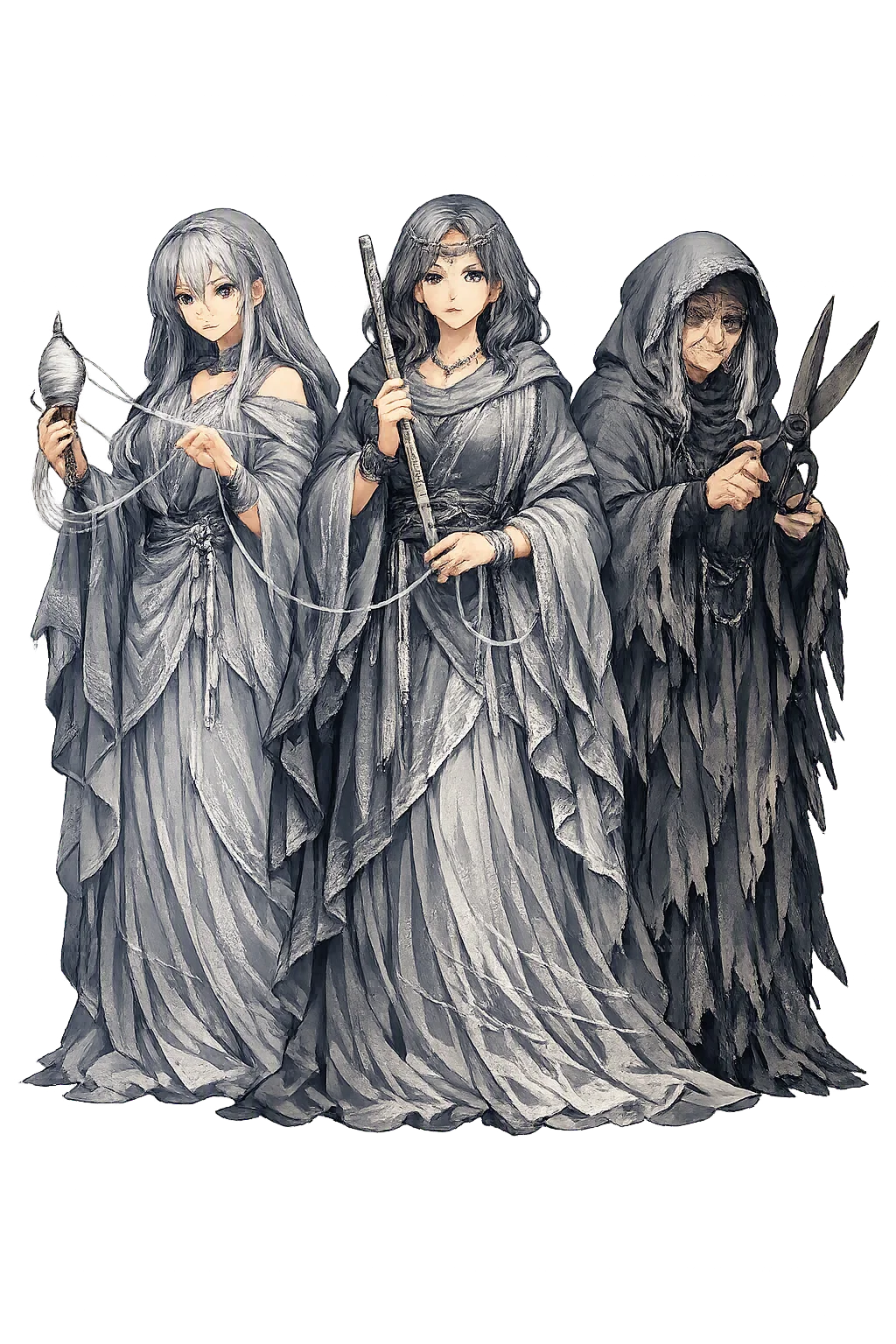
The Moirai are usually three: Klotho, Lachesis, and Atropos. Klotho spins the thread of life, Lachesis measures its length, and Atropos cuts it. This imagery of spinning, measuring, and cutting is among the most powerful in Greek myth because it unites domestic craft with cosmic law. The tools are those of a woman at home — spindle, rod, shears — but the work is the governance of existence itself. The metaphor makes the abstract concrete and the cosmic intimate.
Klotho's name is connected to the verb κλώθω, "to spin." She is the one who begins the thread, the origin of life. Lachesis's name comes from λαγχάνω, "to obtain by lot." She determines what the thread will contain: wealth, honor, suffering, length. Atropos's name means "inflexible" or "inevitable." She is the one who ends the thread, and her name denies any possibility of appeal. Together they cover the whole arc of a life.
The triadic division gave Greek culture a vocabulary for thinking about the stages of life. Birth is spinning; maturity is measuring; death is cutting. The metaphor is domestic and unrelenting. Every life is a thread, and every thread has an end. Yet the image also contains a kind of care: the thread must be spun well, measured fairly, and cut cleanly. Sloppy work would be unworthy of goddesses. The Moirai are therefore not chaotic forces but precise ones.
The Moirai and Zeus
The relationship between the Moirai and Zeus is one of the most debated topics in Greek religion. In some texts, Zeus is supreme and the Moirai carry out his will. In others, even Zeus cannot overturn what the Moirai have spun. The Iliad contains passages that support both views, and Greek poets seem to have been comfortable with the ambiguity. The tension may reflect different local traditions or different poetic contexts.
When Achilles faces his death in the Iliad, it is because his portion has been measured. When Meleager's life is tied to a brand, it is the Moirai who set the condition. Their power is not violent; it is administrative. They do not chase heroes down. They simply keep the books, and the books are final. This quiet inevitability makes them more terrible than any monster. A monster can be fought; a record cannot.
The philosophical question raised by this relationship is profound. If fate governs Zeus, then the king of the gods is not truly omnipotent. If Zeus governs fate, then fate is merely an instrument of divine will. Greek tragedy returns to this question again and again, finding in it the source of human pathos. The Moirai are the guarantors of a cosmic order that even the gods cannot escape.
The Roman Parcae
Roman religion identified the Moirai with the Parcae — Nona, Decima, and Morta. The Parcae inherited the imagery of spinning and cutting, and they too were invoked at births. The survival of the idea across cultures suggests that the metaphor answered a persistent human need: to personify the limits within which life unfolds, and to give those limits a face. The names changed, but the image of three women at the cradle remained.
Nona's name refers to the ninth month of pregnancy; Decima's to the tenth; Morta's to death. These names make explicit what the Greek names imply: the Parcae preside over the whole arc of life from conception to death. They were therefore invoked at births more than at deaths, because the moment of birth was when the thread was first measured. The Romans treated them as guardians of the threshold between womb and world.
The Parcae appear in Roman literature from Ennius to Ovid. They are solemn, rarely sentimental, and always authoritative. Their Roman form preserved the Greek idea while giving it a Latin civic coloring. The Fates, in Rome, were part of the order that made the city and its empire possible. They were not foreign superstitions but ancestral powers.
The Fates in Philosophy and Tragedy
The Moirai raise questions that remain urgent. If fate governs all, what room is left for choice? If the gods themselves are bound, what is the nature of divinity? Stoics answered by identifying with fate; Epicureans tried to escape the anxiety of it; tragedians dramatized the collision between human ambition and allotted limit. Every major Greek thinker had to reckon with the Moirai, because they named the boundary against which all human effort is measured.
In tragedy, the Moirai are often felt rather than seen. Oedipus's story is a Moira story even though the Fates are not characters on stage. The same is true of many Greek tragedies. The power of the Moirai lies in their invisibility. They do not need to appear because their work is visible everywhere. The audience knows that the hero's actions are measured even when the measuring women remain offstage.
The philosophical legacy of the Moirai extends into modern thought. The concept of fate, the problem of free will, and the metaphor of life as a thread all derive in part from the Greek imagination of the Moirai. Even those who reject fate as a superstition still use the language that the Moirai made available. The vocabulary of destiny remains deeply classical.
The Modern Fates
The Moirai have never left Western imagination. They appear in Roman literature, medieval allegory, Renaissance painting, and modern fiction. They are the weird sisters of Shakespeare, the Norns of Wagner, the Fates of countless novels and films. The image of three women controlling human destiny is one of the most portable symbols in world culture, and it begins with the Greek Moirai. Wherever a story needs to represent destiny as both personal and impersonal, the three figures reappear.
In modern usage, "the Fates" often means simply bad luck or unavoidable doom. But the original concept is richer. The Moirai apportion; they do not only destroy. A life well spun, well measured, and well cut is a life complete. The restoration of their name is therefore a small act of philosophical recovery. It reminds us that fate, in the Greek imagination, was not only a limit but a measure. The Fates gave shape to life as well as ending it.
Unicode Restoration
The restoration of Moirai to a working domain is especially fitting because the name itself is about allotment and measure. The plain ASCII moirai allots only the bare letters, stripping away the circumflex that marks the name's prosodic identity. The Unicode form restores that mark and with it the audible shape of the Greek word. A name about precise division should not be rendered imprecisely.
PuniCodex classifies Moirai as Tier 1 because the Greek original carries both stress and length, and because a single historically valid restoration exists. The temple at punicodex.com/moirai is therefore more than a web page; it is a small claim that the old names of necessity should still be pronounceable, still visible, still present in the infrastructure of the modern web. The thread has been cut many times by history. This restoration ties one end back on.
Restoration in Context
The Moirai represent one of the most philosophically demanding ideas in Greek religion: that human life is measured, that the measure is final, and that even the gods participate in this order. Restoring their name is therefore not merely a philological gesture. It is a way of keeping visible a concept that has shaped Western thought for thousands of years. The plain ASCII moirai cannot carry that weight.
In the modern world, the idea of fate has been displaced by talk of choice, agency, and self-determination. Yet the experience of limit remains. People still speak of luck, timing, and the strange patterns that shape a life. The Moirai give these experiences a face and a story. By restoring their name, the project keeps that story accessible.
The restoration also has a practical dimension. The Moirai appear in countless works of literature, art, music, and film. A correctly spelled name makes it easier to connect these references to their source. It helps scholars, students, and curious readers find their way back to the Greek originals. In this sense, the restored domain functions like a thread of its own, leading from the present to the past.
The image of three women spinning, measuring, and cutting is too powerful to be reduced to a lowercase string. The Unicode form Moirai returns the circumflex, the capital, and the dignity of the name. It says that necessity, however feared, deserves to be named properly. The Fates may be relentless, but their name need not be flattened.
The restoration also invites reflection on the role of technology in preserving old ideas. The DNS was built for a narrow character set, and for decades it could not represent names like Moirai correctly. Unicode and punycode have changed that, making it possible for ancient words to exist in the same address bar as modern brands. This is not a trivial development. It means that the infrastructure of the web can now accommodate the full range of human naming, including the names that have shaped our understanding of fate.
In the end, the Moirai ask us to accept that we are not the sole authors of our lives. We spin, we measure, and we cut, but we also receive the thread and hand it on. The restored name Moirai is a reminder of this double condition: we are agents and recipients at once. The domain is small, but the idea it carries is vast. Every time the name is typed correctly, the ancient conception of fate gains a little more visibility in the modern world.
Related Names
- Apóllōn — Light, Music, Prophecy
- Hekátē — Magic, Crossroads, Moon
- Níkē — Victory
- Achérōn — River of Woe
- Achilleús — War, Glory, Rage
Sources
- Homer, Iliad and Odyssey (8th c. BCE).
- Hesiod, Theogony (8th–7th c. BCE).
- Henry George Liddell & Robert Scott, A Greek-English Lexicon (1843; rev. Jones, 1940).