
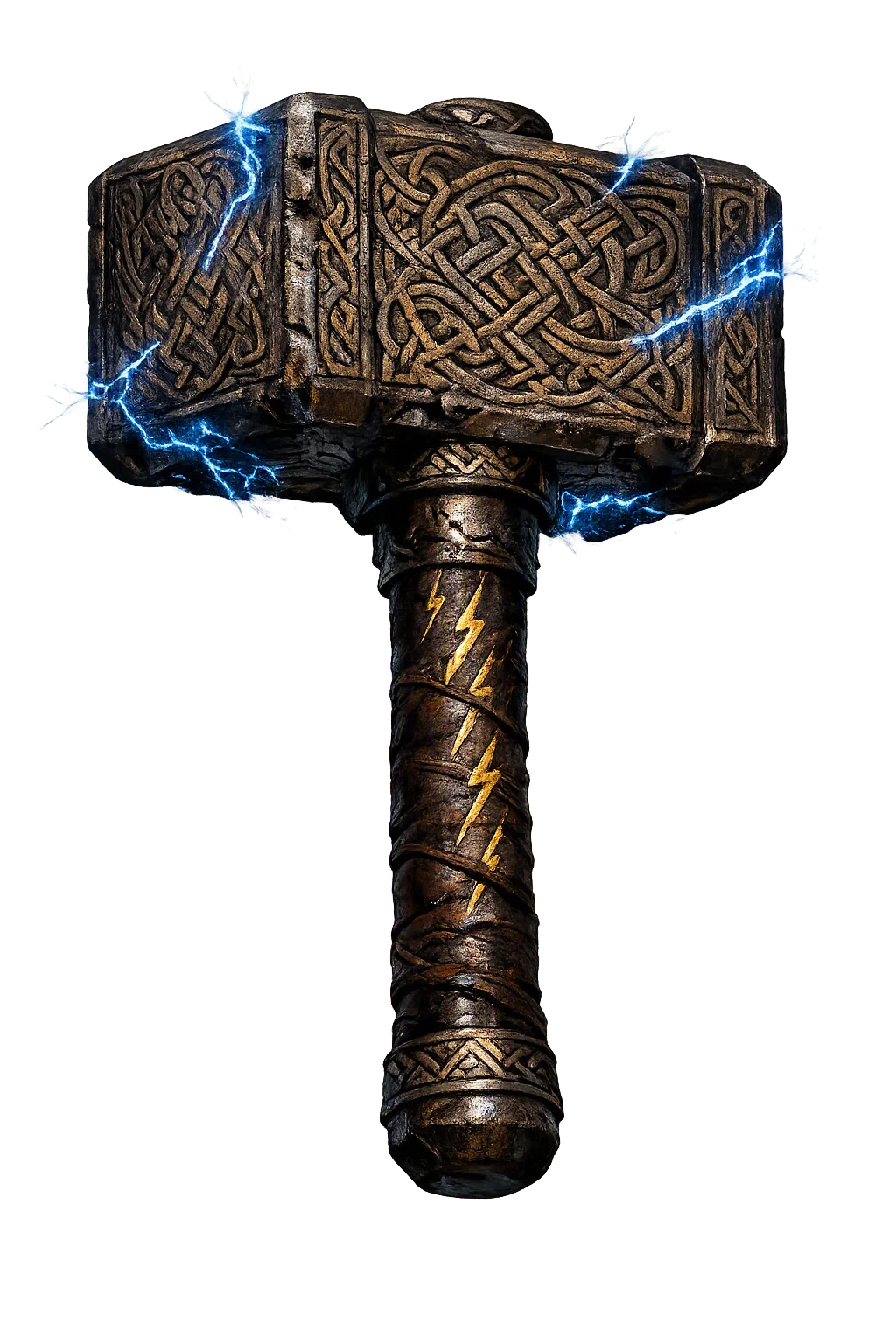
Pronouncing Mjǫllnir: a guide for the curious
Saying Mjǫllnir aloud is harder than reading it on a screen, and more rewarding. The restored spelling is a compressed pronunciation guide: every accent and macron is an instruction. This post unpacks those instructions — the reconstructed sound, the phoneme-by-phoneme record, the kindred forms in neighboring languages — and then zooms out to the full record around the name: its Younger Futhark writing, its mythology, its cult, and its modern life as a Unicode domain. Whether you arrive as a linguist, a reader of myth, or a domainer, you will leave able to say the name the way the evidence suggests it was said — and able to type it the way it was written.
At a Glance
- Restored name: Mjǫllnir
- ASCII form: mjolnir
- Meaning: "The grinder"
- Domain of influence: Thunder Hammer
- Pantheon: Norse
- Classification: Tier 1
- Original script: ᛘᛁᚢᛚᚾᛁᚱ (Younger Futhark)
- Live domain: mjǫllnir.com
Overview
Mjǫllnir (mjolnir) — Thunder Hammer · The grinder — belongs to the Norse tradition, where it is catalogued under the domain "Thunder Hammer". The name means "The grinder".
In the norse tradition, Mjǫllnir is the hammer of Þórr — the one treasure the gods cannot do without. Dwarf-forged and short in the haft from Loki's sabotage, it never misses its mark, never flies so far that it fails to return to the thrower's hand, and shrinks small enough to be hidden inside a shirt. With it Þórr holds the wall between Ásgarðr and the giants.
Yet the hammer is not only a weapon. It is laid in the bride's lap to hallow the marriage, raised over the newborn, and lifted against the dead man's pyre — it blessed Baldr's burning ship. In the Viking Age men and women wore it in silver and iron around their necks, the heathen answer to the Christian cross, and it is worn again today.
PuniCodex restores the name as Mjǫllnir and serves its temple at mjǫllnir.com. The restoration preserves at least one distinctive feature — a diacritic or a distinctive letter — that the ASCII form loses, and exactly one historically valid Unicode restoration exists, which places the name in Tier 1. The plain ASCII form mjolnir survives as a modern convenience imposed by the early domain-name system; the restoration, not the fallback, is the form the project defends as philologically complete.
The Name
The name is attested in Younger Futhark as ᛘᛁᚢᛚᚾᛁᚱ. Etymologically it means "The grinder".
The ASCII form mjolnir survives only because the early domain-name system could not carry diacritics; it is a technological compromise, not an ancient spelling. The Unicode restoration Mjǫllnir recovers the stress accent of the original directly in the address bar. The restoration preserves at least one distinctive feature — a diacritic or a distinctive letter — that the ASCII form loses, and exactly one historically valid Unicode restoration exists, which places the name in Tier 1.
The letter-by-letter transformation runs:
- m → M — Same, capitalized
- j → j — Same
- o → ó — Stress on o
- l → l — Same
- n → n — Same
- i → i — Same
- r → r — Same
The project holds the domain mjǫllnir.com (xn--mjllnir-bnc.com) as the canonical home of this name.
The Original Script
The name is preserved in Younger Futhark as ᛘᛁᚢᛚᚾᛁᚱ.
The scholarly transliteration is miulnir.
The rendering proceeds step by step:
- ᛘ (maðr) writes /m/
- ᛁ (ís) writes both /i/ and /e/
- ᚢ (úr) writes the rounded back vowels /u, o, ø, ǫ, y/ and /w/
- The spelling miulnir is a normalized phonetic reconstruction; Younger Futhark does not distinguish voiced/voiceless stops or separate short and long vowels
The Old Norse form is Mjǫllnir, with o-ogonek for the short rounded vowel [ɔ] and a geminate ll; the medieval manuscripts wrote it in Latin letters, varying between miǫllnir, miöllnir, and kindred spellings. In the Viking age itself the word was carved, not written: the Younger Futhark, the sixteen-rune alphabet of the period, carries both of the hammer's surviving runic witnesses — the Købelev amulet's proud hamar × is ('this is a hammer') and the Kvinneby amulet's invocation of Þórr 'with his hammer'. The site's Unicode restoration Mjǫllnir keeps what ASCII cannot: the o-ogonek and the geminate ll of the dictionary form, registrable as the internationalized domain mjólnir.com (punycode xn--mjlnir-cxa.com). The plain form mjolnir survives only as the anglicized shadow — the name as comics rendered it, with the stress mark and the old rounded vowel filed away.
Pronunciation
The reconstructed pronunciation of the name is /ˈmjɔlː.nir/ — Old Norse Reconstruction.
Phoneme by phoneme:
- Mj — The onset cluster [mj], m followed by a palatal glide, as in English 'music'; the anglicized Mjolnir keeps the spelling but usually drops the glide
- ǫ — Short open-mid back rounded [ɔ], written o-ogonek; the rounded 'o' of 'hot', held short — distinct from both o and ó
- ll — Long or geminated alveolar lateral [lː], written double in Old Norse to show length; hold it like the ll of Italian 'bella'
For the modern speaker, the closest approximation is: 'MYAWL-lnir' — begin with the mj of 'music', sound the vowel like the short rounded 'o' of 'hot', and hold the ll double before the final '-nir'.
Kindred and historical forms of the name:
- Proto-Norse — *melluniaR, the reconstructed ancestor of the hammer's name
- Old Norse — Mjǫllnir, the normalized form of the dictionaries and editions
- Modern Icelandic — Mjölnir, the living Icelandic form
- Continental Scandinavian — Danish and Norwegian Mjølner, Swedish Mjölner
- Anglicized — Mjolnir, the ASCII form made famous by comics and film
Mjǫllnir is Tier 1: the o-ogonek ǫ (the short rounded [ɔ] of Old Norse) and the geminate ll are features the ASCII form loses — this is the normalized dictionary form (Cleasby–Vigfusson, s.v. 'Mjöllnir'; Zoëga, s.v. 'Mjǫllnir'). The etymology is genuinely disputed: proposals connect the name to Old Norse mala, 'to grind' ('the grinder'), to mjǫll, 'new snow' ('the shining one'), and to the Slavic lightning word seen in Russian mólnija, and the scholarship has settled on none of them.
Mythology
Mjǫllnir is the most famous weapon in the northern world and the busiest: no other treasure of the gods both kills and consecrates. Forged as the stake in one of Loki's wagers, it came out of the dwarf Sindri's forge with a haft too short, and the gods judged it the best of all the treasures nonetheless — with it, Þórr could hold the giants off forever. It revives his slaughtered goats, it is laid in the lap of the bride at the wedding, it hallows the pyre of the slain god. The whole theology of the hammer is gathered in its two great stories: its flawed making and its comic theft, when Þrymr the giant buried it and the mightiest of the Æsir had to put on bridal linen to get it back. The Viking age answered with silver hammers worn at the throat, and the modern world has never put the hammer down.
The Wager and the Short Haft (Skáldskaparmál)
After Loki shears the goddess Sif's hair, he must replace it, and from the sons of Ívaldi he commissions three treasures: hair of living gold for Sif, the ship Skíðblaðnir, and the spear Gungnir. Swaggering, he wagers his own head with the dwarf Brokkr that Brokkr's brother Sindri — named Eitri in some tellings — cannot make three treasures as fine. At the forge, Loki turns himself into a fly and bites Brokkr at the bellows: once on the arm, once on the neck, and neither bite moves him. But the third bite lands on his eyelid as Sindri works the iron, and blood blinds him for one stroke of the bellows. Out comes a hammer — and its haft is too short.
Óðinn, Þórr, and Freyr judge the treasures, and Brokkr names the hammer's virtues: however hard it is swung, it will not fail; thrown, it never misses; it will never fly so far that it does not return to the hand; and it can be made so small it is kept inside the shirt. Only the short haft stands against it. The gods judge it the best of all six gifts, for with it the Æsir can defend themselves against the frost giants — and Loki keeps his head. The flaw in the most trusted weapon in the world is the permanent signature of Loki's sabotage.
The Hammer in the Bride's Lap (Þrymskviða)
Þórr wakes one morning and the hammer is gone. Loki borrows Freyja's feather-coat, flies to Jötunheimr, and hears Þrymr, lord of giants, boast that he has buried Mjǫllnir eight leagues under the earth — and no one gets it back unless Freyja is brought to him as bride. Freyja's rage at the suggestion shakes the hall and snaps her necklace Brísingamen, so the gods take counsel, and Heimdallr proposes the unthinkable: dress Þórr as the bride. The thunder-god protests, but Loki answers that without the hammer the giants will soon be living in Ásgarðr — and so Þórr is veiled, hung with Brísingamen and jingling keys, and driven to Jötunheimr with Loki as his maidservant.
The comedy is exact: the 'bride' devours an ox and eight salmon and drinks three casks of mead, and Loki must explain that Freyja has not eaten for eight nights, so great was her longing. Þrymr lifts the veil to steal a kiss and leaps the length of the hall from the fire in her eyes — eight nights without sleep, Loki insists. Then Þrymr calls for the hammer to be brought in to hallow the bride, laid on her knees by the hand of Vár. Þórr's heart laughs; his hand closes on the haft. He kills Þrymr first, then the giant's whole household. It is the funniest poem in the Edda and the hammer's most famous story — and the joke has a hard core: the hammer laid in the bride's lap is not a stage prop but the actual consecration of a marriage.
Hallowing Baldr's Pyre (Gylfaginning)
When Baldr lies dead, the gods build his pyre on his ship Hringhorni, and the giantess Hyrrokkin, riding a wolf with vipers for reins, must be fetched to launch it. Baldr's wife Nanna dies of grief and is laid beside him. Then Þórr steps forward, raises Mjǫllnir, and hallows the pyre — the god of thunder consecrating the ship of the dead god before the fire is lit. A dwarf named Litr runs before his feet in that moment, and Þórr kicks him into the flames. The same gesture that revives his goats after they have been slaughtered and eaten, that blesses the bride at the wedding feast, here blesses the burning of the best of the gods. Hammer at the cradle, hammer at the marriage bed, hammer at the grave: the sources are clear that Þórr's weapon marked every threshold of life, and the Viking-age custom of wearing it hung that power around the neck.
Symbols & Iconography
The iconography associated with Mjǫllnir concentrates in a small set of recurring attributes, each a compressed statement about the name:
- The short haft — The flaw left by Loki's fly-form sabotage at the bellows — the defect that makes the hammer a one-handed weapon
- The unerring throw — It never misses its target and never flies so far that it fails to return to the thrower's hand
- The hidden hammer — It shrinks small enough to be kept inside the shirt — power carried unseen
- Lightning made iron — The thunderbolt given haft and head, the storm wielded as a tool
- The amulet — The pendant form worn across the Viking world, the heathen counterpart of the cross
Archaeology & Evidence
The hammer is one of the best-attested symbols of the Viking age. Around a thousand Mjǫllnir pendants in iron, silver, and amber have been unearthed across Scandinavia, England, northern Germany, the Baltic, and Russia — most simply made, about a hundred with ornament, and a tenth from graves, predominantly women's cremations; Jörn Staecker's typology (1999) and Katherine Beard's Eitri database (2019) order the material. Famous finds include the Rømersdal hammer from Bornholm, the gold-plated Bredsätra pendant from Öland, the Foss 'wolf-cross' from Iceland that reads as cross and hammer at once, and the Hiddensee gold treasure, where a hammer hangs among crosses. The Købelev hammer from Lolland (10th century) is the only one that names itself, inscribed in Younger Futhark 'hamar × is' — 'this is a hammer' — and the 11th-century Kvinneby copper amulet from Öland invokes Þórr's protection 'with his hammer' in runes. Iron hammer-rings cluster in the cremation graves of the Mälaren region, Åland, and Russia. Thor's hammer is carved on runestones (DR 26, DR 48, DR 120, VG 113, Sö 86, Sö 111) and appears in the fishing scenes on the Altuna stone and at Gosforth; the small bronze Eyrarland figure from Iceland (c. AD 1000) may show the god gripping it. Saxo Grammaticus records that as late as 1125 Magnus the Strong carried off great bronze 'hammers of Jupiter' from a Swedish temple. Textually, Þrymskviða and Lokasenna survive in the Codex Regius of the Poetic Edda (c. 1270), the forging and the hallowing of Baldr's pyre in the Prose Edda manuscripts, above all the Codex Regius GKS 2367 4to.
Realm & Domain
In the norse tradition, Mjǫllnir is the hammer of Þórr — the one treasure the gods cannot do without. Dwarf-forged and short in the haft from Loki's sabotage, it never misses its mark, never flies so far that it fails to return to the thrower's hand, and shrinks small enough to be hidden inside a shirt. With it Þórr holds the wall between Ásgarðr and the giants.
Yet the hammer is not only a weapon. It is laid in the bride's lap to hallow the marriage, raised over the newborn, and lifted against the dead man's pyre — it blessed Baldr's burning ship. In the Viking Age men and women wore it in silver and iron around their necks, the heathen answer to the Christian cross, and it is worn again today.
The Dwarven Forge
Wagered into being by Loki, forged by the dwarf brothers Sindri and Brokkr; a fly's bite at the bellows left the haft too short.
The Stolen Hammer
Þrymr the giant buried it eight miles down and demanded Freyja as bride-price; Þórr won it back veiled as the bride.
Hammer of Hallowing
The same weapon that shatters giants consecrates brides, newborns, and funeral pyres — destruction and blessing in one tool.
The Worn Hammer
Viking-age smiths cast it by the hundred in silver and iron; the pendant answered the cross then and signifies heathen faith now.
Across Cultures
The hammer did not stay inside Iceland's manuscripts. On the continent its god appears as Donar, and when Adam of Bremen describes the temple at Uppsala he says that Thor 'with his mace looks like Jupiter' — the interpretatio romana equating thunder with thunder. Saxo Grammaticus gives Thor an oak club and, tellingly, preserves the short handle: in the Gesta Danorum the hero Høther disables the weapon by lopping off its shaft, an euhemerized echo of the fly at the bellows. Archaeology reaches further back: scholars have long connected the hammer pendants to the older club-of-Hercules amulets of the Roman frontier provinces, and Bronze Age rock carvings already show axe- and hammer-bearing figures in consecrating poses.
Comparativists place Mjǫllnir in a wide Indo-European family of thunder-weapons — Indra's vajra, the club of the Dagda, the axe of Perun — and one proposed etymology would make the name itself a cousin of Slavic mólnija, 'lightning', though the derivation is contested. In later folklore the weapon survived transmuted: Neolithic axe-heads and belemnites were kept as 'thunder-stones' (torshammare), guards against lightning, and early-modern Icelandic grimoires went so far as to label the swastika 'Thor's hammer'. The twentieth century folded the hammer back into myth again through comics and film — a modern transmutation as thorough as any Saxo performed.
Within the Norse tradition, closely related names in the corpus include Álfheimr, Bifrǫst, Búri, Eggþér, Fáfnir, and Helheimr.
Cultural Legacy
Nineteenth-century art made the hammer visible: Mårten Eskil Winge's Thor's Fight with the Giants (1872) swings it over the goat-chariot, and the book illustrations of Lorenz Frølich and Elmer Boyd Smith fixed the bridal veil and the forge in the popular imagination. In Wagner's Ring it is Donner — the continental Þórr — who raises the hammer in Das Rheingold to summon the storm that clears the air for the rainbow bridge to Valhalla. Games have made the weapon interactive, from Smite and Valheim to God of War Ragnarök, where Mjölnir is an antagonist's instrument. Marvel's Mjolnir, introduced in 1962, added the 'worthiness' enchantment — whosoever holds this hammer — a modern invention with no Eddic basis, and arguably the single most successful addition to the mythology since Snorri. In modern Heathenry and Ásatrú the hammer is worn and wielded again in earnest: the hamarsigna, the sign of the hammer, blesses rites much as the sources describe, and since 2013 the Mjölnir emblem has been approved for the government headstones of American service members. Restoring Mjǫllnir in Unicode preserves the name's Old Norse specificity — stress, rounding, and length — against the flattening force of plain ASCII.
A Meditation
Names are not merely labels; they are compressed worlds. Mjǫllnir carries within it a norse understanding that the fiercest weapon is also the holiest instrument — that the force which breaks the giants is the same force that blesses the bride, the child, and the dead. Its haft is short because perfection was sabotaged and the flaw endured; gods and men alike made do with the tool they had, and it was enough. For a thousand years people wore this name against their skin as the storm made portable, protection you could carry. Unicode restoration returns that world to readable form.
The Unicode Restoration
Mjǫllnir is classified as Tier 1: the restoration preserves at least one distinctive feature — a diacritic or a distinctive letter — that the ASCII form loses. The ASCII fallback mjolnir still resolves everywhere, but it is the restored form that carries the name's full information. Across the 7 characters of the name, the restoration adjusts 2: 2 further adjustments (ǫ, ll). That is the whole thesis of this temple: the marks are the message.
The Domain Name
The restored name is live as a working domain: mjǫllnir.com, which the DNS carries in punycode form as xn--mjllnir-bnc.com — an ASCII-compatible encoding that lets a non-ASCII name travel the global network without breaking older infrastructure. The visitor sees Mjǫllnir; the machines see the encoding. That duality is the engineering compromise on which the entire restoration rests, and it is why a name written the way its own tradition wrote it in Younger Futhark can now be typed into any browser on earth.
Why This Restoration Matters
Pronunciation turns out to be the heart of the matter. The marks in Mjǫllnir are instructions for the voice, and a web that strips them is a web that mispronounces the past at scale. The restoration hands the instructions back: say it as the evidence suggests, type it as the tradition wrote it, and let the punycode machinery do the quiet translation in between. That is all the PuniCodex project asks of the infrastructure — and everything it asks of you, the reader, is to use the whole name.
Explore Further
This post is one doorway into the temple. The home page carries the full character breakdown and the ambient canvas; the lore page tells the myths in long form; the Scholarly Edition preserves the sources, pronunciation data, and revision history; and the patron wall supports the restoration directly. For the wider map, browse the Lexicon, explore the Pantheon, or return to the PuniCodex blog.
Related Names
Sources
The full scholarly apparatus — every citation, revision, and review — lives in the Scholarly Edition. Key references for this post:
- Poetic Edda: Þrymskviða (Bellows translation) — the theft of the hammer and Þórr's bridal disguise.
- Poetic Edda: Lokasenna (Bellows translation) — Loki's flyting, with the hammer as refrain and final threat.
- Prose Edda: Skáldskaparmál (Brodeur translation) — Loki's wager and the forging of Mjǫllnir.
- An Icelandic-English Dictionary, 2nd ed. with supplement, 1874.
- Poetic Edda (Eddukvæði), ed. Neckel-Kuhn; trans. Carolyn Larrington, Oxford World's Classics (2014), 1270.
- Snorri Sturluson, Prose Edda, trans. Anthony Faulkes, Everyman / Viking Society for Northern Research, 1220.
- Poetic Edda, Þrymskviða (the theft; the bridal hallowing).
- Poetic Edda, Lokasenna (the hammer as refrain and final threat).
- Poetic Edda, Völuspá (the last swing at the doom).
- Prose Edda, Skáldskaparmál (Loki's wager; the forging).
- Lexicon authorities for this entry: Poetic Edda, Cleasby-Vigfusson.