
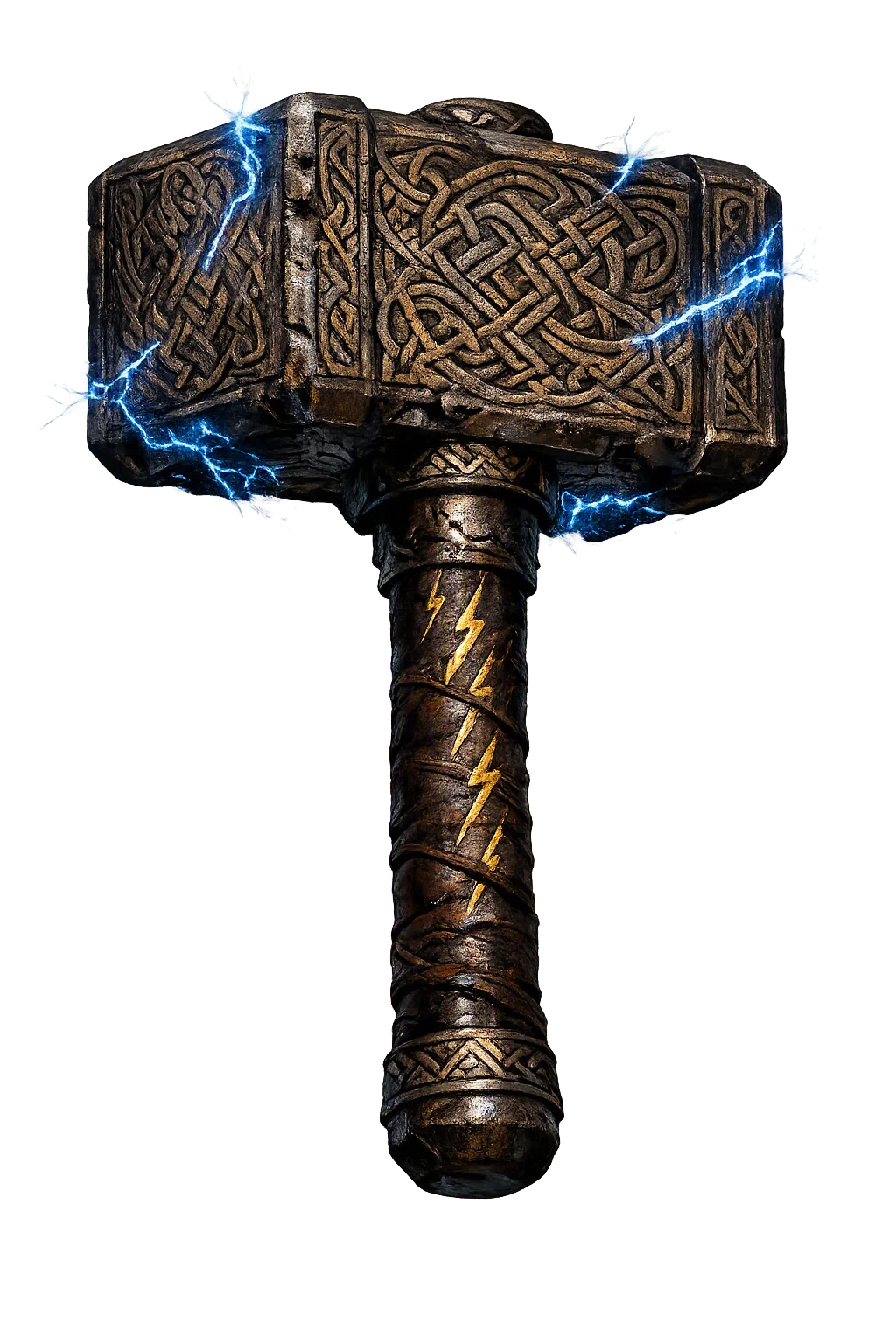
How Mjǫllnir was rebuilt, mark by mark
The workshop file for Mjǫllnir. Every rejected form is recorded here too — that is the point of keeping notes.
What We Found
The attestation runs through the tradition's own sources: ᛘᛁᚢᛚᚾᛁᚱ. Meaning: "The grinder".
The figure behind the name: Mjǫllnir is the most famous weapon in the northern world and the busiest: no other treasure of the gods both kills and consecrates.
What the Name Carried In
The Wager and the Short Haft. After Loki shears Sif's hair, he must replace it, and from the sons of Ívaldi he commissions hair of living gold, the ship Skíðblaðnir, and the spear Gungnir. Swaggering, he wagers his head with the dwarf Brokkr that Brokkr's brother Sindri cannot make three finer treasures.
The Hammer in the Bride's Lap. Þórr wakes one morning and the hammer is gone. Loki borrows Freyja's falcon-shape, flies to Jötunheimr, and hears Þrymr boast that he has buried Mjǫllnir eight leagues down — and that no one recovers it unless Freyja is brought to him as bride.
A spelling that has to carry stories like these is not a label. It is equipment.
Where It Stood Before Us
The hammer is one of the best-attested symbols of the Viking age. Around a thousand Mjǫllnir pendants in iron, silver, and amber have been unearthed across Scandinavia, England, northern Germany, the Baltic, and Russia — most simply made, about a hundred with ornament, and a tenth from graves, predominantly women's cremations; Jörn Staecker's typology (1999) and Katherine Beard's Eitri database (2019) order the material. Famous finds include the Rømersdal hammer from Bornholm, the gold-plated Bredsätra pendant from Öland, the Foss 'wolf-cross' from Iceland that reads as cross and hammer at once, and the Hiddensee gold treasure, where a hammer hangs among crosses. The Købelev hammer from Lolland (10th century) is the only one that names itself, inscribed in Younger Futhark 'hamar × is' — 'this is a hammer' — and the 11th-century Kvinneby copper amulet from Öland invokes Þórr's protection 'with his hammer' in runes. Thor's hammer is carved on runestones (DR 26, DR 48, DR 120, VG 113, Sö 86, Sö 111) and appears in the fishing scenes on the Altuna stone and at Gosforth; the small bronze Eyrarland figure from Iceland (c. AD 1000) may show the god gripping it. Textually, Þrymskviða and Lokasenna survive in the Codex Regius of the Poetic Edda (c. 1270), the forging and the hallowing of Baldr's pyre in the Prose Edda manuscripts, above all the Codex Regius GKS 2367 4to. The bench inherits all of it — the web temple is the newest site, not the first.
What We Rejected
The plain ASCII mjolnir — admissible as a fallback, never as the primary. A wrong accent would have been worse: the rulebook is explicit that a misplaced mark is worse than none.
What We Set Down
Mjǫllnir — The restoration preserves more than the ASCII form can express — stress, length, or a letter the Latin keyboard lost — which places it, mechanically, in Tier-1.
For the voice: 'MYAWL-lnir' — begin with the mj of 'music', sound the vowel like the short rounded 'o' of 'hot', and hold the ll double before the final '-nir'.
The temple stands at /mjolnir/ — the notes above are public in its Scholarly Edition, sources and all.
At a Glance
- Restored name: Mjǫllnir
- ASCII form: mjolnir
- Meaning: "The grinder"
- Domain of influence: Thunder Hammer
- Pantheon: Norse
- Classification: Tier 1
- Original script: ᛘᛁᚢᛚᚾᛁᚱ
- Series: The Restoration Files, No. 315 of 546
The File Continues
The temple's founding dispatch tells the name's story; its Resonance File reads the myths into the industries; the blog index holds the whole archive.
Continue the series — previous file: Mixcōātl (read it here) · next file: Mnēmosýnē (read it here).
The Restoration Files are written from the same canonical record as the temples themselves: the lexicon, the lore catalog, the pattern atlas, and the cited scholarly sources. If a file ever disagrees with its temple, the temple is right — tell us, and the file will be corrected.