
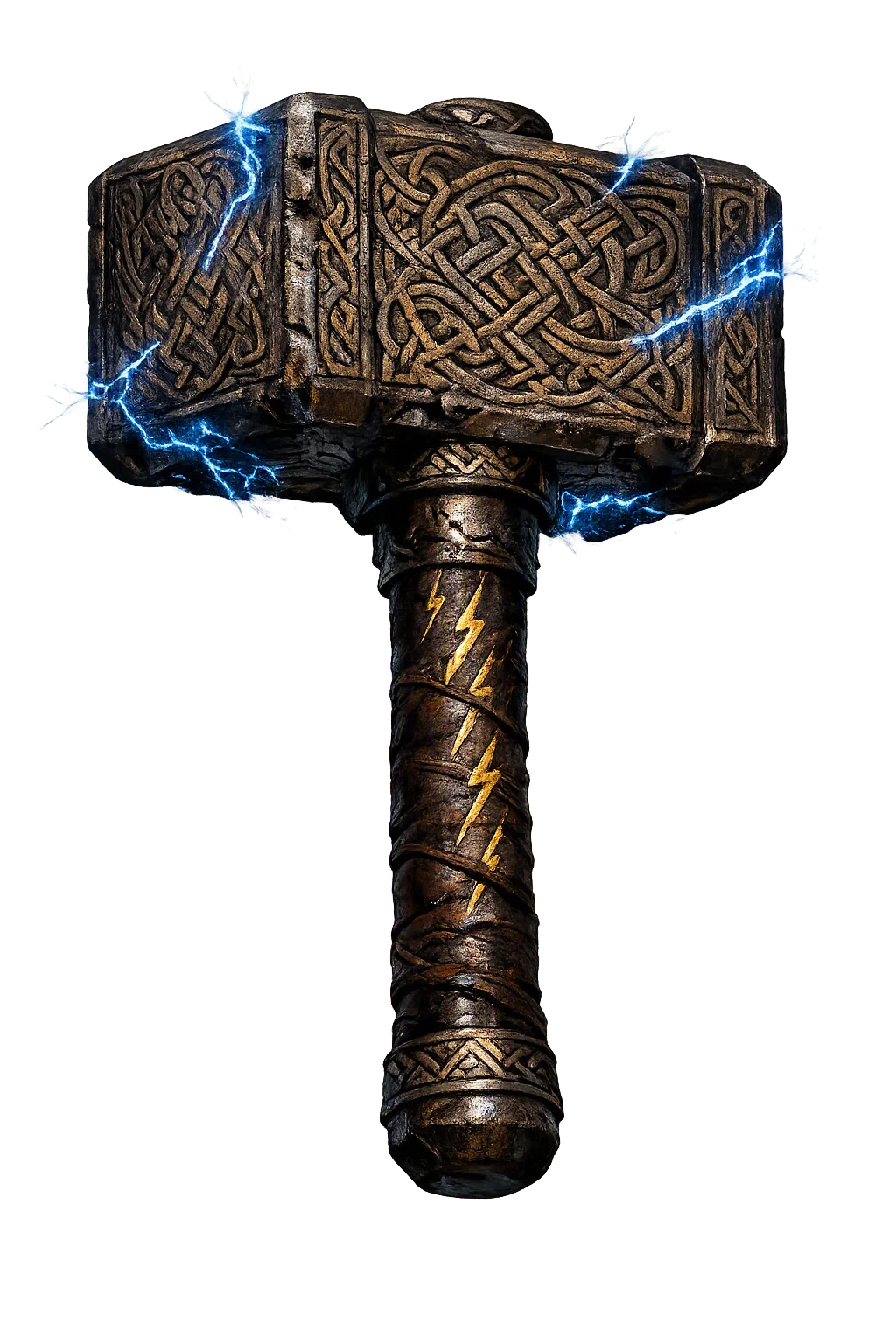
The appointments Mjǫllnir made — and who is keeping them
Take Mjǫllnir's stories in sequence. They are not episodes; they are appointments — and the modern trades are keeping them.
At a Glance
- Temple: Mjǫllnir
- Pantheon: Norse
- Domain of influence: Thunder Hammer
- Pattern seats: 4
- Sectors touched: Commerce & Governance · Home & Lifestyle · Culture & Entertainment · Technology & Innovation
- Strongest seat: Defense, Military & Security
- Series: The Resonance Files, No. 315 of 546
The Cycle, Read Forward
Defense, Military & Security — through The Wager and the Short Haft
After Loki shears Sif's hair, he must replace it, and from the sons of Ívaldi he commissions hair of living gold, the ship Skíðblaðnir, and the spear Gungnir. Swaggering, he wagers his head with the dwarf Brokkr that Brokkr's brother Sindri cannot make three finer treasures.
The atlas states the seat in one line: The weapon that defends Ásgarðr and Miðgarðr from the giants — the shield-wall of the worlds in a single hammer. The story above is the long version of the same sentence. That is the cycle working: story becomes duty, duty becomes trade.
Gems, Jewelry & Luxury Materials — through The Hammer in the Bride's Lap
Þórr wakes one morning and the hammer is gone. Loki borrows Freyja's falcon-shape, flies to Jötunheimr, and hears Þrymr boast that he has buried Mjǫllnir eight leagues down — and that no one recovers it unless Freyja is brought to him as bride.
The atlas states the seat in one line: The Þórr's-hammer amulet is the most-worn pendant of the Viking Age; archaeology recovers it by the thousand and jewelers cast it still. The story above is the long version of the same sentence. The trade thinks it is optimizing a process. It is re-enacting a charter.
Gaming, Fantasy & Entertainment IP — through Hrungnir and the Whetstone
The hammer's most dangerous duel came against the giant Hrungnir, who boasted in Asgard itself that he would kill all the gods, carry Freyja and Sif off to Jötunheimr, and drain the Æsir's ale. The gods sent for Þórr, and at the ford of Grjótúnagarðar the giant waited behind his stone shield, hurling his whetstone weapon.
The atlas states the seat in one line: The most famous weapon in modern mythic IP — Marvel's Mjolnir and God of War made the hammer a franchise logo. The story above is the long version of the same sentence. That is the cycle working: story becomes duty, duty becomes trade.
Manufacturing, Craft & Automation — through Hallowing Baldr's Pyre
When Baldr lies dead, the gods build his pyre on the ship Hringhorni, and the giantess Hyrrokkin, riding a wolf with vipers for reins, must be fetched to launch it. Baldr's wife Nanna dies of grief and is laid beside him.
The atlas states the seat in one line: Forged by the dwarfs Sindri and Brokkr — the masterwork of divine smithcraft, short handle and all. The story above is the long version of the same sentence. That is the cycle working: story becomes duty, duty becomes trade.
The Theme That Runs the Cycle
Mjǫllnir is the most famous weapon in the northern world and the busiest: no other treasure of the gods both kills and consecrates. Forged as the stake in one of Loki's wagers, it came out of Sindri's forge with a haft too short — and the gods judged it the best of all treasures anyway. The sources hand it four great stories: its flawed making, its theft, its duel, and its blessing of the dead god's pyre.
The Method, Stated Plainly
None of this is numerology. A seat exists only where the match can be argued from the deity’s documented domains and deeds — weighted, published, and falsifiable. The derivation, the weights, and the challenge process are public on the methodology page. If a seat in this file reads wrong, the atlas itself tells you how to prove it — and the correction becomes part of the record.
For the Ones Who Work There
If you work in defense, military & security, gems, jewelry & luxury materials, or any trade this temple holds a seat in, this is the honest version of what a placement means: your industry beside the story it has been re-telling all along — on the temple floor itself, before an audience that came specifically to read it. The patron tier and the advertising terms describe the mechanics; the resonance above describes the fit.
The File Continues
One of 546 Resonance Files — the series where the pantheon goes to work. Read the founding dispatch for the name, the Restoration File for the spelling, or the whole archive end to end.
Continue the series — previous: Mixcōātl (read it) · next: Mnēmosýnē (read it).
The Resonance Files are argued from the same canonical record as the pattern atlas itself: the lexicon, the lore catalog, and the cited sources. Every seat can be challenged at the methodology page — and the challenge is the point.