
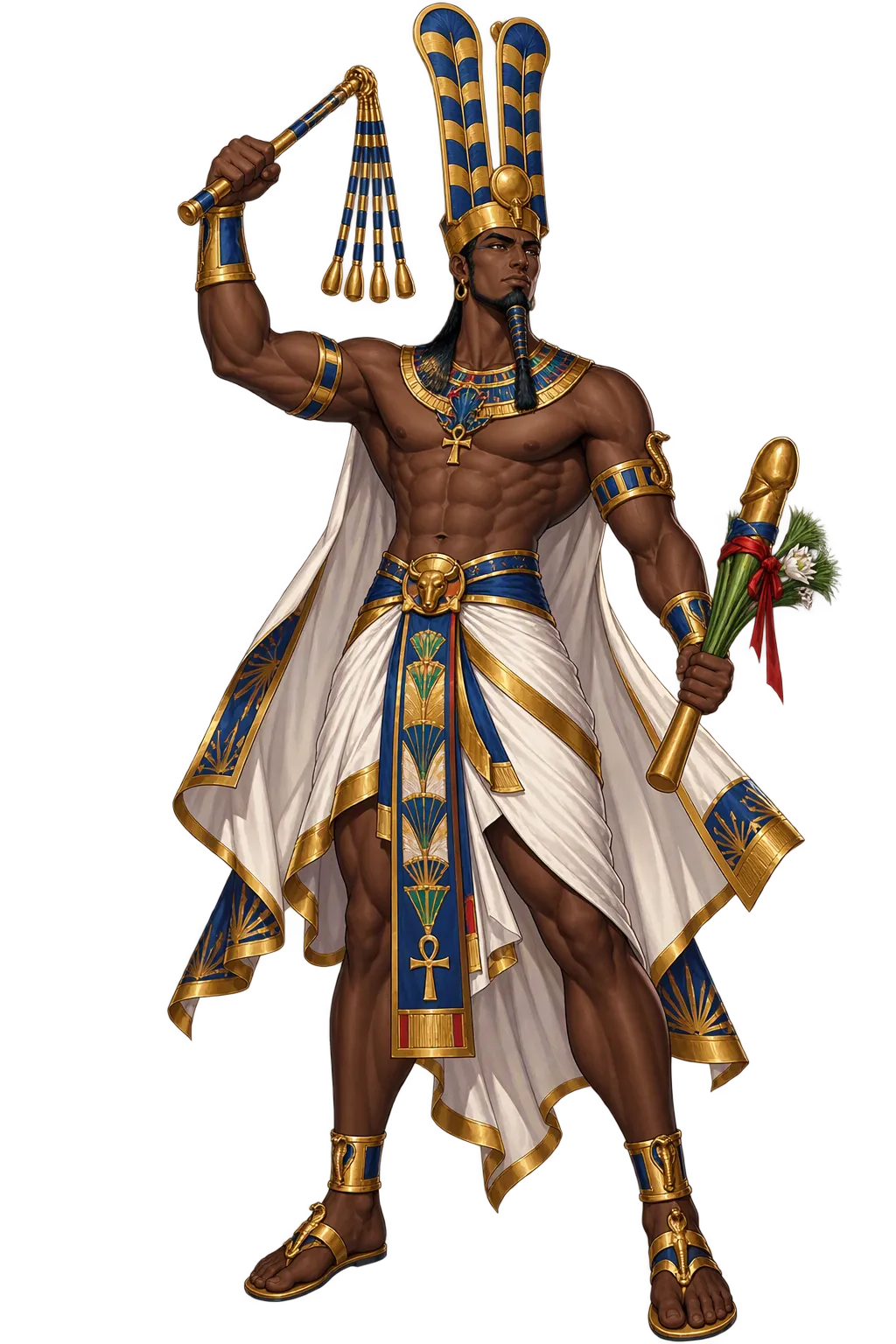
Stress-testing Mnw: do the industry seats hold?
Audit: Mnw, seat by seat. The atlas makes claims; the myths decide which ones stand. This is the record of what held.
At a Glance
- Temple: Mnw
- Pantheon: Egyptian
- Domain of influence: Fertility, Harvest
- Pattern seats: 4
- Sectors touched: Energy & Natural World · Home & Lifestyle · Commerce & Governance · Culture & Entertainment
- Strongest seat: Agriculture, Food & Harvest
- Series: The Resonance Files, No. 340 of 597
The Test
Seat 1: Agriculture, Food & Harvest
Claim: His harvest festival opens with the king cutting the first sheaf before Min's shrine — the first-sheaf rite's divine owner. Exhibit: Older Than the Kings — Min’s emblem appears on the artefacts of the late Predynastic — the famous Min-standard carved on the maceheads of King Scorpion and Narmer’s age.
Verdict: stands. Strip both to their function and the functions match.
Seat 2: Wedding, Family & Maternity
Claim: The fertility god of the harvest and the bed — generative power as festival and guarantee. Exhibit: The Procession at the Harvest — His great festival in the month of Shemu opened with the king cutting a sheaf of emmer — the ‘coming forth of Min’ from his shrine on the shoulders of his priests, carried to the acclaim of the crowd, followed by the ritual release of four wild birds to the four winds.
Verdict: survives scrutiny. The myth and the trade do the same work.
Seat 3: Defense, Military & Security
Claim: His epithets link him to military power — the desert-roads he guarded fed the pharaoh's campaigns. Exhibit: The Only People with a Pan — Herodotus describes Min’s procession at Chemmis — the carrying shrine, the phallic imagery — and concludes that the Egyptian Min is the original of the Greek Pan, the same god under two names.
Verdict: stands. Strip both to their function and the functions match.
Seat 4: Sports, Fitness & Competition
Claim: The potency and the procession — vitality as festival-contest. Exhibit: Older Than the Kings — Min’s emblem appears on the artefacts of the late Predynastic — the famous Min-standard carved on the maceheads of King Scorpion and Narmer’s age.
Verdict: stands. Strip both to their function and the functions match.
The Control Group
Against the seats that survived, one control: the temple's own summary of its figure — Min has no narrative myth-cycle; his ‘stories’ are the rituals that stage him — the processions, the erect phallus, the lettuce beds of his gardens — and the oldest continuous cult record of any Egyptian god. The seats do not drift far from it. That is the audit's cleanest result.
The Method, Stated Plainly
Skeptical? Good — the system is built for you. Every seat in this file carries its why-line and its weight, the full derivation is public at the methodology page, and the challenge process is part of the design. Falsifiable is not a posture here; it is the mechanism.
For the Ones Who Work There
For a sponsor in agriculture, food & harvest, the fit here is not adjacency — it is inheritance. Your trade already tells this story every working day; the temple simply holds the original. The patron tier and the advertising terms carry the mechanics; the myths above carry the reason.
The File Continues
This is one of 597 Resonance Files — the third dispatch from every flagship temple, where the myths meet the markets. The temple's founding dispatch tells the name's story; its Restoration File tells the spelling's; the blog index holds the whole archive.
Continue the series — previous: Midir (read it) · next: Mixcōātl (read it).
The Resonance Files are argued from the same canonical record as the pattern atlas itself: the lexicon, the lore catalog, and the cited sources. Every seat can be challenged at the methodology page — and the challenge is the point.