The Living Myth
Fertility, Harvest · Fertility, the Eastern Desert, Male Potency · The firm one
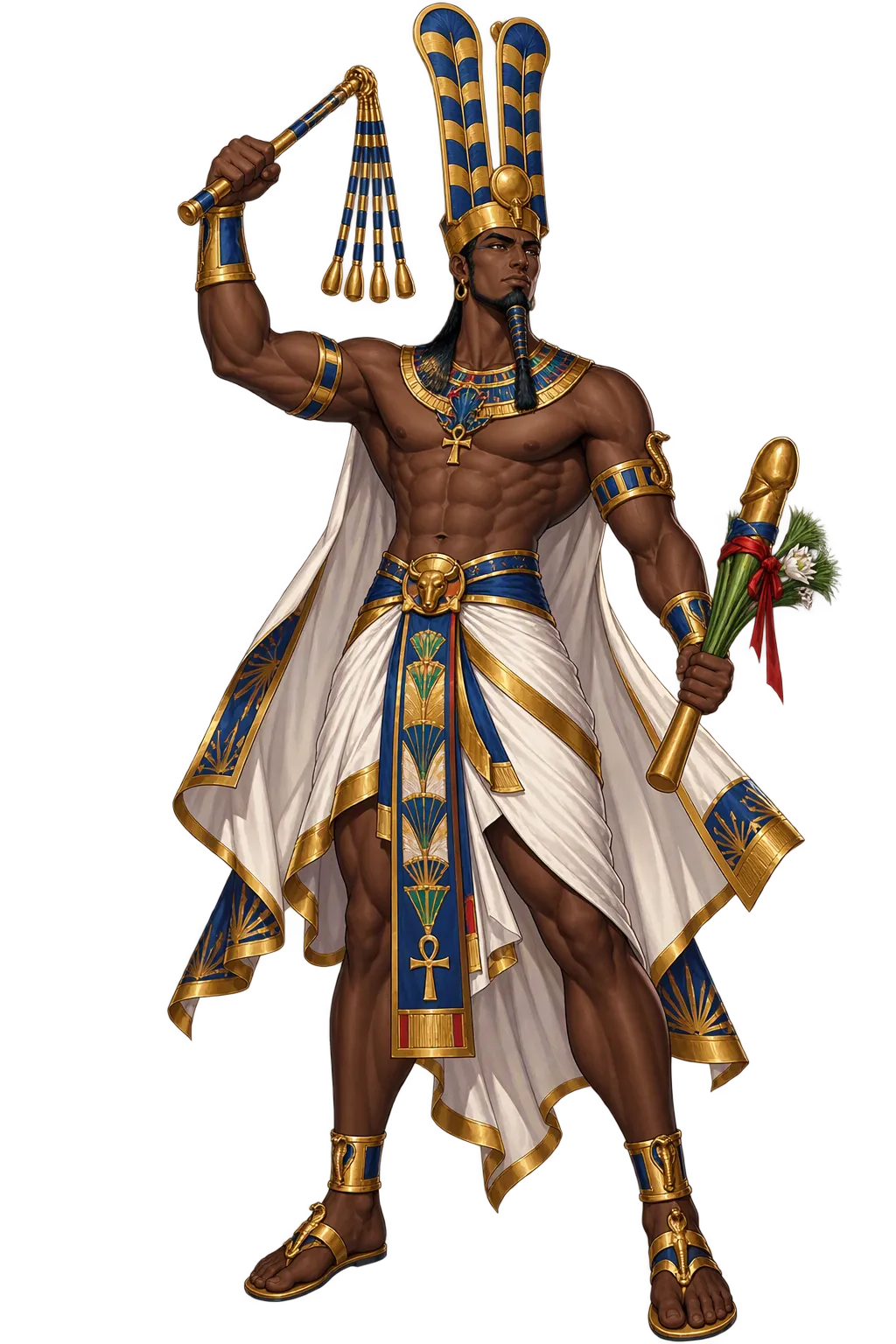
Stories of Mnw
Min has no narrative myth-cycle; his ‘stories’ are the rituals that stage him — the processions, the erect phallus, the lettuce beds of his gardens — and the oldest continuous cult record of any Egyptian god. His mythology is written in the calendar: his great festival closed the harvest and opened the desert’s travelling season.
Min’s emblem appears on the artefacts of the late Predynastic — the famous Min-standard carved on the maceheads of King Scorpion and Narmer’s age. Before Horus belonged to the king, Min belonged to the land: the lightning-rod, the ithyphallic pillar, the force that stood behind fertility itself.
His great festival in the month of Shemu opened with the king cutting a sheaf of emmer — the ‘coming forth of Min’ from his shrine on the shoulders of his priests, carried to the acclaim of the crowd, followed by the ritual release of four wild birds to the four winds. The rite married the harvest to virility: the cut grain and the standing god are one mystery.
Herodotus describes Min’s procession at Chemmis — the carrying shrine, the phallic imagery — and concludes that the Egyptian Min is the original of the Greek Pan, the same god under two names. It is the earliest comparative-religion argument in Western literature, and it was made about Min.
At Coptos he was paired with the lioness-goddess Repyt, ‘the Weary One’ who nonetheless endures; in the wider Osirian orbit his fertility stands behind Horus’ conception. In the Late Period his statue was carried to the graveyards to visit Osiris — the fertility god paying his respects to the dead one, generation greeting dissolution.
The Firm One, Lord of the Processions
Mnw — Min — is the lightning-rod god of male fertility: erect, flail raised, lettuce-crowned, lord of the desert roads to the Red Sea and of everything that stands firm. The Greeks saw Pan in him; the Egyptians saw the power that makes the land and its people endure — mn, the root of his name, means ‘to remain’.
His name is the verb “to be enduring”; he is the god of what stands fast — harvests, dynasties, erections.
Master of the eastern highlands and the routes to the Red Sea gold mines.
The lettuce — an aphrodisiac to the Egyptians — and the flail of the harvest belong to his iconography.
His festival raised his image on its litter in public procession — Egypt’s most ancient god-ritual.
From the original script to the living URL
𓀽
The name in its original Egyptian form. Mnw (𓀽) is attested in the source tradition — “The firm one”. Its original diacritics and script distinctions carry the full phonetic and orthographic weight of the source tradition.
min
The plain min form is identical to the Unicode restoration. Because this name is already written in Latin letters, no diacritics, stress, or script information were lost — only capitalization differs.
Mnw
The Unicode restoration does not need to recover lost marks for Mnw. Its value is canonical spelling and consistent cataloguing, not the reconstruction of erased orthography. The domain is readable as-is to both DNS and humanity.
Mnw.com
This restoration is written entirely in ASCII letters — no Punycode encoding stands between Mnw and the DNS. The domain reads identically to machines and to human eyes.
The attested spelling family of Mnw
Mnw
Restores 𓀽. The full Unicode restoration. mnw.com is not in the PuniCodex collection — it is watched for release; if it drops, this temple upgrades to an owned flagship. Attested by Faulkner, Wb.
How Mnw was spoken
How Mnw travels from ancient script to the modern URL
Egyptian Mnw; the original vocalisation is unknown. The god of fertility and the eastern desert, “the firm one".
The lore you have read is the living myth. Extended Lore opens the scholarly vault beneath it: the cult and its material remains, a history of the image, the name after antiquity, a meditation on what the name still means, and the full scholarly apparatus — etymology, orthography, sources.
Enter Extended Lore