
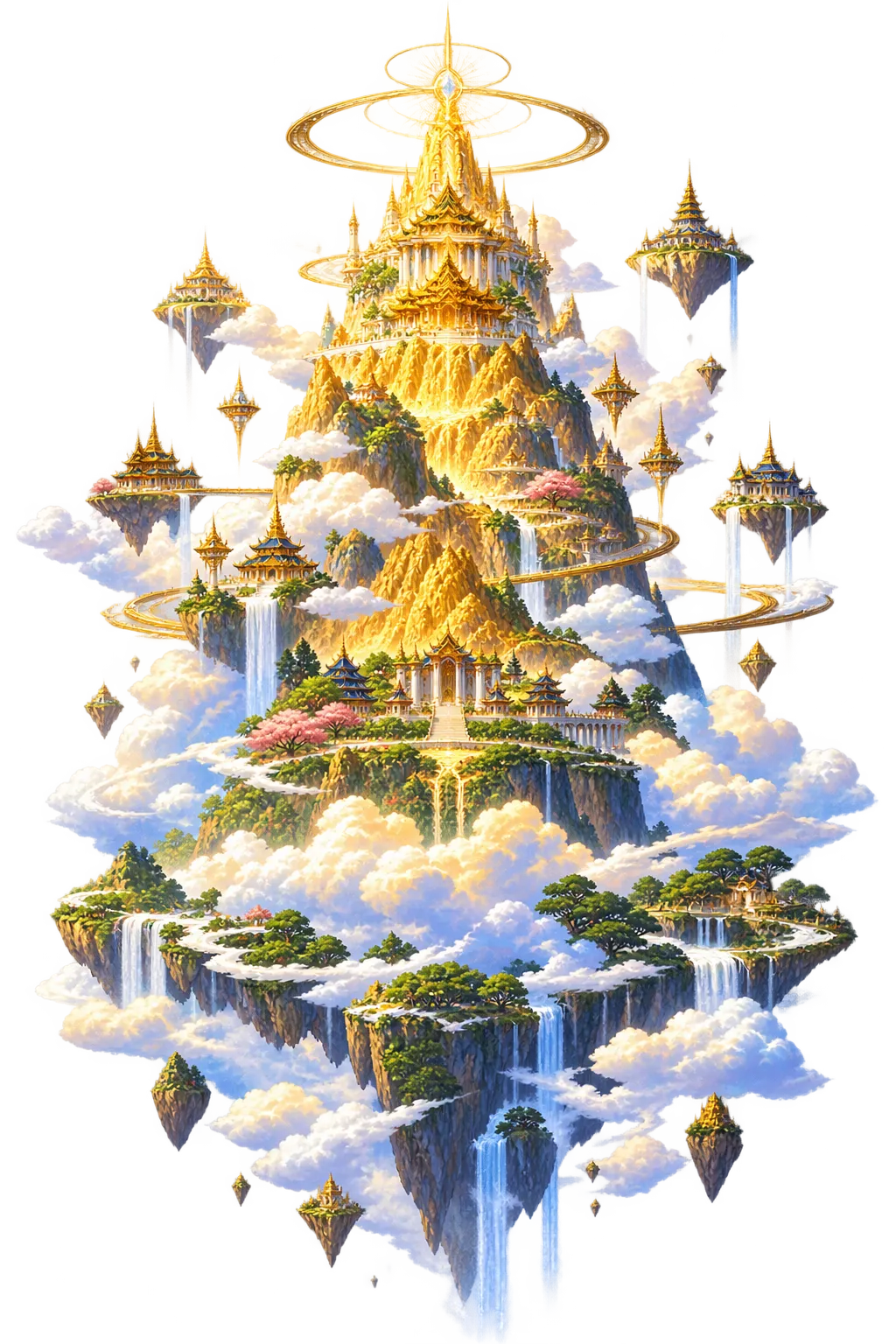
The appointments Meru made — and who is keeping them
The mistake is reading myths as entertainment. Meru's cycle reads more like a charter — each story assigning a duty the modern world still pays for.
At a Glance
- Temple: Meru
- Pantheon: Sanskrit
- Domain of influence: Cosmic Mountain, Axis Mundi
- Pattern seats: 3
- Sectors touched: Technology & Innovation · Home & Lifestyle
- Strongest seat: Mapping & Geospatial
- Series: The Resonance Files, No. 334 of 597
The Cycle, Read Forward
Mapping & Geospatial — through The Mountain of Measure
The Purāṇas give Meru its statistics: 84,000 leagues high, its base 32,000 across, its summit the square of the gods’ city. The sun’s horses, tired from circling it, rest at night on its western face; the moon’s waxing is the gods’ drinking of the lunar soma on its terraces.
The atlas states the seat in one line: The centre of every cosmological map — the mandala is geography's oldest projection. The story above is the long version of the same sentence. That is the cycle working: story becomes duty, duty becomes trade.
Space, Astronomy & Celestial Science — through The River’s First Fall
When Bhagīratha won the Ganges’ descent for his burned ancestors, the river fell first from heaven onto the matted hair of Śiva — and before that, the tradition adds, upon Meru’s summit, where the gods’ gardens divided her into the seven streams. Meru is the river’s first landing, heaven’s customs-house.
The atlas states the seat in one line: The axis mountain around which sun, moon, and planets revolve — the cosmos's first orrery. The story above is the long version of the same sentence. That is the cycle working: story becomes duty, duty becomes trade.
Architecture & Spatial Design — through The Mountain Diagrammed
The Buddhist and Hindu maṇḍala is Meru flattened into a map: the square’s four gates are its faces, the inner palace the summit’s city, the concentric rings its seven world-encircling ranges. To construct a mandala is to rebuild Meru; to enter it is to climb.
The atlas states the seat in one line: Every mandala and temple-mountain is Meru in plan — sacred architecture's cosmographic source. The story above is the long version of the same sentence. That is the cycle working: story becomes duty, duty becomes trade.
The Theme That Runs the Cycle
Meru’s mythology is cosmography — the mountain’s biography is the world’s architecture. It rises from the centre of Jambudvīpa, the rose-apple continent; the sun’s chariot circles it daily; the Ganges falls first on its summit and only then to the earth; and the gods’ wars are fought on its terraces. The Purāṇic geographies measure all distance from its base.
The Method, Stated Plainly
Skeptical? Good — the system is built for you. Every seat in this file carries its why-line and its weight, the full derivation is public at the methodology page, and the challenge process is part of the design. Falsifiable is not a posture here; it is the mechanism.
For the Ones Who Work There
If you work in mapping & geospatial, space, astronomy & celestial science, or any trade this temple holds a seat in, this is the honest version of what a placement means: your industry beside the story it has been re-telling all along — on the temple floor itself, before an audience that came specifically to read it. The patron tier and the advertising terms describe the mechanics; the resonance above describes the fit.
The File Continues
One of 597 Resonance Files — the series where the pantheon goes to work. Read the founding dispatch for the name, the Restoration File for the spelling, or the whole archive end to end.
Continue the series — previous: Mèngpó (read it) · next: Metztli (read it).
The Resonance Files are argued from the same canonical record as the pattern atlas itself: the lexicon, the lore catalog, and the cited sources. Every seat can be challenged at the methodology page — and the challenge is the point.