
The Cult
No separate cult — every cosmological rite is his. The consecration of a stupa ‘plants Meru’; the temple’s foundation deposits place the mountain under the god’s throne. The circumambulation of any sacred centre is its summit-walk.
Extended Lore
Etymology · Orthography · Cult · Iconography · Reception · Sources
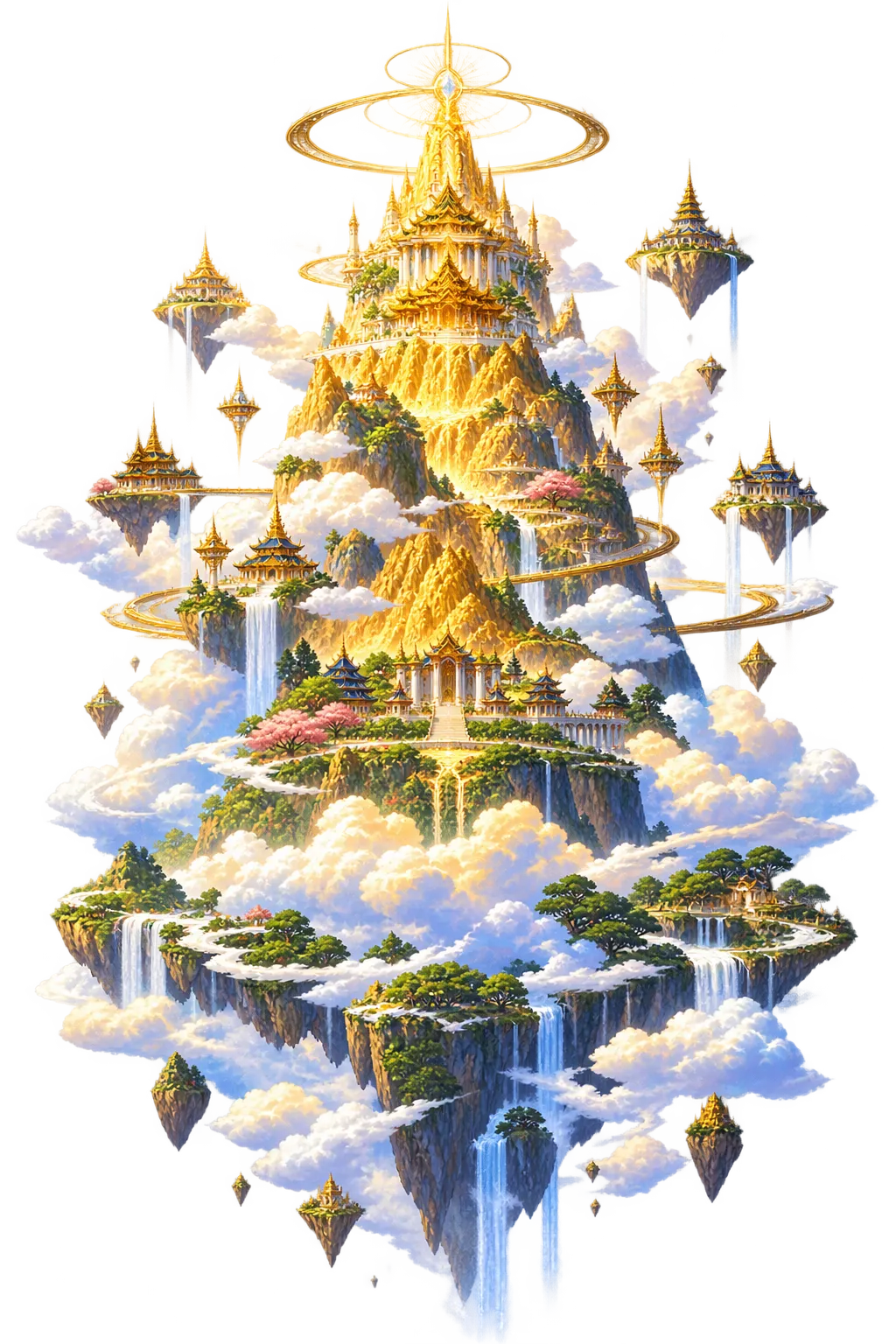
Essential information about Meru, Cosmic Mountain, Axis Mundi
From original script to Unicode restoration
The name Meru reaches the modern world through scholarly transliteration of the sanskrit tradition. Because the conventional spelling uses only Latin letters, its Unicode and ASCII forms coincide — the tradition it carries is in the name itself, not in diacritics.
Character-by-character philological analysis
| Character | Unicode | Name | Block | Phonetic Role |
|---|---|---|---|---|
| M | U+004D | Latin Capital Letter M | Basic Latin | Same, capitalized |
| e | U+0065 | Latin Small Letter E | Basic Latin | Same |
| r | U+0072 | Latin Small Letter R | Basic Latin | Same |
| u | U+0075 | Latin Small Letter U | Basic Latin | Same |
This restoration reflects fidelity to the attested tradition, not recovered diacritics: every character of Meru already survives in ASCII. What the restoration preserves is the canonical spelling itself — the form scholarship standardised.
How the sacred was kept — rites, sanctuaries, remains
No separate cult — every cosmological rite is his. The consecration of a stupa ‘plants Meru’; the temple’s foundation deposits place the mountain under the god’s throne. The circumambulation of any sacred centre is its summit-walk.
Meru’s monuments are every stupa and pagoda — the Borobudur terraces walk the pilgrim up Sumeru; the temple mountains of Angkor are Meru in sandstone. The maṇḍala-paintings of Tibet diagram it ten thousand times.
How Meru was imaged across the ages
The stepped pyramid-mountain, four-faced and jewel-coloured, crowned by Indra’s palace or the thousand-armed deity; or the square mandala with its four gates. The stupa’s harmikā tower is Meru’s tip in portable form.
The name after its own age — transmission, translation, survival
History of science studies Meru as the ancient world’s most influential cosmic model — the flat-earth cosmography’s greatest rival, and the template of every Asian sacred building. The pagoda’s archaeology is, in one reading, nothing but Meru’s long migration east.
Meru is shared property: Hindu Meru, Buddhist Sumeru, Jain Meru of the madhyaloka. The Greeks of Bactria heard Olympus in it; and the East Asian Buddhist cosmologies drew Sumeru as the world’s spike on temple banners from Java to Japan. The mountain out-religioned every religion that mapped it.
Every mandala, stupa, and temple plan is a Meru; the prayer-wheel’s axis and the pagoda’s spire are its hardware. ‘Sumeru’ and ‘Meru’ entered the names of a thousand monasteries and mountains — and travellers to the real Himalaya argued for centuries which peak the geographers had meant.
What Meru means — beyond the dictionary
Meru: the name of the centre, restored at the centre of a plain line of letters. It needs no diacritic — the mountain carries its own height, and every reader’s eye climbs it. Two syllables, eighty-four thousand leagues.
Common questions about Meru, Cosmic Mountain, Axis Mundi, and Unicode restoration
In reconstructed pronunciation, Meru is /ˈmɛruː/ — approximately “MEH-roo”.
Meru means Name of a fabulous mountain — the central point of Jambūdvīpa, round which the sun, moon and planets revolve; the Olympus of Hindu mythology and abode of the gods. in the sanskrit tradition.
Meru is associated with The Axis (The world turns on Meru; the pole star wheels above its summit as the heavens’ nail-head.), The Four Faces (Gold to the east, crystal south, ruby west, lapis north — the four colours of the mandala.), City of the Gods (Indra’s Amarāvatī crowns the summit; the thirty-three gods feast in its halls.), The Mandala’s Map (Every maṇḍala diagrams Meru: centre, four gates, and the enclosing world-rings.).
Meru is written entirely in ASCII letters, so its restoration is about canonical fidelity rather than recovered diacritics: the temple fixes the name in its scholarly standard spelling, attested in the source tradition, instead of leaving it to drift.
“The Mountain of Measure” — the Purāṇic Cosmography story that anchors the mythology of Meru, told in full on the lore page.
The philological foundations of this restoration
Every claim on this page is grounded in established scholarship. The orthographic restorations follow disciplinary convention. The etymological chain follows the best available reference works. This is not invention — it is resurrection through scholarship.
You have traced the name from its earliest attestation to its Unicode restoration. Now return to the myth. The story is where the name lives.
Back to Lore