The Living Myth
Cosmic Mountain, Axis Mundi · The Axis Mountain, Olympus of the Hindus · Name of a fabulous mountain — the central point of Jambūdvīpa, round which the sun, moon and planets revolve
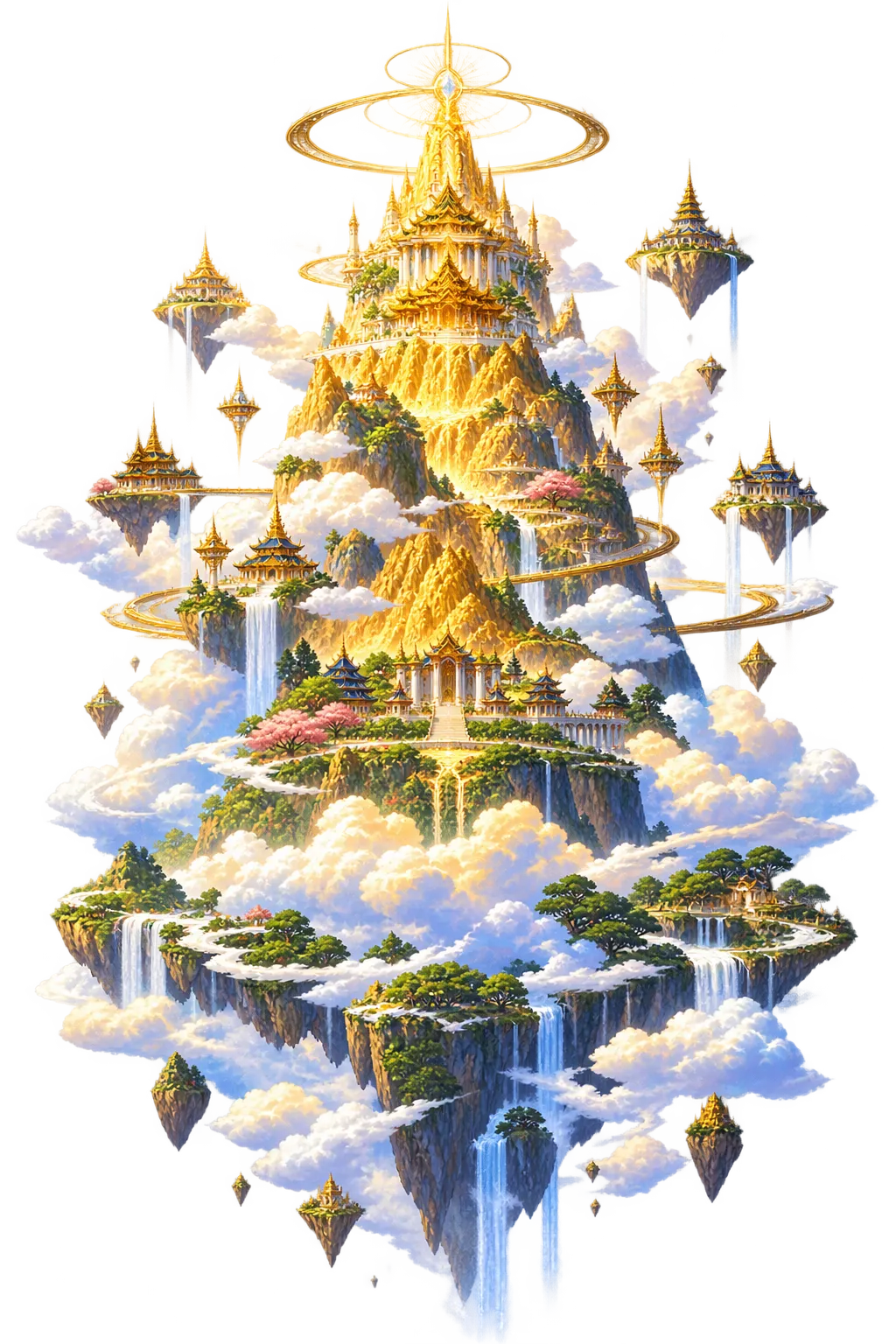
Stories of Meru
Meru’s mythology is cosmography — the mountain’s biography is the world’s architecture. It rises from the centre of Jambudvīpa, the rose-apple continent; the sun’s chariot circles it daily; the Ganges falls first on its summit and only then to the earth; and the gods’ wars are fought on its terraces. The Purāṇic geographies measure all distance from its base.
The Purāṇas give Meru its statistics: 84,000 leagues high, its base 32,000 across, its summit the square of the gods’ city. The sun’s horses, tired from circling it, rest at night on its western face; the moon’s waxing is the gods’ drinking of the lunar soma on its terraces. The mountain is the cosmos’s clock, scale, and sceptre.
When Bhagīratha won the Ganges’ descent for his burned ancestors, the river fell first from heaven onto the matted hair of Śiva — and before that, the tradition adds, upon Meru’s summit, where the gods’ gardens divided her into the seven streams. Meru is the river’s first landing, heaven’s customs-house.
The Buddhist and Hindu maṇḍala is Meru flattened into a map: the square’s four gates are its faces, the inner palace the summit’s city, the concentric rings its seven world-encircling ranges. To construct a mandala is to rebuild Meru; to enter it is to climb. The Vajrayāna made the diagram the path itself.
When the gods and demons churned the ocean of milk, the churning-rod was Mandara, Meru’s little brother of a mountain; the serpent Vāsuki the rope. Meru’s family thus supplied the axis of the gods’ greatest work — the axis-mountain’s line, lending itself to every cosmic rotation.
The Centre of the World
Meru is the world’s axle: the golden mountain at the centre of the cosmos, around which the sun, moon, and planets revolve, on whose summit Indra’s city stands, and whose four faces of gold, crystal, ruby, and lapis feed the four great rivers of the directions. Every Indian cosmology — Hindu, Buddhist, Jain — puts Meru in the middle; every mandala is its plan.
The world turns on Meru; the pole star wheels above its summit as the heavens’ nail-head.
Gold to the east, crystal south, ruby west, lapis north — the four colours of the mandala.
Indra’s Amarāvatī crowns the summit; the thirty-three gods feast in its halls.
Every maṇḍala diagrams Meru: centre, four gates, and the enclosing world-rings.
From the original script to the living URL
मेरु
The name in its original Sanskrit form. Meru (मेरु) is attested in the source tradition — “Name of a fabulous mountain — the central point of Jambūdvīpa, round which the sun, moon and planets revolve; the Olympus of Hindu mythology and abode of the gods.”. Its original diacritics and script distinctions carry the full phonetic and orthographic weight of the source tradition.
meru
The plain meru form is identical to the Unicode restoration. Because this name is already written in Latin letters, no diacritics, stress, or script information were lost — only capitalization differs.
Meru
The Unicode restoration does not need to recover lost marks for Meru. Its value is canonical spelling and consistent cataloguing, not the reconstruction of erased orthography. The domain is readable as-is to both DNS and humanity.
Meru.com
This restoration is written entirely in ASCII letters — no Punycode encoding stands between Meru and the DNS. The domain reads identically to machines and to human eyes.
The attested spelling family of Meru
Meru
Restores मेरु. The full Unicode restoration. meru.com is not in the PuniCodex collection — it is watched for release; if it drops, this temple upgrades to an owned flagship. Attested by MW, Puranas.
How Meru was spoken
How Meru travels from ancient script to the modern URL
The lore you have read is the living myth. Extended Lore opens the scholarly vault beneath it: the cult and its material remains, a history of the image, the name after antiquity, a meditation on what the name still means, and the full scholarly apparatus — etymology, orthography, sources.
Enter Extended Lore