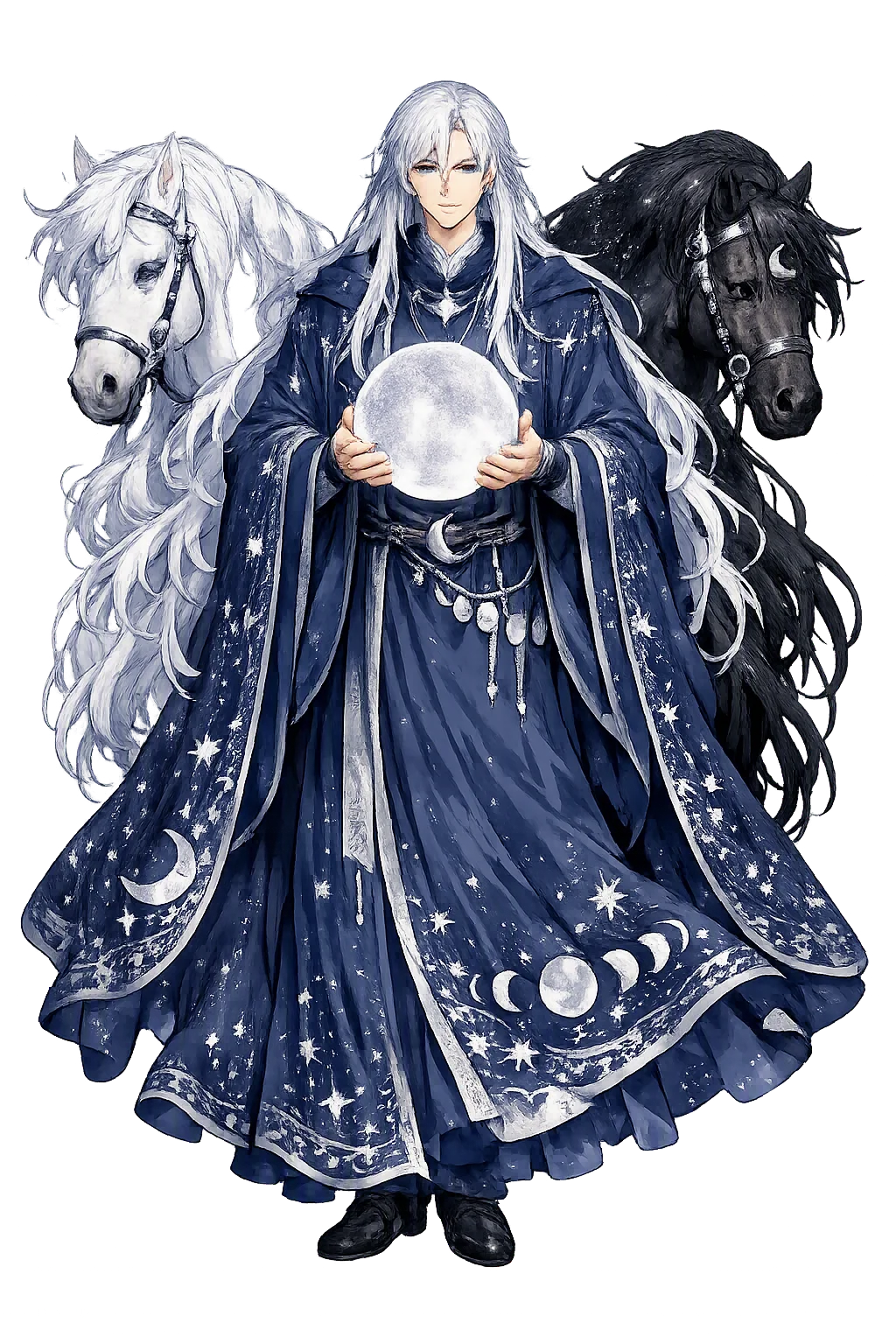
Stories of Máni
Máni's mythology is brief but exact: he has no hammer-duels and no disguises, only a course to keep and a hunter behind him. The Eddas give him four scenes — a father's fatal boast, the breeding of the wolf that hunts him, two children lifted from a well, and the swallowing that ends the sky — and together they explain both why the moon moves and why it keeps its human face.
In the Vafþrúðnismál, the giant Vafþrúðnir tells Óðinn that Mundilfari is the father of Máni and of Sól alike. Snorri, in Gylfaginning (ch. 11), gives the story its edge: Mundilfari's two children were so fair that he named his son Máni, 'Moon', and his daughter Sól, 'Sun', and married Sól to a man named Glenr. The gods were angered by this ofdramb — this overweening pride — and took the siblings and set them in the heavens.
The punishment is an appointment. Sól is made to drive the horses of the sun, Árvakr and Alsviðr, while Máni is charged with steering the course of the moon and ruling its waxing and waning. What a father claimed in arrogance, the gods confirmed in office: the names became the duties, and the children became the sky. The myth is the Eddas' quiet essay on vanity — the one boast the gods could not leave unpunished was a claim of ownership over light.
Why does the moon flee? Because something was bred to chase it. Snorri preserves the genealogy (Gylfaginning, ch. 12): east of Midgard, in the forest called Járnviðr — Iron Wood — a giantess in troll-woman's shape bore a brood of giant sons in wolf forms, and from that pack come the wolves that hunt the lights. Two of them the Æsir caught and set to their courses: Skǫll runs after the sun, and Hati Hróðvitnisson runs before the moon, and he will catch it — so it must be. The Grímnismál names them in verse: Skǫll follows the shining god, while Hati, Hróðvitnir's son, runs before the bright bride of heaven (st. 39). And the brood is not finished: from the same Iron Wood, Snorri says, will come the mightiest of all, Mánagarmr, the Moon-Hound, who feeds on the lives of the dead; the Vǫluspá laments the coming tormentor in a troll's shape (st. 40). The myth makes the night sky a battlefield of kinship: the lights of heaven are pursued by the children of the giantess, and Máni's speed is the speed of survival.
The moon does not drift; it flees. Snorri explains the physics by the hunter: the wolves run with the lights of heaven, and Hati Hróðvitnisson is the one who runs before the moon and means to take it — and so it will come to pass (Gylfaginning, ch. 12). From earth, men watching the moon hurry across a winter sky believed the wolf was near; the chase is the Eddic explanation of lunar speed, and of eclipses, when the hound closed its jaws for a moment and the world held its breath.
The chase has an ending, and the Eddas do not flinch from it. At Ragnarǫk the Moon-Hound Mánagarmr — fed all his life on the blood of the dying — swallows the moon whole and spatters the sky and the air with blood, so that the sun itself loses its shining and the stars are shaken from the heavens. The image is exact and terrible: time, which Máni measures, is also time, which is eaten. Every month closes because the wolf behind it is a month closer.
Snorri records that Máni took two children up from the earth, Bil and Hjúki, as they walked from the well called Byrgir, carrying on their shoulders the pail Sægr — often read as a mead-tub — slung from the pole Simul. Their father is named Viðfinnr. 'These children follow Máni,' Snorri adds, 'as can be seen from earth': look at the moon and you will find them there.
This is the Norse answer to the man in the moon — not a face but two small figures under a burden, fixed forever in mid-errand. The detail of the well, the pail, and the pole is too homely to be invented ornament; it reads as the residue of nursery-lore older than the manuscript, the kind of story told to children who had already been shown the markings in the moon. Scholars have sometimes linked the pair to the Jack and Jill of English rhyme, but that connection is modern speculation, not attestation. What the myth insists on is gentler: the moon-god's company is not warriors but errand-bearers, and the sky remembers two children on their way home from water.
The domain of Máni
In the Norse tradition, Máni is the moon itself made personal — the shining body that crosses the night sky, imagined as a god who steers it. Where Sól, his sister, drives the sun, Máni governs the gentler light: Snorri says he 'steers the course of the moon and rules the new and the waning moons,' the phases by which men first learned to count their days. Every month that turns is his signature: mánaðr, 'month', is his own word, and Monday is his day.
A father's pride named his children Moon and Sun; the gods answered the boast by setting the pair to drive the lights of heaven.
The wolf Hati Hróðvitnisson runs before the moon and will one day take it; at Ragnarǫk the Moon-Hound swallows the light and spatters the sky with blood.
Two children with a pail on a pole, taken up from the well Byrgir; they follow Máni, Snorri says, 'as can be seen from earth' — the man in the moon.
He rules the new and waning moons, the counting of time itself; mánaðr, 'month', is his word, and the calendar was his first temple.
From the original script to the living URL
ᛘᛅᚾᛁ
The name in its original Norse form. Máni (ᛘᛅᚾᛁ) is attested in the source tradition — “Moon (the personified moon, brother of Sól)”. Its acute stress marks carry the full phonetic and orthographic weight of the source tradition.
mani
Reduced to plain mani, the name loses everything that made it specific: acute stress marks. What remains is an ASCII string that machines can parse but that no longer speaks with its original voice.
Máni
The Unicode restoration recovers what ASCII flattened. Máni restores acute stress marks, returning the name to its original written dignity. The domain encodes to Punycode, but the browser displays the truth.
Máni.com → xn--mni-ela.com
The non-ASCII characters in Máni are encoded while the ASCII remains visible. To the DNS, it is Punycode. To humanity, it is Máni.
Owned, ideal, and ASCII forms of Máni
Máni
Restores ᛘᛅᚾᛁ. The live temple domain — máni.com.
mani
Flattens ᛘᛅᚾᛁ. The plain ASCII fallback — what DNS and legacy systems see.
How Máni was spoken
How Máni travels from ancient script to the modern URL
The lore you have read is the living myth. Extended Lore opens the scholarly vault beneath it: the cult and its material remains, a history of the image, the name after antiquity, a meditation on what the name still means, and the full scholarly apparatus — etymology, orthography, sources.
Enter Extended Lore