PuniCodex

Extended Lore

ᛘᛅᚾᛁ Máni

Etymology · Orthography · Cult · Iconography · Reception · Sources

Tier 1 Máni.com
Máni — Moon, Night, Time
01

Quick Facts

Essential information about Máni, Moon, Night, Time

Original Scriptᛘᛅᚾᛁ
Unicode RestorationMáni
Reconstructed Pronunciation/ˈmɑːni/
PantheonNorse
DomainMoon, Night, Time
MeaningMoon (the personified moon, brother of Sól)
ClassificationTier 1
Primary DomainMáni.com
Sacred SymbolsNý ok nið (new and waning moons), Hati Hróðvitnisson, Mánagarmr (Moon-Hound), Sægr and Simul (pail and pole), The month-mark
02

Etymology & Word Family

From original script to Unicode restoration

Original Script ᛘᛅᚾᛁ Máni — "Moon (the personified moon, brother of Sól)"
Unicode Restoration Máni Restored stress, length, and script
Modern ASCII mani Plain-ASCII fallback

The name Máni carries the orthographic signature of the norse tradition: ᛘᛅᚾᛁ. Unicode restoration recovers what ASCII flattens.

03

Unicode Character Breakdown

Character-by-character philological analysis

CharacterUnicodeNameBlockPhonetic Role
MU+004DLatin Capital Letter MBasic LatinSame, capitalized
áU+00E1Latin Small Letter A with AcuteLatin-1 SupplementAcute on a
nU+006ELatin Small Letter NBasic LatinSame
iU+0069Latin Small Letter IBasic LatinSame

The Tier 1 classification reflects how much of the original phonology this restoration preserves — stress and vowel length for Greek names, distinctive letters and diacritics for every other tradition.

04

Cult & Worship

How the sacred was kept — rites, sanctuaries, remains

The Cult

No cult of Máni is attested anywhere in the sources, and honesty forbids inventing one. No sanctuary names him, no festival calendar marks his days, no priesthood and no votive deposit is his. What the tradition gives instead is a god of exactly one rite: the monthly count itself. Mánaðr, the month, is his word, and Snorri's charge that he 'rules the new and the waning moons' makes every new moon his sign. The runic inscriptions know the common noun but never address the god, and the Gotland picture stones show the moon as a disc beside the sun-wheel — an emblem, never a person at a rite. The nearest thing to worship the record preserves is calendrical: the moon watched, the month named, the reckoning of meetings and tides pegged to his light. Modern heathen observance that hails Máni at the month's turn is a revival built on that calendrical logic, not the survival of any ancient feast.

In the Earth

Máni has no secure iconography: no picture stone, runestone, or amulet has been convincingly identified as his image, and his attestation is essentially textual. The Poetic Edda poems that name him — Vafþrúðnismál, Grímnismál, and Vǫluspá — survive chiefly in the Codex Regius (GKS 2365 4to, c. 1270), with Vǫluspá also in the Hauksbók; Snorri's account in Gylfaginning is transmitted by the main Snorra Edda manuscripts. The older strata of Scandinavian sky-religion are, however, material: the Bronze Age Trundholm sun chariot (c. 1400 BC) proves a native tradition of a heavenly body drawn by horse across the sky, and wheel- and disc-marked Gotland picture stones show the sun and moon as enduring cultic signs. The runic record knows the common noun máni and the month-names descended from it, but no runic inscription names the god directly.

05

Iconography

How Máni was imaged across the ages

The Image

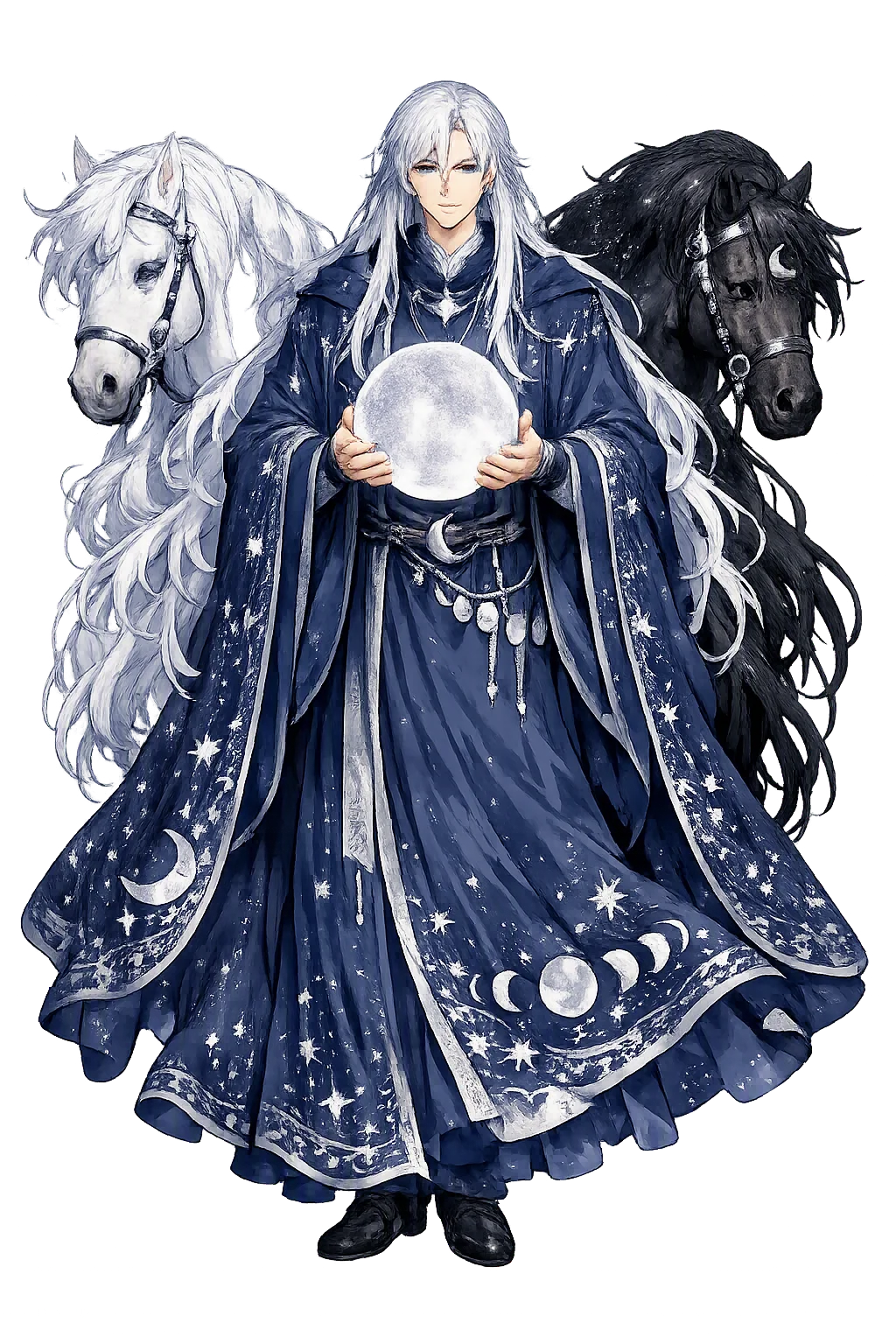
Máni was never given a body the way Þórr and Óðinn were. No picture stone, runestone, or amulet has been securely read as his portrait; the moon reaches the Viking-Age image-repertoire only as a symbol — the small disc or crescent set beside the sun-wheel on the Gotland picture stones, where both lights attend the ships. The texts, however, hand him a precise imagined physiognomy: the face in the moon is Bil and Hjúki, the two children carried from the well Byrgir with the pail Sægr on the pole Simul — Snorri's reading of the lunar markings, and the oldest written 'man in the moon' on record. Later art fills the gap with convention: when nineteenth-century illustrators drew him, they drew a pale charioteer borrowed wholesale from classical Selene, an image with no medieval warrant. His true attributes are all textual — the steered course, the pursuing wolf, the pail and pole on the face.

06

Reception & Transformation

The name after its own age — transmission, translation, survival

Afterlives

Máni's afterlife is the story of a god who became a word. The manuscripts carried him quietly: the Vafþrúðnismál and Grímnismál stanzas in the Codex Regius, Snorri's tidy prose chapters, preserved through the Icelandic book-trade and published with the Eddas from the seventeenth century onward. The nineteenth century's comparative philologists made him a case-study: here was proof that the Germanic peoples had kept the Proto-Indo-European masculine moon where Greece and Rome made it feminine, and the evidence was grammatical — Mōna, Māno, máni — across every daughter language. Grimm treated the moon-god at length in Deutsche Mythologie, and the great dictionaries, from Cleasby–Vigfusson to the Oxford English Dictionary, recorded the kinship of moon and month as his inheritance. The folklorists traced the 'man in the moon' of English ballad and nursery rhyme back through Snorri's two children to a Germanic reading of the sky. He remains in modern Icelandic simply máni, the everyday word — and in every month and every Monday spoken in the Germanic world, the most complete survival any Norse god can claim.

Identifications Across Traditions

Máni belongs to the common Germanic inheritance in which the moon is grammatically and mythologically masculine — Old English Mōna, Old High German Māno, Gothic mēna — a striking counterweight to the feminine moons of the classical world, Greek Selēnē and Latin Luna. The word itself runs deeper: Proto-Indo-European *mḗh₁nōt- / *mḗh₁n̥s meant both 'moon' and 'month', the double sense Máni still carries in mánaðr, so that his personification is the personification of time-reckoning itself. The pairing of a moon-god with a sun-goddess, brother and sister, is the Germanic reversal of the Greek Selene and Helios pattern, though the daily celestial chase — light pursued by devourer — has echoes from the wolves of Ragnarǫk back to the eclipse-monsters of other traditions. The liveliest survival is folkloric: the Norse reading of the moon's markings as two children with a pail stands at the head of the whole northern 'man in the moon' tradition that later fills English ballads and nursery rhymes, and the tempting equation of Hjúki and Bil with Jack and Jill has been argued since the nineteenth century — as speculation, never as proof.

Modern Legacy

Máni's deepest legacy is calendrical: every month and every Monday in the Germanic-speaking world is his, for Mōnandæg and its Norse kin are simply the moon's day, and the words descend from his name. In literature his clearest heir is Tolkien's Tilion, the Maia who steers the vessel of the moon across the sky — the personified moon-driver of the Eddas translated into a new mythology. Notably, Wagner left him out: the Ring runs on gold, fire, and Wotan's will, and the moon-driver never steps onto that stage, a measure of how thin Máni's high-cultural afterlife is beside Þórr's or Óðinn's. The chase around him fares better: the pursuing wolves Skǫll and Hati stalk recent retellings, including God of War Ragnarök (2022), where the stolen moon and its hunters drive a whole arc of the story. And the oldest survival is still the most democratic — the face and figures people point out to children in the full moon, which Snorri already explained by Bil and Hjúki eight centuries ago. In modern heathenry Máni is honored quietly, at the turning of the months he still measures.

07

The Meditation

What Máni means — beyond the dictionary

Names are not merely labels; they are compressed worlds. Máni compresses the oldest technology there is: the counting of time by a light that reliably changes. Before calendars were written they were watched, and the watcher-god is the moon — not its conqueror, like Þórr riding out, but its keeper, driving a course he did not choose, with a wolf behind him and two lost children for company. His myth is the honest one about time: it moves because it is pursued, it is beautiful because it is borrowed, and it will one day be swallowed. Yet the word he leaves behind — mánaðr, the month — is how every farmer, sailor, and poet after him held the dark at bay. Unicode restoration returns that world to readable form: the acute on á is the long vowel the whole calendar leans on.

08

Frequently Asked Questions

Common questions about Máni, Moon, Night, Time, and Unicode restoration

01How do you pronounce Máni?

In reconstructed pronunciation, Máni is /ˈmɑːni/ — approximately 'MAH-nee' — hold the first vowel long and open, as in 'father', with the weight squarely on the first syllable and a quick, light '-nee' to close.

02What does Máni mean?

Máni means Moon (the personified moon, brother of Sól) in the norse tradition.

03What are the symbols of Máni?

Máni is associated with Ný ok nið (new and waning moons) (The phases over which Máni rules, the divine charge by which the gods ordained the counting of years for men), Hati Hróðvitnisson (The wolf who runs before the moon and gives its crossing its haste, the promise that even the lights of heaven are hunted), Mánagarmr (Moon-Hound) (The mightiest of the Iron-Wood brood, who fattens on the lives of the dying and swallows the moon at the world's end), Sægr and Simul (pail and pole) (The burden Bil and Hjúki carried from the well Byrgir, still legible as the markings on the moon's face), The month-mark (Mánaðr, the month — the unit of time that bears his name in every Germanic calendar).

04Why restore Máni in Unicode?

Plain ASCII mani strips the stress, length, and script that make the name specific. Unicode restoration returns the name to its original written dignity.

05What is the most important myth about Máni?

“Mundilfari's Boast” — the Vafþrúðnismál / Gylfaginning story that anchors the mythology of Máni, told in full on the lore page.

09

Scholarly Sources

The philological foundations of this restoration

Every claim on this page is grounded in established scholarship. The orthographic restorations follow disciplinary convention. The etymological chain follows the best available reference works. This is not invention — it is resurrection through scholarship.

◈

Lexicography & Philology

  • Cleasby-Vigfusson
  • Zoëga
◎

Primary Texts

  • Poetic Edda
  • Prose Edda
  • Poetic Edda: Vafþrúðnismál (Mundilfari as father of Máni and Sól; Bellows translation)
  • Poetic Edda: Grímnismál (Skǫll and Hati's pursuit of the heavenly lights; Bellows translation)
  • Snorri Sturluson, Prose Edda: Gylfaginning chs. 11–12 (Mundilfari's boast, the wolves, Bil and Hjúki; Brodeur translation)
  • Gylfaginning, Old Norse text (Guðni Jónsson edition), chs. 11–12: Frá Sól ok Mána; Frá úlfakreppu Sólar
  • Völuspá, Old Norse text (the tungls tjúgari stanza on the moon's devourer)
◉

Archaeology & Art History

  • Material evidence — iconography, inscriptions, and temple archaeology — for Máni and related cults.
✦

Religious Studies

  • Cleasby & Vigfusson, An Icelandic-English Dictionary (1874), s.v. máni, mánaðr
Return

The Surface Awaits

You have traced the name from its earliest attestation to its Unicode restoration. Now return to the myth. The story is where the name lives.

Back to Lore
Máni mascot