
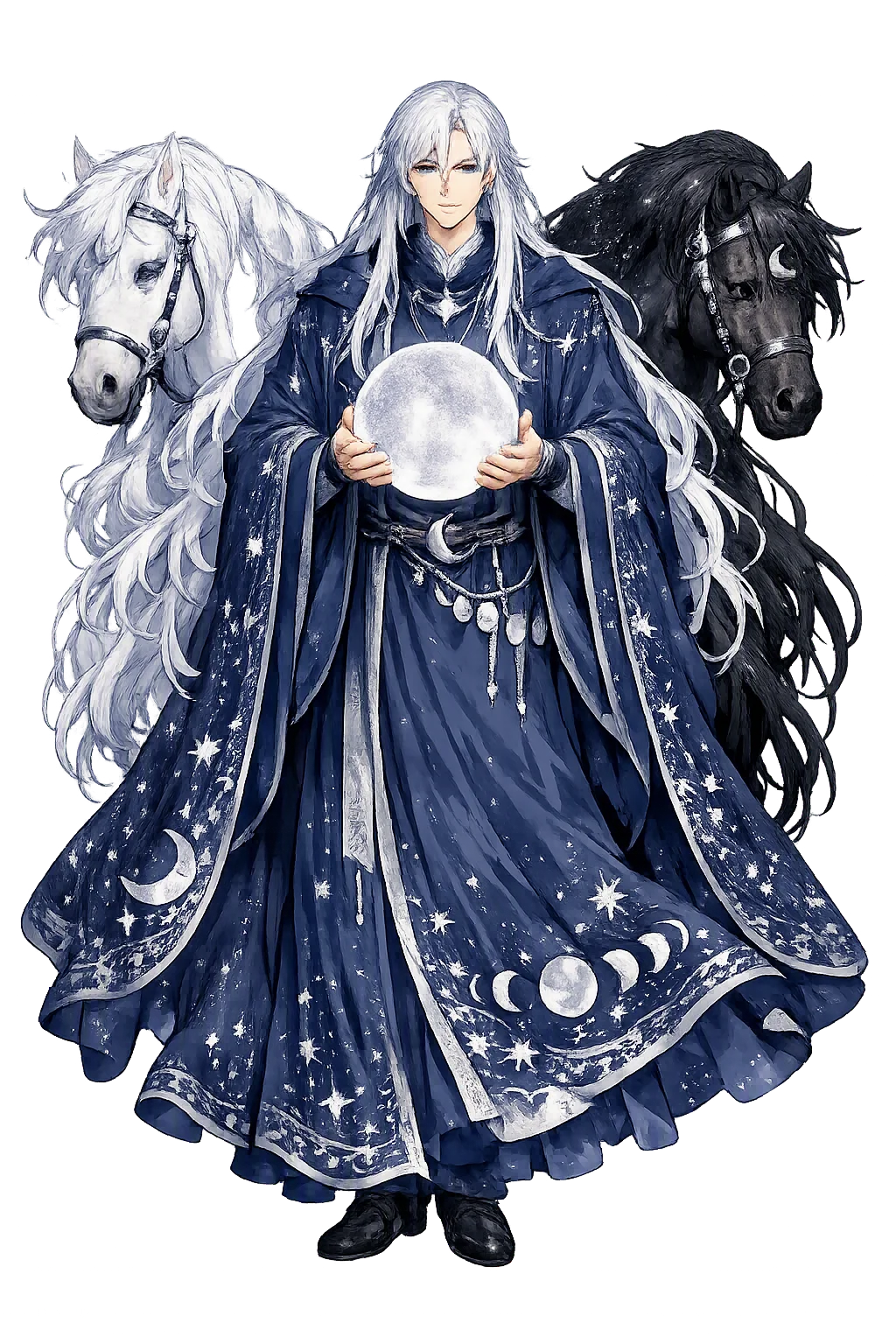
From Runes to Unicode: the journey of Máni
Long before it was a domain, this name traveled through scripts. Máni begins in Runes, passes through scholarly transliteration, and ends — for now — inside the punycode machinery of the global DNS. Each stage of that journey preserves some information and loses some, and the craft of restoration is knowing exactly which marks matter. This post follows the name stage by stage: the original script, the reconstructed pronunciation, the mythological record, the material evidence, and finally the Unicode form that carries all of it into the address bar. Think of it as a biography of a name, told through its spelling.
At a Glance
- Restored name: Máni
- ASCII form: mani
- Meaning: "Moon (the personified moon, brother of Sól)"
- Domain of influence: Moon, Night, Time
- Pantheon: Norse
- Classification: Tier 1
- Live domain: máni.com
Overview
Máni (mani) — Moon, Night, Time · Moon (the personified moon, brother of Sól) — belongs to the Norse tradition, where it is catalogued under the domain "Moon, Night, Time". The name means "Moon (the personified moon, brother of Sól)".
In the norse tradition, Máni is the moon itself made personal — the shining body that crosses the night sky, imagined as a god who steers it. Where Sól, his sister, drives the sun, Máni governs the gentler light: Snorri says he 'steers the course of the moon and rules the new and the waning moons,' the phases by which men first learned to count their days.
His is a charged quietness. The gods themselves assigned him his course, a wolf runs forever at his heels, and two earth-born children ride with him, their pail still visible on his face. Every month that turns is his signature: mánaðr, 'month', is his own word, and Monday is his day.
PuniCodex restores the name as Máni and serves its temple at máni.com. The restoration preserves at least one distinctive feature — a diacritic or a distinctive letter — that the ASCII form loses, and exactly one historically valid Unicode restoration exists, which places the name in Tier 1. The plain ASCII form mani survives as a modern convenience imposed by the early domain-name system; the restoration, not the fallback, is the form the project defends as philologically complete.
The Name
No indigenous written attestation survives for this name; Máni is a scholarly transliteration of the reconstructed spoken form. Etymologically the name means "Moon (the personified moon, brother of Sól)".
The ASCII form mani survives only because the early domain-name system could not carry diacritics; it is a technological compromise, not an ancient spelling. The Unicode restoration Máni recovers the stress accent of the original directly in the address bar. The restoration preserves at least one distinctive feature — a diacritic or a distinctive letter — that the ASCII form loses, and exactly one historically valid Unicode restoration exists, which places the name in Tier 1.
The letter-by-letter transformation runs:
- m → M — Same, capitalized
- a → á — Acute on a
- n → n — Same
- i → i — Same
The project holds the domain máni.com (xn--mni-ela.com) as the canonical home of this name.
The Original Script
The original script for this norse name has not yet been added to PUNICODEX. The form shown is a scholarly transliteration.
The form Máni is therefore a scholarly transliteration rather than an attested ancient spelling; it encodes the reconstructed sound of the name for modern use, and no mark in it is decorative.
The Old Norse form is máni, the ordinary common noun 'moon' borne as a theonym, attested throughout the manuscript tradition of both Eddas. In the earlier epigraphic medium, the Younger Futhark, the name would be rendered approximately ᛘᛅᚾᛁ — the long á written with the ᛅ (óss) rune, the Younger Futhark's sign for the a-family vowels, nasalized and long alike; no runic inscription preserves the theonym itself. In the normalized Old Norse spelling the acute on á marks vowel length, [ɑː], the same long vowel heard in 'father'. The PUNICODEX registrable form Máni preserves that acute as a Tier-1 restoration — the single distinctive feature the ASCII form Mani loses — carrying the long vowel that links the god directly to mánaðr, the month he measures.
Pronunciation
The reconstructed pronunciation of the name is /ˈmɑːni/ — Old Norse Reconstruction.
Phoneme by phoneme:
- M- — Bilabial nasal [m], unchanged from Proto-Germanic *m to Old Norse; the name opens with the same consonant as English 'moon'
- -á- — Long open back [ɑː] with the acute marking length; Old Norse stress falls on the first syllable by default
- -ni — Short alveolar nasal [n] and close front [i]; the light second syllable of the nominative singular
For the modern speaker, the closest approximation is: 'MAH-nee' — hold the first vowel long and open, as in 'father', with the weight squarely on the first syllable and a quick, light '-nee' to close.
Kindred and historical forms of the name:
- Old English — Mōna, the masculine moon of the Anglo-Saxons, whose name survives in Monday (Mōnandæg)
- Old High German — Māno, the continental Germanic moon, likewise masculine
- Proto-Germanic — *Mēnô, 'moon', a masculine noun — an inheritance the Germanic languages kept where most Indo-European tongues made the moon feminine
- Modern Icelandic — Máni, the living reflex, unchanged in form and gender
Máni is Tier 1: the acute on á marks the long vowel [ɑː], a distinctive feature the ASCII form Mani loses; Old Norse initial stress is the default and needs no further mark. The name is simply the common noun máni, 'moon', raised to a person — the same word that gives mánaðr, 'month'. Attestation and reconstruction follow Cleasby & Vigfusson, An Icelandic-English Dictionary (1874), s.v. máni; and Zoëga, A Concise Dictionary of Old Icelandic (1910), s.v. máni.
Mythology
Máni's mythology is brief but exact: he has no hammer-duels and no disguises, only a course to keep and a hunter behind him. The Eddas give him three scenes — a father's fatal boast, a wolf's patient pursuit, and two children lifted from a well — and together they explain both why the moon moves and why it keeps its human face. Around those scenes gathers the quieter charge the Vafþrúðnismál records: the gods shaped the new and waning moons so that men could reckon their years.
Mundilfari's Boast (Vafþrúðnismál / Gylfaginning)
In the Vafþrúðnismál, the giant Vafþrúðnir tells Óðinn that Mundilfari is the father of Máni and of Sól alike. Snorri, in Gylfaginning, gives the story its edge: Mundilfari's two children were so fair that he named his son Máni, 'Moon', and his daughter Sól, 'Sun', and married Sól to a man named Glenr. The gods were angered by this ofdramb — this overweening pride — and took the siblings and set them in the heavens.
The punishment is an appointment. Sól is made to drive the horses of the sun, Árvakr and Alsviðr, while Máni is charged with steering the course of the moon and ruling its waxing and waning. What a father claimed in arrogance, the gods confirmed in office: the names became the duties, and the children became the sky.
The Wolf at the Moon's Heels (Grímnismál / Gylfaginning)
The moon does not drift; it flees. Snorri explains its speed by its hunter: two wolves run with the lights of heaven, and Hati Hróðvitnisson is the one who runs before the moon and means to take it — 'and so it will come to pass.' The Grímnismál knows the same pursuit, naming Hati as the son of Hróðvitnir who waits upon the bright bride of the sky.
The chase has an ending, and the Eddas do not flinch from it. From the Iron-Wood brood, Snorri says, will come the mightiest wolf of all, called Mánagarmr, the Moon-Hound: he fills himself with the lives of all who die, swallows the moon, and spatters heaven and air with blood, so that the sun loses its shining. The Vǫluspá names him the moon's devourer in a troll's skin. At Ragnarǫk the long pursuit is finished, and the calendar itself goes dark.
Bil and Hjúki at the Well (Gylfaginning)
Snorri records that Máni took two children up from the earth, Bil and Hjúki, as they walked from the well called Byrgir, carrying on their shoulders the pail Sægr — often read as a mead-tub — slung from the pole Simul. Their father is named Viðfinnr. 'These children follow Máni,' Snorri adds, 'as can be seen from earth': look at the moon and you will find them there.
This is the Norse answer to the man in the moon — not a face but two small figures under a burden, fixed forever in mid-errand. The detail of the well, the pail, and the pole is too homely to be invented ornament; it reads as the residue of nursery-lore older than the manuscript, the kind of story told to children who had already been shown the markings in the moon. Scholars have sometimes linked the pair to the Jack and Jill of English rhyme, but that connection is modern speculation, not attestation.
Symbols & Iconography
The iconography associated with Máni concentrates in a small set of recurring attributes, each a compressed statement about the name:
- Ný ok nið (new and waning moons) — The phases over which Máni rules, the divine charge by which the gods ordained the counting of years for men
- Hati Hróðvitnisson — The wolf who runs before the moon and gives its crossing its haste, the promise that even the lights of heaven are hunted
- Mánagarmr (Moon-Hound) — The mightiest of the Iron-Wood brood, who fattens on the lives of the dying and swallows the moon at the world's end
- Sægr and Simul (pail and pole) — The burden Bil and Hjúki carried from the well Byrgir, still legible as the markings on the moon's face
- The month-mark — Mánaðr, the month — the unit of time that bears his name in every Germanic calendar
Archaeology & Evidence
Máni has no secure iconography: no picture stone, runestone, or amulet has been convincingly identified as his image, and his attestation is essentially textual. The Poetic Edda poems that name him — Vafþrúðnismál, Grímnismál, and Vǫluspá — survive chiefly in the Codex Regius (GKS 2365 4to, c. 1270), with Vǫluspá also in the Hauksbók; Snorri's account in Gylfaginning is transmitted by the main Snorra Edda manuscripts (GKS 2367 4to, Codex Upsaliensis, Codex Wormianus). The older strata of Scandinavian sky-religion are, however, material: the Bronze Age Trundholm sun chariot (c. 1400 BC) proves a native tradition of a heavenly body drawn by horse across the sky, and wheel- and disc-marked Gotland picture stones show the sun and moon as enduring cultic signs. The runic record knows the common noun máni and the month-names descended from it, but no runic inscription names the god directly.
Realm & Domain
In the norse tradition, Máni is the moon itself made personal — the shining body that crosses the night sky, imagined as a god who steers it. Where Sól, his sister, drives the sun, Máni governs the gentler light: Snorri says he 'steers the course of the moon and rules the new and the waning moons,' the phases by which men first learned to count their days.
His is a charged quietness. The gods themselves assigned him his course, a wolf runs forever at his heels, and two earth-born children ride with him, their pail still visible on his face. Every month that turns is his signature: mánaðr, 'month', is his own word, and Monday is his day.
Mundilfari's Boast
A father's pride named his children Moon and Sun; the gods answered the boast by setting the pair to drive the lights of heaven.
Hati's Pursuit
The wolf Hati Hróðvitnisson runs before the moon and will one day take it; at Ragnarǫk the Moon-Hound swallows the light and spatters the sky with blood.
Bil and Hjúki
Two children with a pail on a pole, taken up from the well Byrgir; they follow Máni, Snorri says, 'as can be seen from earth' — the man in the moon.
Measurer of Months
He rules the new and waning moons, the counting of time itself; mánaðr, 'month', is his word, and the calendar was his first temple.
Across Cultures
Máni belongs to the common Germanic inheritance in which the moon is grammatically and mythologically masculine — Old English Mōna, Old High German Māno, Gothic mēna — a striking counterweight to the feminine moons of the classical world, Greek Selēnē and Latin Luna. The word itself runs deeper: Proto-Indo-European mḗh₁nōt- / mḗh₁n̥s meant both 'moon' and 'month', the double sense Máni still carries in mánaðr, so that his personification is the personification of time-reckoning itself. The pairing of a moon-god with a sun-goddess, brother and sister, is the Germanic reversal of the Greek Selene and Helios pattern, though the daily celestial chase — light pursued by devourer — has echoes from the wolves of Ragnarǫk back to the eclipse-monsters of other traditions. The liveliest survival is folkloric: the Norse reading of the moon's markings as two children with a pail stands at the head of the whole northern 'man in the moon' tradition that later fills English ballads and nursery rhymes, and the tempting equation of Hjúki and Bil with Jack and Jill has been argued since the nineteenth century — as speculation, never as proof.
Within the Norse tradition, closely related names in the corpus include Álfheimr, Bifrǫst, Búri, Eggþér, Fáfnir, and Helheimr.
Cultural Legacy
Máni's deepest legacy is calendrical: every month and every Monday in the Germanic-speaking world is his, for Mōnandæg and its Norse kin are simply the moon's day, and the words descend from his name. In literature his clearest heir is Tolkien's Tilion, the Maia who steers the vessel of the moon across the sky — the personified moon-driver of the Eddas translated into a new mythology. Notably, Wagner left him out: the Ring runs on gold, fire, and Wotan's will, and the moon-driver never steps onto that stage, a measure of how thin Máni's high-cultural afterlife is beside Þórr's or Óðinn's. The chase around him fares better: the pursuing wolves Skǫll and Hati stalk recent retellings, including God of War Ragnarök (2022), where the stolen moon and its hunters drive a whole arc of the story. And the oldest survival is still the most democratic — the face and figures people point out to children in the full moon, which Snorri already explained by Bil and Hjúki eight centuries ago. In modern heathenry Máni is honored quietly, at the turning of the months he still measures.
The Scholarly Record
The account of Máni given in this edition rests on the witnesses and reference works listed below. Lexica and etymological dictionaries secure the form and meaning of the name; the literary and religious texts supply the narrative evidence.
- Poetic Edda: Vafþrúðnismál (Mundilfari as father of Máni and Sól; Bellows translation). Full text
- Poetic Edda: Grímnismál (Hati's pursuit of the heavenly lights; Bellows translation). Full text
- Snorri Sturluson, Prose Edda: Gylfaginning (Mundilfari's boast, Bil and Hjúki, the wolves; Brodeur translation). Full text
- Gylfaginning, Old Norse text (Guðni Jónsson edition), chs. 11–12: Frá Sól ok Mána; Frá úlfakreppu Sólar. Full text
- Völuspá, Old Norse text (the tungls tjúgari stanza on the moon's devourer). Full text
- Cleasby & Vigfusson, An Icelandic-English Dictionary (1874), s.v. máni, mánaðr. Full text
- Zoëga, A Concise Dictionary of Old Icelandic (1910), s.v. máni. Full text
- Máni — overview of attestations and scholarship. Full text
A Meditation
Names are not merely labels; they are compressed worlds. Máni compresses the oldest technology there is: the counting of time by a light that reliably changes. Before calendars were written they were watched, and the watcher-god is the moon — not its conqueror, like Þórr riding out, but its keeper, driving a course he did not choose, with a wolf behind him and two lost children for company. His myth is the honest one about time: it moves because it is pursued, it is beautiful because it is borrowed, and it will one day be swallowed. Yet the word he leaves behind — mánaðr, the month — is how every farmer, sailor, and poet after him held the dark at bay. Unicode restoration returns that world to readable form: the acute on á is the long vowel the whole calendar leans on.
The Unicode Restoration
Máni is classified as Tier 1: the restoration preserves at least one distinctive feature — a diacritic or a distinctive letter — that the ASCII form loses. The ASCII fallback mani still resolves everywhere, but it is the restored form that carries the name's full information. Across the 4 characters of the name, the restoration adjusts 1: 1 mark of stress (á). That is the whole thesis of this temple: the marks are the message.
The Domain Name
The restored name is live as a working domain: máni.com, which the DNS carries in punycode form as xn--mni-ela.com — an ASCII-compatible encoding that lets a non-ASCII name travel the global network without breaking older infrastructure. The visitor sees Máni; the machines see the encoding. That duality is the engineering compromise on which the entire restoration rests, and it is why a name written the way its own tradition wrote it in Runes can now be typed into any browser on earth.
Why This Restoration Matters
Every stage of the journey from Runes to Unicode was an act of care: the scribe who first wrote the name, the lexicographer who glossed it, the engineer who taught the DNS to carry it. The PuniCodex restoration is the latest stage, not the last word — the Scholarly Edition is revised as the evidence improves. What does not change is the principle: a name deserves to be written the way its own tradition wrote it. Máni in the address bar is that principle, made routable.
Explore Further
This post is one doorway into the temple. The home page carries the full character breakdown and the ambient canvas; the lore page tells the myths in long form; the Scholarly Edition preserves the sources, pronunciation data, and revision history; and the patron wall supports the restoration directly. For the wider map, browse the Lexicon, explore the Pantheon, or return to the PuniCodex blog.
Related Names
Sources
The full scholarly apparatus — every citation, revision, and review — lives in the Scholarly Edition. Key references for this post:
- Poetic Edda: Vafþrúðnismál (Mundilfari as father of Máni and Sól; Bellows translation).
- Poetic Edda: Grímnismál (Hati's pursuit of the heavenly lights; Bellows translation).
- Snorri Sturluson, Prose Edda: Gylfaginning (Mundilfari's boast, Bil and Hjúki, the wolves; Brodeur translation).
- Gylfaginning, Old Norse text (Guðni Jónsson edition), chs. 11–12: Frá Sól ok Mána; Frá úlfakreppu Sólar.
- Völuspá, Old Norse text (the tungls tjúgari stanza on the moon's devourer).
- Cleasby & Vigfusson, An Icelandic-English Dictionary (1874), s.v. máni, mánaðr.
- Poetic Edda, Vafþrúðnismál (Mundilfæri; the reckoning of years).
- Poetic Edda, Grímnismál (Hati's pursuit).
- Poetic Edda, Völuspá (the tungls tjúgari stanza).
- Prose Edda, Gylfaginning ch. 11 (Mundilfæri's boast; the course of the moon).
- Lexicon authorities for this entry: Poetic Edda, Prose Edda, Cleasby-Vigfusson, Zoëga.