
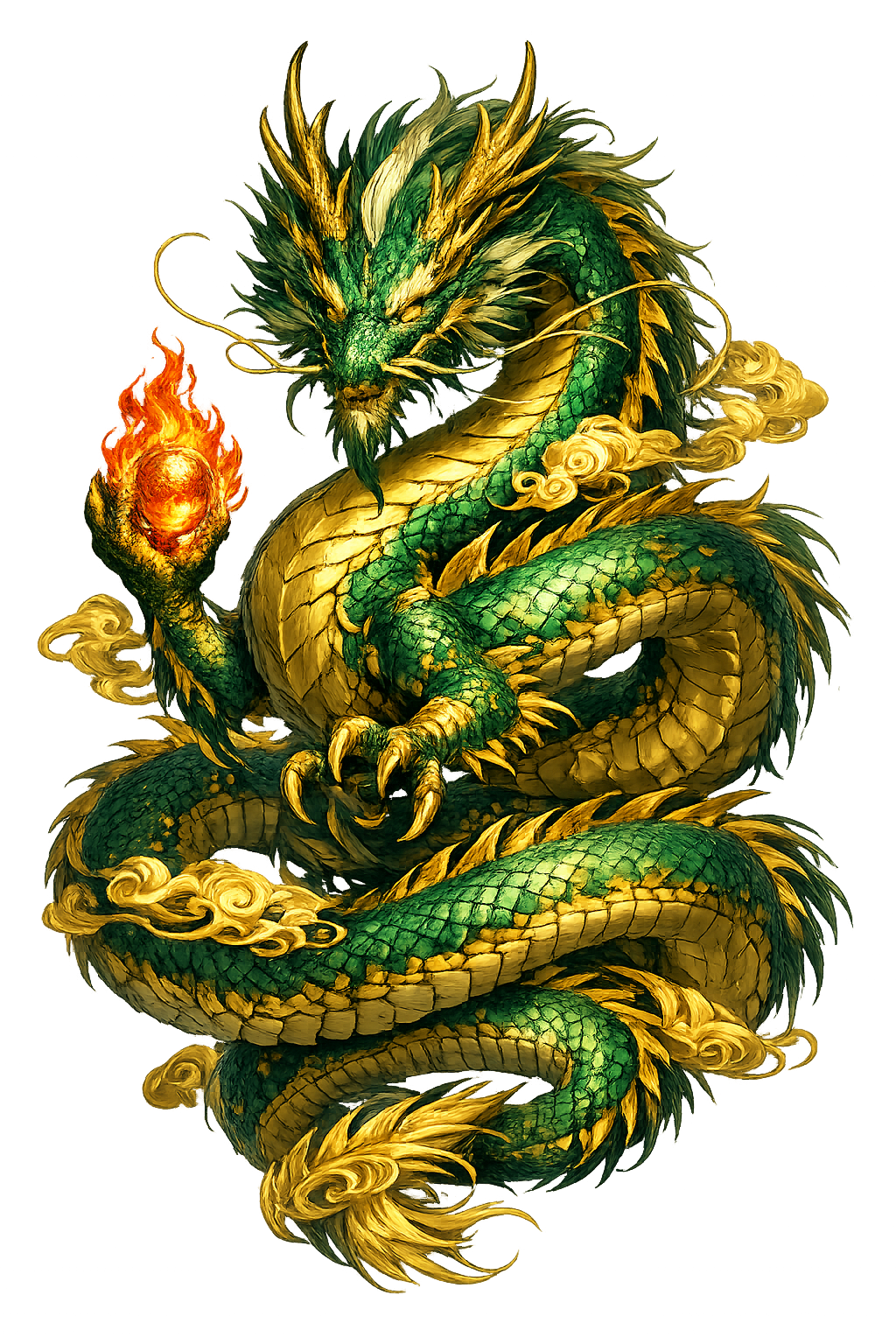
The provenance file on Lóng
Catalogue entry — Lóng. Every claim below carries its chain of custody.
Provenance
1. The attestation. 龍 — "Chinese dragon".
2. The preserved evidence. o → ó (Second tone) — absent from the ASCII form long, present in the restoration, verifiable against the sources above.
3. The narrative record. Yinglong, the Winged Dragon — The oldest dragon of record is a war-machine of rain. When the Yellow Emperor faced the rebel Chiyou at Zhuolu — the battle that made Chinese kingship — Chiyou raised a fog so thick that day became night and the imperial armies lost their way. The Carp at Dragon Gate — Every spring the carp of the Yellow River run upstream past the rapids called Longmen, 'Dragon Gate', the cleft the Great Yu was said to have cut through the mountain. Few survive the leap; those that do are transformed into dragons.
4. The physical record. The earliest dragon image in China may be the C-shaped jade 'pig-dragon' of the Hongshan culture (c. 4700–2900 BCE) from Inner Mongolia and Liaoning; the Erlitou culture (c. 1900–1500 BCE) produced a turquoise-inlaid dragon plaque; Shang and Zhou bronzes coil dragon-derived taotie masks across their surfaces. Han dynasty tomb murals and stone reliefs show dragons pulling chariots, guarding ascents to immortality, and arching between earth and heaven. Textually the dragon is present from the oracle-bone inscriptions onward, already a royal and meteorological sign by the Western Zhou — three thousand years of continuous iconography for a creature that was never alive and never stopped acting.
5. The current holding. The temple at /long/, classified Tier 1. What survives here cannot be shown in ASCII: a feature of the original that the fallback alphabet flattens. That is the Tier-1 test, and this name passes it without argument.
6. The documented resonances. Gaming, Fantasy & Entertainment IP, Freshwater & Hydrology, Education, Research & Knowledge — seats argued and weighted in the pattern atlas, read through the myths in this temple's Resonance File.
7. The primary sources. Tao Te Ching — the library this file answers to, open at the Sacred Texts collection.
8. The continuing record. The dragon never left Chinese public life. The Qing imperial flag was a five-clawed dragon on a yellow field; the Republic and early People's Republic used dragon motifs on currency, stamps, and regalia.
At a Glance
- Restored name: Lóng
- ASCII form: long
- Meaning: "Chinese dragon"
- Domain of influence: Dragon
- Pantheon: Chinese
- Classification: Tier 1
- Original script: 龍
- Series: The Restoration Files, No. 281 of 546
The File Continues
Read the founding dispatch for the name's full story, the Resonance File for the archetype at work — or the whole archive in one sitting.
Continue the series — previous file: Loki (read it here) · next file: Lóngwáng (read it here).
The Restoration Files are written from the same canonical record as the temples themselves: the lexicon, the lore catalog, the pattern atlas, and the cited scholarly sources. If a file ever disagrees with its temple, the temple is right — tell us, and the file will be corrected.