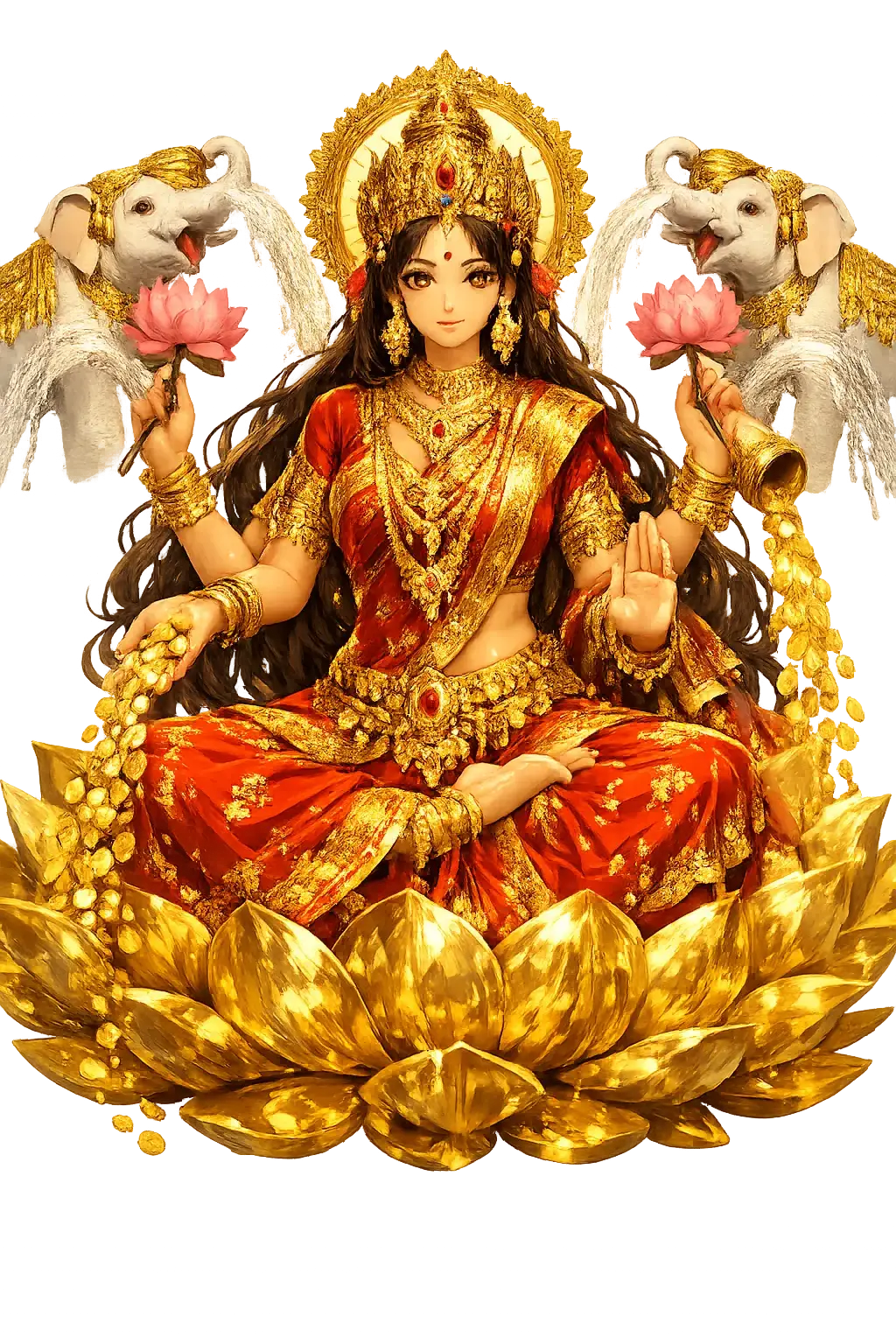
Stories of Lakṣmī
Lakṣmī's mythology spans the Vedic hymns to the great Purāṇic narratives. She rises from the churned ocean, chooses Viṣṇu over every rival, descends to earth as Sītā, tests the gods themselves through the sage Bhṛgu, and crowns the devotion of a righteous king — teaching at every turn that fortune is a moral energy, not a lucky accident.
When the gods and the demons churned the cosmic ocean for the nectar of immortality, the treasures surfaced one by one: the wish-fulfilling cow, the jewel Kaustubha, the moon, the goddess of wine. Then, robed in white and standing on a lotus, 'born with the nectar's own radiance' (Bhāgavata Purāṇa 8.8.8), Lakṣmī rose from the foam. Every god stretched out his hand — but she moved past Indra and all the others and set her garland on Viṣṇu's neck, choosing the preserver as her eternal lord. The account is told in the Mahābhārata's Ādi Parvan (18.38–40), the Rāmāyaṇa's Bālakāṇḍa (45), the Viṣṇu Purāṇa (1.9), and the Bhāgavata Purāṇa (8.8), with details shifting between recensions — in some she appears before the nectar, in some the gods are too dazzled to speak. The core never changes: prosperity must choose a guardian of order, or it becomes a prize of war. Lakṣmī's choice of Viṣṇu is the myth's thesis — that wealth is legitimate only in the keeping of dharma.
Before Lakṣmī was Viṣṇu's consort, she was Śrī — and the Śrī Sūkta, a khila hymn appended to the fifth maṇḍala of the Ṛgveda and preserved in the Atharvaveda tradition, invokes her directly. The hymn describes a goddess of gold and flame: radiant as fire, her complexion golden like the sun's, her path attended by horses and by elephants bearing water for her lustration. She is begged to seat herself in the house, to stay, to scatter her hoof-marked blessings on the family (Śrī Sūkta 1–6); kings rise and fall by her regard. Later tradition fused this independent Vedic Śrī with Lakṣmī so completely that the two names became synonyms — but the hymn preserves an older theology: fortune is not a gift handed down from the gods but a goddess in her own right, courted with praise and propitiated like any sovereign power.
The Rāmāyaṇa makes the identification quietly, and the tradition makes it explicit: Sītā, found in a furrow as King Janaka plows the earth, is Lakṣmī herself descended with Viṣṇu's avatāra (Rāmāyaṇa, Bālakāṇḍa 66; the identification becomes explicit in the epic's later frame and in Purāṇic theology). Where Lakṣmī chooses Viṣṇu at the churning, Sītā chooses Rāma in the marriage assembly, garlanding him before the assembled kings. Her abduction by Rāvaṇa and her long captivity in the Aśoka grove test what the churning only declared: that fortune's purity survives even when fortune is seized and imprisoned. The fire ordeal she undergoes before the armies reads, in this light, less as a trial of her than as the world's attempt to deserve her return. The myth's meaning is the epic's own: the goddess of fortune descends to earth as a woman, and dharma is measured by how men treat her when they think no god is watching.
The sage Bhṛgu set out to learn which of the three supreme gods deserved worship. Brahmā received him without rising; Śiva received him quarrelling; but Viṣṇu lay asleep, and Bhṛgu kicked the god's chest to wake him — the very chest that bears Lakṣmī's dwelling. Viṣṇu answered not with wrath but by massaging the sage's foot, lest it ache from the blow (Mahābhārata, Śānti Parvan 272; retold at Bhāgavata Purāṇa 10.89). Lakṣmī, affronted that her husband bore the insult without anger, cursed him: she would leave his chest and dwell only where humility, generosity, and patience reigned — and the two of them descended to earth to work out the curse through human lives. It is the subtlest of her myths: fortune is not offended by poverty but by pride, and she can be provoked into leaving even the chest of God. Lakṣmī's restlessness is her theology — she stays only where merit makes a home.
King Ambarīṣa worshipped Lakṣmī's lord with the Ekādaśī fast, and as he was about to break it at the appointed hour the volatile sage Durvāsā arrived and cursed him for receiving him impatiently; the curse took the form of a demon that sprang to devour the king — but the king's devotion had weight: the Sudarśana discus of Viṣṇu rose from his brow, burned the demon, and then pursued Durvāsā himself across the worlds, into the underworld and back (Bhāgavata Purāṇa 9.4). The humbled sage fled to Brahmā, to Śiva, and finally to Viṣṇu, who answered that discus and devotees were alike invincible: only the king's forgiveness could save him. Durvāsā returned and begged pardon, and the king's first act was to break his fast and feed his enemy. The myth closes its circle: the goddess of fortune dwells in the house where the enemy is fed before the self, and Lakṣmī's favor outruns even a sage's curse.
Wealth, Beauty, Sovereignty, and Auspiciousness
Lakṣmī is the goddess who turns possibility into prosperity: gold, grain, good children, royal power, moral merit, and the radiance (śrī) that surrounds any flourishing life. Where she dwells there is abundance; where she departs, even palaces become deserts. As Viṣṇu's consort she descends with him in every avatāra — yet her roots in the Vedic goddess Śrī are older, and she was never merely a wife.
She governs crops, cattle, gold, and every resource that sustains life; her name is invoked at markets, harvests, and account books.
As Śrī she is the fragrance, grace, and radiance that distinguish the noble and the divine from the merely ordinary.
Kingship is legitimized by her presence; the wheel of sovereignty turns only for the ruler whom Lakṣmī favors.
She accompanies the preserver in every avatāra, descending with him to restore dharma whenever the world grows dark.
From the original script to the living URL
लक्ष्मी
The name in its original Sanskrit form. Lakṣmī (लक्ष्मी) is attested in the source tradition — “The goddess of fortune and beauty — Viṣṇu's consort, born from the churning of the ocean”. Its emphatic consonants, macron-length vowels, and palatal/retroflex sibilants carry the full phonetic and orthographic weight of the source tradition.
lakshmi
Reduced to plain lakshmi, the name loses everything that made it specific: emphatic consonants, macron-length vowels, and palatal/retroflex sibilants. What remains is an ASCII string that machines can parse but that no longer speaks with its original voice.
Lakṣmī
The Unicode restoration recovers what ASCII flattened. Lakṣmī restores emphatic consonants, macron-length vowels, and palatal/retroflex sibilants, returning the name to its original written dignity. The domain encodes to Punycode, but the browser displays the truth.
Lakṣmī.com → xn--lakm-tya2995b.com
The non-ASCII characters in Lakṣmī are encoded while the ASCII remains visible. To the DNS, it is Punycode. To humanity, it is Lakṣmī.
Owned, ideal, and ASCII forms of Lakṣmī
Lakṣmī
Restores लक्ष्मी. The live temple domain — lakṣmī.com.
lakshmi
Flattens लक्ष्मी. The plain ASCII fallback — what DNS and legacy systems see.
How Lakṣmī was spoken
How Lakṣmī travels from ancient script to the modern URL
Sanskrit Lakṣmī; from lakṣma “mark, sign"; the goddess of fortune, beauty, and prosperity.
Wealth, Fortune, Beauty
The IAST form Lakṣmī uses registrable Latin diacritics; the Devanagari form is not supported in .com.
The lore you have read is the living myth. Extended Lore opens the scholarly vault beneath it: the cult and its material remains, a history of the image, the name after antiquity, a meditation on what the name still means, and the full scholarly apparatus — etymology, orthography, sources.
Enter Extended Lore