PuniCodex

Extended Lore

लक्ष्मी Lakṣmī

Etymology · Orthography · Cult · Iconography · Reception · Sources

Tier 1 Lakṣmī.com
Lakṣmī — Wealth, Fortune, Beauty
01

Quick Facts

Essential information about Lakṣmī, Wealth, Fortune, Beauty

Original Scriptलक्ष्मी
Unicode RestorationLakṣmī
Reconstructed Pronunciation/lək.ʂmiː/
PantheonSanskrit
DomainWealth, Fortune, Beauty
MeaningThe goddess of fortune and beauty — Viṣṇu's consort, born from the churning of the ocean
ClassificationTier 1
Primary DomainLakṣmī.com
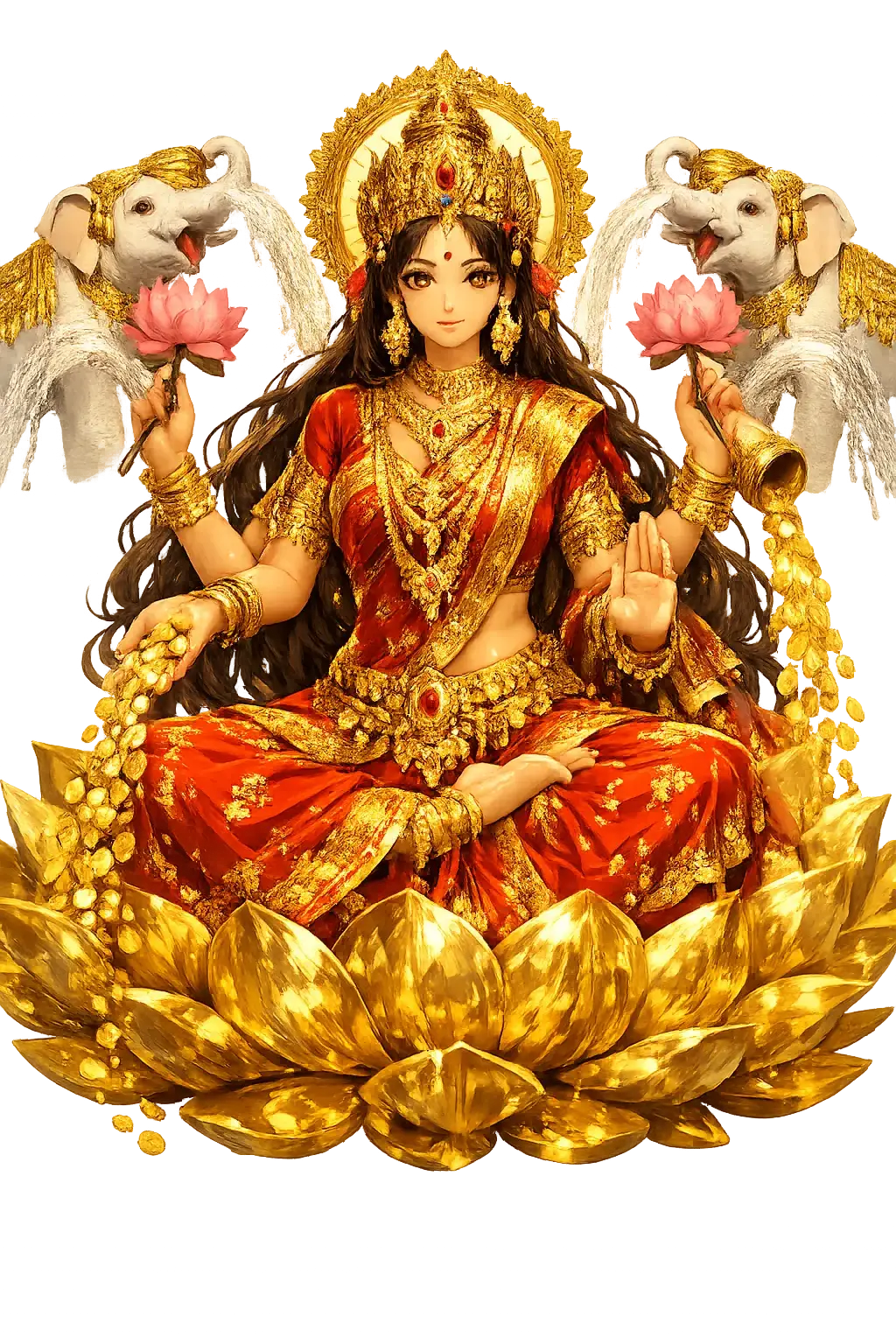
Sacred SymbolsLotus (padma), Gold coins, Owl (ulūka), Elephant (gaja), Conch and discus
02

Etymology & Word Family

From original script to Unicode restoration

Original Script लक्ष्मी Lakṣmī — "The goddess of fortune and beauty — Viṣṇu's consort, born from the churning of the ocean"
Unicode Restoration Lakṣmī Restored stress, length, and script
Modern ASCII lakshmi Plain-ASCII fallback

The name Lakṣmī carries the orthographic signature of the sanskrit tradition: लक्ष्मी. Unicode restoration recovers what ASCII flattens.

03

Unicode Character Breakdown

Character-by-character philological analysis

CharacterUnicodeNameBlockPhonetic Role
LU+004CLatin Capital Letter LBasic LatinSame
aU+0061Latin Small Letter ABasic LatinShort /a/
kU+006BLatin Small Letter KBasic LatinSame
ṣU+1E63Latin Small Letter S with Dot BelowUnknownS-dot-under: retroflex /ʂ/
—N/ADropped characterSanskrit orthographyDropped: digraph simplified
mU+006DLatin Small Letter MBasic LatinSame
īU+012BLatin Small Letter I with MacronLatin Extended-AMacron: long /iː/

The Tier 1 classification reflects how much of the original phonology this restoration preserves — stress and vowel length for Greek names, distinctive letters and diacritics for every other tradition.

04

Cult & Worship

How the sacred was kept — rites, sanctuaries, remains

The Cult

Lakṣmī is worshipped wherever prosperity is hoped for — which in Hindu India is nearly everywhere. Her oldest cultic layer is domestic: the household shrine, the recitation of the Śrī Sūkta, and the Friday observances that make her the working deity of merchants and housewives. Temples followed — the great Mahālakṣmī shrines at Kolhapur and Mumbai draw pilgrims in their tens of thousands, and a Lakṣmī shrine stands in most Viṣṇu temples across the subcontinent. Her festivals mark the calendar's prosperous turns: Varalakṣmī Vrata, the Friday vow kept by women for the family's fortune; Kojāgarī on the autumn full moon, when the goddess walks the night asking who is awake; and the closing of account books before the year turns. The ritual is consistent — lotus flowers, gold, vermilion, new cloth, lamps, and the invitation spoken aloud at the threshold. Votive evidence runs deep: Gupta gold coins already show her enthroned as the guarantor of royal fortune, and her images still receive the first coin of the day in shops from Chennai to Singapore.

In the Earth

Lakṣmī's earliest identifiable images predate the Kuṣāṇas: among the 2nd-century BCE railing reliefs of Bharhut a lotus-borne goddess is labeled Sirimā Devatā — Śrī herself — and the stūpa's medallions already show the lustration-by-elephants scheme that becomes her signature gajalakṣmī motif. Gupta-era temples and early Hindu cave shrines include her among the guardians and consorts of Viṣṇu. From the medieval period onward, her iconography becomes highly standardized: standing on a lotus, holding lotuses, showering coins, and accompanied by elephants or owls. Archaeological and numismatic evidence across South and Southeast Asia confirms her presence as a royal and mercantile deity from the early centuries CE onward.

05

Iconography

How Lakṣmī was imaged across the ages

The Image

Learn four signs and you can name Lakṣmī across two thousand years of art: the lotus she stands on and holds, the gold that spills from her lower palm, the elephants that lave her from either side, and — in later eastern images — the owl that waits at her feet. The formula crystallized early. Kuṣāṇa-period sculptors at Mathura gave her the four-armed, lotus-bearing standing type, and the Guptas froze the canon in stone and on their coinage: two lotuses, the gesture of giving, the seat a lotus throne. From the sixth century onward she guards thresholds — Gajalakṣmī, lustrated by a pair of elephants, crowns doorways from the Pallava open-air reliefs of Mamallapuram to the lintels of Angkor. Medieval bronzes and Pahari miniatures multiplied her in every medium, and the chromolithographs of Raja Ravi Varma carried the medieval icon onto the modern wall. For antiquity, the Mathura figures and the Gupta coins; for the mature image, Ravi Varma's seated, coin-showering Lakṣmī — the same four signs, endlessly rehearsed.

06

Reception & Transformation

The name after its own age — transmission, translation, survival

Afterlives

Lakṣmī's transmission is a river with many feeders. The Vedic Śrī Sūkta — a supplementary hymn preserved in recitation lineages and the Atharvaveda — handed her down as an independent goddess of radiance before any Purāṇa existed. The epics folded her into narrative, born at the churning in the Mahābhārata's first book and descending as Sītā in the Rāmāyaṇa; the Purāṇic redactors made her the constant consort of Viṣṇu. Tamil bhakti then gave her a theology: the Āḻvār poets sang her as Nappinnai, Krishna's beloved, and as the mother who mediates between the soul and Nārāyaṇa, and the Śrīvaiṣṇava tradition raised her into a principle — Vedānta Deśika's Śrī Stuti argues that her grace is the doorway to God's. The iconographers legislated her form in the Viṣṇudharmottara Purāṇa, and painters carried her across cultural borders, from Rajput and Mughal ateliers to the chromolithographs of the nineteenth century. European scholarship met her through the lexicon — Monier-Williams parsed lakṣmī as 'mark, sign, fortune' — and modern religious studies, from Kinsley's Hindu Goddesses onward, reads her as the theology of auspiciousness itself. At every stage she has carried the same argument: that prosperity is holy.

Identifications Across Traditions

Lakṣmī absorbed the Vedic goddess Śrī and, in later Hinduism, was identified with Rādhā, Sītā, and the various consorts of Viṣṇu. In Buddhism, Śrī or Lakṣmī appears as a protector of the Dharma and a bringer of royal fortune; in Jainism, similar auspicious goddesses guard the Jinas. Southeast Asian kings from Cambodia to Bali claimed her presence as a sign of legitimate rule. The ancient pairing of a goddess of abundance with a preserver god has parallels in Near Eastern and Greco-Roman divine couples, though Lakṣmī's specific association with the lotus and the churning ocean is distinctively Indic.

Modern Legacy

Lakṣmī remains one of the most widely worshipped goddesses in the Hindu world. Dīpāvalī, the festival of lights, is above all her festival: lamps are lit to welcome her into homes, businesses are closed and reopened with new account books, and families pray for a year of prosperity. Her image appears on coins, banknotes, corporate logos, and domestic shrines across South Asia and the diaspora. In classical and Bollywood dance, in temple sculpture, and in feminist reinterpretations, Lakṣmī continues to represent the idea that beauty and wealth are not vices but divine gifts that must be honored and shared.

07

The Meditation

What Lakṣmī means — beyond the dictionary

Lakṣmī challenges the suspicion that wealth and spirituality cannot coexist. In her presence, abundance is not exploitation but flowering; beauty is not vanity but the radiance of a well-ordered life. She asks us to consider what we truly value and whether we are capable of receiving good things without clutching them.

Yet she is also a warning. Fortune is described as restless because it cannot be hoarded; it must circulate through generosity, ritual, and care. To worship Lakṣmī is therefore to commit to a discipline of abundance — not merely asking for more, but becoming the kind of person around whom prosperity can settle without being corrupted.

08

Frequently Asked Questions

Common questions about Lakṣmī, Wealth, Fortune, Beauty, and Unicode restoration

01How do you pronounce Lakṣmī?

In reconstructed pronunciation, Lakṣmī is /lək.ʂmiː/ — approximately 'LUKH-shmee' — the middle consonant is a curled-tongue 'sh', and the final vowel is held long like 'ee' in 'see'.

02What does Lakṣmī mean?

Lakṣmī means The goddess of fortune and beauty — Viṣṇu's consort, born from the churning of the ocean in the sanskrit tradition.

03What are the symbols of Lakṣmī?

Lakṣmī is associated with Lotus (padma) (She stands or sits upon a lotus, a symbol of purity rising unstained from the waters of material existence), Gold coins (The shower of wealth that flows from her hands; prosperity as divine blessing), Owl (ulūka) (Her vehicle, associated with alertness and, in some readings, with the ability to find value in darkness), Elephant (gaja) (The showering elephants of the Samudra Manthan symbolize royal abundance and fertilizing rain), Conch and discus (Attributes shared with Viṣṇu, marking her identity as his śakti).

04Why restore Lakṣmī in Unicode?

Plain ASCII lakshmi strips the stress, length, and script that make the name specific. Unicode restoration returns the name to its original written dignity.

05What is the most important myth about Lakṣmī?

“Born from the Churning Ocean” — the Samudra Manthan story that anchors the mythology of Lakṣmī, told in full on the lore page.

09

Scholarly Sources

The philological foundations of this restoration

Every claim on this page is grounded in established scholarship. The orthographic restorations follow disciplinary convention. The etymological chain follows the best available reference works. This is not invention — it is resurrection through scholarship.

◈

Lexicography & Philology

  • MW
  • KEWA
◎

Primary Texts

  • Ṛgveda khila, Śrī Sūkta; Atharvaveda Śrī Sūkta
  • Viṣṇu Purāṇa 1.9 (churning and Lakṣmī's birth); Bhāgavata Purāṇa 8.8 and 9.4
◉

Archaeology & Art History

  • Material evidence — iconography, inscriptions, and temple archaeology — for Lakṣmī and related cults.
✦

Religious Studies

  • Mahābhārata, Ādi Parvan 18.38–40 (churning); Śānti Parvan 272 (Bhṛgu's test)
  • Rāmāyaṇa, Bālakāṇḍa 45 and 66
  • Monier-Williams, Sanskrit-English Dictionary (lakṣmī)
  • Kinsley, Hindu Goddesses: Visions of the Divine Feminine
  • Coburn, Encountering the Goddess: A Translation of the Devī-Māhātmya
Return

The Surface Awaits

You have traced the name from its earliest attestation to its Unicode restoration. Now return to the myth. The story is where the name lives.

Back to Lore
Lakṣmī mascot