
How Lakṣmī was rebuilt, mark by mark
From the restoration bench — the working notes on Lakṣmī, kept because the process is the proof.
What We Found
The attestation runs through the tradition's own sources: लक्ष्मी. Meaning: "The goddess of fortune and beauty — Viṣṇu's consort, born from the churning of the ocean".
The figure behind the name: Lakṣmī's mythology spans the Vedic hymns to the great Purāṇic narratives.
What the Name Carried In
Born from the Churning Ocean. When the gods and the demons churned the cosmic ocean for the nectar of immortality, the treasures surfaced one by one: the wish-fulfilling cow, the jewel Kaustubha, the moon, the goddess of wine. Then, robed in white and standing on a lotus, 'born with the nectar's own radiance' (Bhāgavata Purāṇa 8.
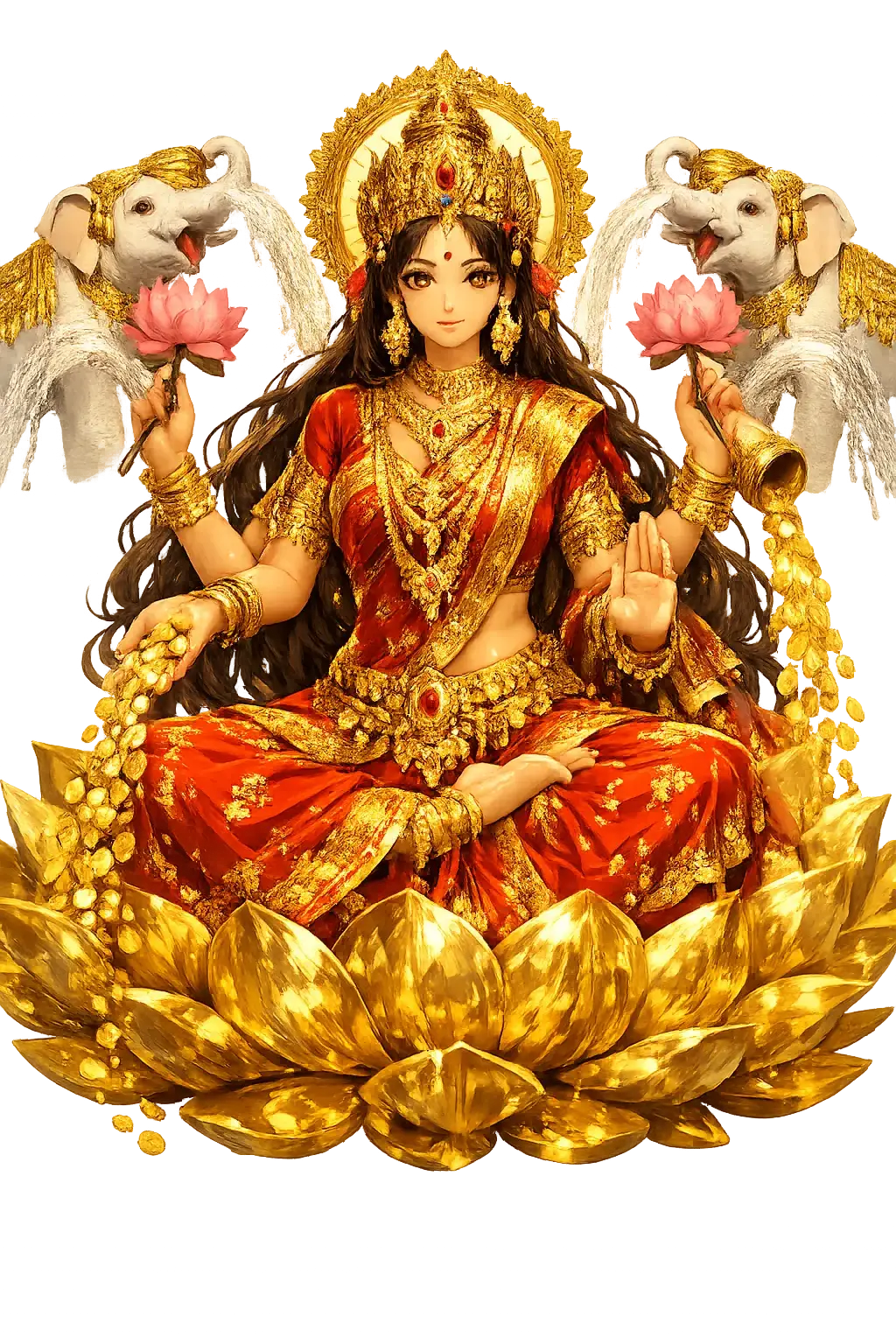
The Golden Hymn. Before Lakṣmī was Viṣṇu's consort, she was Śrī — and the Śrī Sūkta, a khila hymn appended to the fifth maṇḍala of the Ṛgveda and preserved in the Atharvaveda tradition, invokes her directly. The hymn describes a goddess of gold and flame: radiant as fire, her complexion golden like the sun's, her path attended by horses and by elephants bearing water for her lustration.
A spelling that has to carry stories like these is not a label. It is equipment.
Where It Stood Before Us
Lakṣmī's earliest identifiable images predate the Kuṣāṇas: among the 2nd-century BCE railing reliefs of Bharhut a lotus-borne goddess is labeled Sirimā Devatā — Śrī herself — and the stūpa's medallions already show the lustration-by-elephants scheme that becomes her signature gajalakṣmī motif. Gupta-era temples and early Hindu cave shrines include her among the guardians and consorts of Viṣṇu. From the medieval period onward, her iconography becomes highly standardized: standing on a lotus, holding lotuses, showering coins, and accompanied by elephants or owls. Archaeological and numismatic evidence across South and Southeast Asia confirms her presence as a royal and mercantile deity from the early centuries CE onward. The bench inherits all of it — the web temple is the newest site, not the first.
What We Kept
The evidence, mark by mark — 1 feature the keyboard form lakshmi cannot hold:
- i → ī — Macron: long /iː/. Kept.
What We Rejected
lakshmi as the primary form. It survives as the convenience it is; it does not get to lead. The hierarchy is full restoration first, and this name can afford to stand at the top of it.
What We Set Down
Lakṣmī — What survives here cannot be shown in ASCII: a feature of the original that the fallback alphabet flattens. That is the Tier-1 test, and this name passes it without argument.
For the voice: 'LUKH-shmee' — the middle consonant is a curled-tongue 'sh', and the final vowel is held long like 'ee' in 'see'.
The temple stands at /lakshmi/ — the notes above are public in its Scholarly Edition, sources and all.
At a Glance
- Restored name: Lakṣmī
- ASCII form: lakshmi
- Meaning: "The goddess of fortune and beauty — Viṣṇu's consort, born from the churning of the ocean"
- Domain of influence: Wealth, Fortune, Beauty
- Pantheon: Sanskrit
- Classification: Tier 1
- Original script: लक्ष्मी
- Series: The Restoration Files, No. 274 of 546
The File Continues
The temple's founding dispatch tells the name's story; its Resonance File reads the myths into the industries; the blog index holds the whole archive.
Continue the series — previous file: Lahmu (read it here) · next file: Lǎozǐ (read it here).
The Restoration Files are written from the same canonical record as the temples themselves: the lexicon, the lore catalog, the pattern atlas, and the cited scholarly sources. If a file ever disagrees with its temple, the temple is right — tell us, and the file will be corrected.