
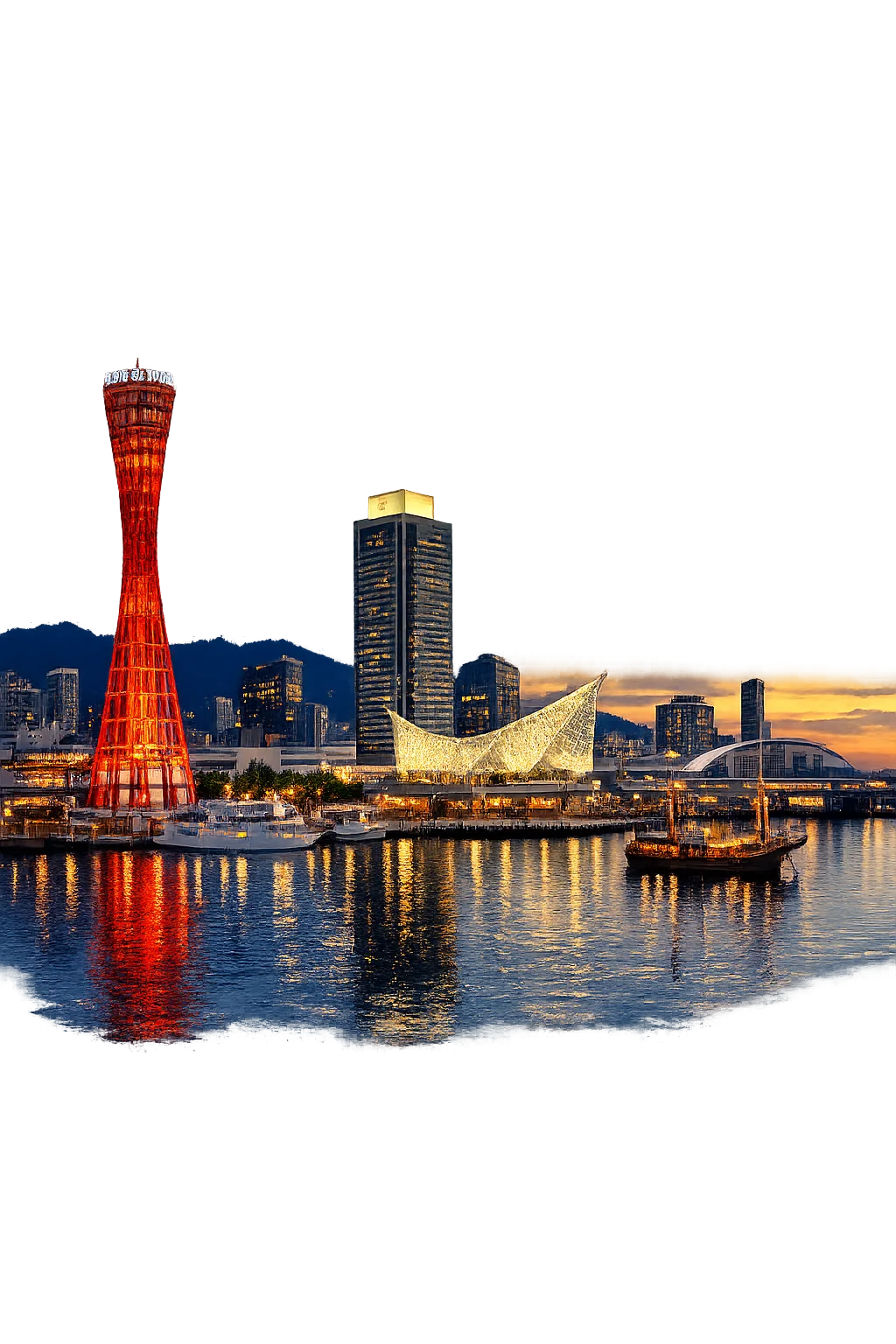
How Kōbe was rebuilt, mark by mark
From the restoration bench — the working notes on Kōbe, kept because the process is the proof.
What We Found
The attestation, as Nihon Shoki (Empress Jingū chapter; traditional founding of Ikuta Shrine, AD 201) and Heike monogatari and Azuma Kagami (the Fukuhara-kyō episode of 1180) preserve it: 神戸. Meaning: "Door to the gods or support door".
The figure behind the name: Kōbe has no myth in the divine sense — its lore is the documentary record of a port that became a threshold: a shrine estate whose serving families gave the city its name, a medieval harbour where a warlord briefly planted a capital, and a modern port-city rebuilt from earthquake ruins.
What the Name Carried In
The Shrine at the God-Door. The foundation tradition recorded in the Nihon Shoki makes Empress Jingū the foundress of Ikuta Shrine in AD 201, on her return from the Korean campaign; the shrine enshrines Wakahirume, the heavenly weaving maiden. Its sacred grove, Ikuta-no-mori, stood at the only flat ground between the Rokkō mountains and the sea, and for sailors crossing the Inland Sea it was the landmark of shelter.
Owada Anchorage and the Capital That Failed. By the Heian period the harbour below Ikuta appears in court records as Owada-no-tomari, the anchorage where ships bound between the capital and western Japan rode out the weather; it grew rich on Inland Sea tolls and, under the Taira, on trade with Song China. In 1180 Taira no Kiyomori — now the realm's chief minister — moved the imperial capital itself to his own estate at Fukuhara, in modern Kōbe, hoping to hold court and commerce in one hand (Heike monogatari; Azuma Kagami).
A spelling that has to carry stories like these is not a label. It is equipment.
Where It Stood Before Us
Ikuta Shrine's cultic deposits anchor the city's 'god-door' toponym, while Sakuragaoka's Yayoi bronze bells and the Goshikizuka kofun attest early elite authority around the harbour. Medieval Kyōgashima anchorages and the Kitano foreign-settlement excavations trace Kōbe's evolution from shrine estate to maritime threshold. The 1995 earthquake recovery layers document modern urban reconstruction directly above earlier port installations. The bench inherits all of it — the web temple is the newest site, not the first.
What We Kept
The evidence, mark by mark — 1 feature the keyboard form kobe cannot hold:
- o → ō — Macron: long vowel. Kept.
What We Rejected
kobe as the primary form. It survives as the convenience it is; it does not get to lead. The hierarchy is full restoration first, and this name can afford to stand at the top of it.
What We Set Down
Kōbe — What survives here cannot be shown in ASCII: a feature of the original that the fallback alphabet flattens. That is the Tier-1 test, and this name passes it without argument.
For the voice: 'KOH-beh' — hold the first vowel roughly twice as long as the second, without stress in the English sense.
The temple stands at /kobe/ — the notes above are public in its Scholarly Edition, sources and all.
At a Glance
- Restored name: Kōbe
- ASCII form: kobe
- Meaning: "Door to the gods or support door"
- Domain of influence: Port City, Hyōgo
- Pantheon: Japanese
- Classification: Tier 1
- Original script: 神戸
- Series: The Restoration Files, No. 262 of 546
The File Continues
The temple's founding dispatch tells the name's story; its Resonance File reads the myths into the industries; the blog index holds the whole archive.
Continue the series — previous file: Kleiṓ (read it here) · next file: Kǒngzǐ (read it here).
The Restoration Files are written from the same canonical record as the temples themselves: the lexicon, the lore catalog, the pattern atlas, and the cited scholarly sources. If a file ever disagrees with its temple, the temple is right — tell us, and the file will be corrected.