PuniCodex

Extended Lore

Kōbe — The Deeper Record

Etymology · Orthography · Cult · Iconography · Reception · Sources

Preserves vowel length Kōbe.com
Kōbe — Port City, Hyōgo
01

At a Glance

Kōbe — every fact links to its home

PantheonJapanese
DomainPort City, Hyōgo
Original Script神戸 →
Primary Sources2 cited →
02

Etymology & Word Family

From original script to Unicode restoration — the full etymology page →

Proto-sino-tibetan 神戸 god + door, gate
Original Script 神戸 Kōbe — "Door to the gods or support door"
Unicode Restoration Kōbe Restored stress, length, and script
Modern ASCII kobe Plain-ASCII fallback

From Japanese 神戸 (Kanbe) "god's door"; ancient shrine port.

03

Unicode Character Breakdown

Character-by-character philological analysis

CharacterUnicodeNameBlockPhonetic Role
KU+004BLatin Capital Letter KBasic LatinSame
ōU+014DLatin Small Letter O with MacronLatin Extended-AMacron: long vowel
bU+0062Latin Small Letter BBasic LatinSame
eU+0065Latin Small Letter EBasic LatinSame

The restoration of Kōbe preserves what it can of the original phonology — stress and vowel length for Greek names, distinctive letters and diacritics for every other tradition.

04

Cult & Worship

How the sacred was kept — rites, sanctuaries, remains

The Cult

The cult at the root of Kōbe is Ikuta Shrine's. It enshrines Wakahirume, the heavenly weaving maiden, and its priesthood was the hereditary kanbe — the 'god-door' households whose very title became the city's name. Their shrine stands as it has for centuries in downtown Kōbe, its sacred grove, Ikuta-no-mori, a surviving pocket of the ancient forest between mountain and sea. The ritual calendar still turns on the old rhythms: the spring rice-planting rite, in which seedlings are set in the shrine's field to secure Wakahirume's favor for the year, has been kept up without interruption and is registered as an intangible folk cultural property, and the New Year pilgrimage pours the city through its gates in the first days of January. Neighboring Nagata Shrine and the modern Minatogawa Shrine extend the sacred map, and since 1995 the January commemorations at the earthquake memorial have added a civic rite that is new, crowded, and sincere. No figure is worshipped here — but a service is: the kanbe's ancient office, keeping the door of the god.

In the Earth

Ikuta Shrine's cultic deposits anchor the city's 'god-door' toponym, while Sakuragaoka's Yayoi bronze bells and the Goshikizuka kofun attest early elite authority around the harbour. Medieval Kyōgashima anchorages and the Kitano foreign-settlement excavations trace Kōbe's evolution from shrine estate to maritime threshold. The 1995 earthquake recovery layers document modern urban reconstruction directly above earlier port installations.

05

Iconography

How Kōbe was imaged across the ages

The Image

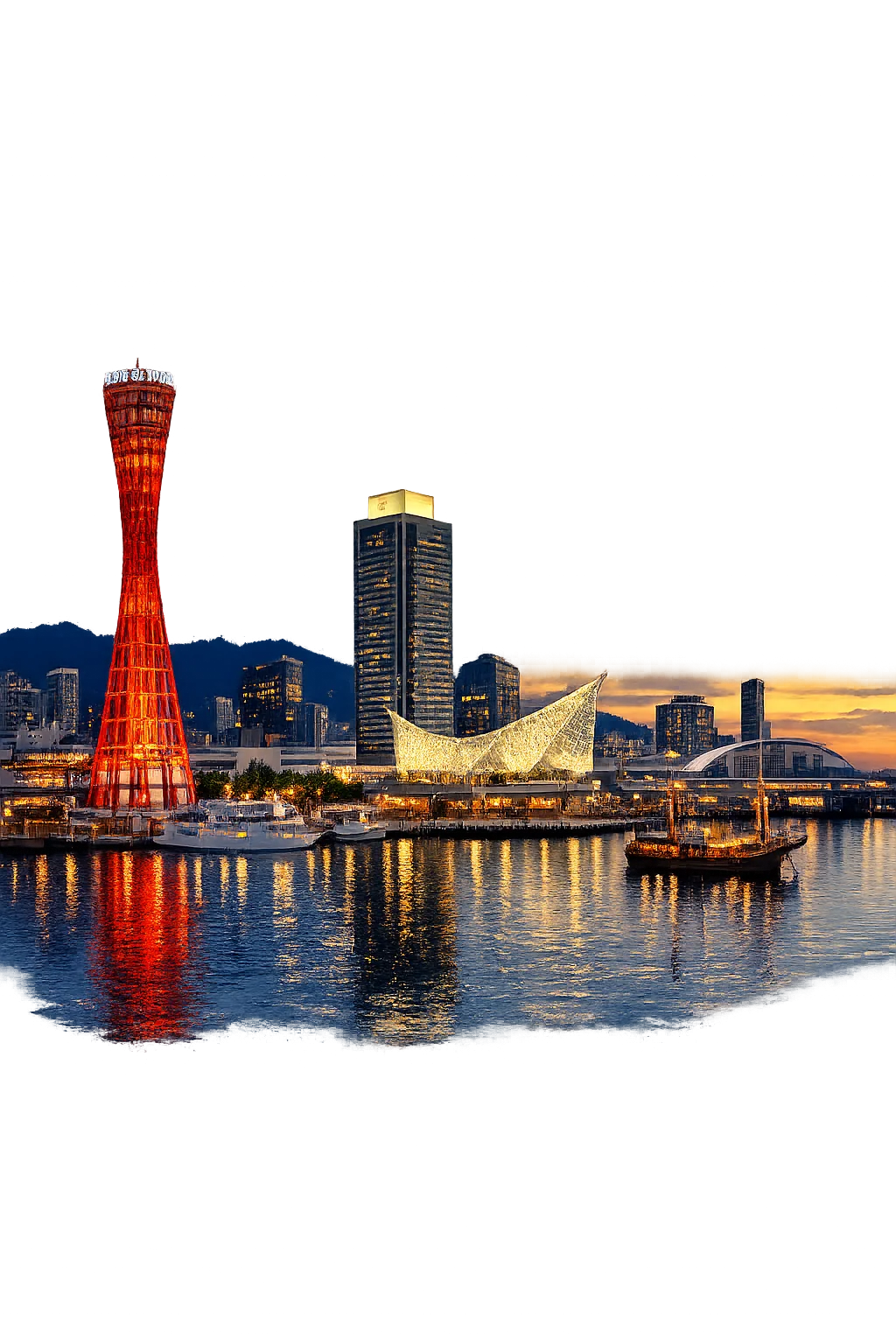
A city has no attributes, so Kōbe is imaged by its thresholds. The first image is the sacred grove: Ikuta-no-mori, the dark pocket of forest between the Rokkō ridge and the sea, appears in Edo-period guidebooks to the Sanyō road as the landmark of the port. The second is the veranda town: after 1868 the ijinkan of the Kitano hills — clapboard, fretwork, chimneys — gave the city its foreign face, and early photography fixed the type; the foreign settlement is the view labelled 'Japan' in the era's stereograph sets, where Kōbe is usually the first Western-looking sight. The third image is industrial and unsentimental: gantry cranes, container stacks, and the harbor skyline that signalled postwar recovery — interrupted forever by the photograph the world knows best, the elevated expressway toppled onto its side in 1995. Grove, veranda, gantry, fallen highway: four pictures of one threshold.

06

Reception & Transformation

The name after its own age — transmission, translation, survival

Afterlives

Kōbe's name travelled the way its harbour did — by document and trade. The Nihon Shoki fixed the shrine's legendary founding in the early eighth century, and from the Heian period onward the title kanbe, 'god-door,' the hereditary keepers of Ikuta, appears in court and estate records as the place-name of the stretch between mountain and sea. The medieval war-tale Heike monogatari carried the harbour into national memory as Fukuhara, the capital that failed, and the shogunate's Azuma Kagami logged its trade. For early modern Japan, Kōbe was a waystation on the Sanyō road, its grove a celebrated view. Then the treaties made the name global: from 1 January 1868 the open port of Hyōgo-Kōbe appeared on Western charts, in shipping schedules and stereographs, as Japan's doorway — and the kanji 神戸, 'god-door,' acquired the flattering gloss foreigners gave it. The twentieth century added two chapters to the name's journey: the earthquake of 1995, after which 'Kōbe' became worldwide shorthand for urban catastrophe and reconstruction, and the scholarship of the Kobe City Museum, which has made the port's layered archaeology — shrine estate, medieval anchorage, treaty port, modern metropolis — a documented story rather than a legend.

Identifications Across Traditions

Kōbe has always been a place where worlds overlap.

Shinto and Buddhism shared the city's sacred landscape for centuries, with Ikuta Shrine and nearby Buddhist temples serving overlapping communities. After 1868, Western Christianity, Islam, Judaism, and Freemasonry established visible presences alongside native traditions. The result is a layered city: a Shinto shrine stands a short walk from a mosque, a synagogue, and a former foreign consulate. Kōbe's culinary fame — Kōbe beef, sake from Nada, Chinese food in Nankinmachi — is itself a product of this long encounter.

Modern Legacy

Kōbe is the city Japan built to face outward.

It was one of the first ports to reopen to the world in the modern era, and it remains a symbol of cosmopolitan openness and disaster resilience. The Great Hanshin Earthquake recovery became a global textbook for urban reconstruction. Kōbe beef, Arima Onsen, and the Kitano ijinkan attract visitors, while the port keeps the city economically tied to East Asia. In Japanese popular memory, Kōbe represents both the rewards and the risks of living on a fault line, literal and historical.

08

The Original Script Note

What the written record preserves — and what it does not

Original Script

神戸 reads 'god-door': the hereditary shrine households — the kanbe — who kept the doors of Ikuta Shrine and served its goddess, listed in the Engishiki's early-tenth-century shrine registers. The port city took the priests' name: when the harbour opened to foreign trade in 1868, the new settlement borrowed the name of the shrine's service families rather than the older provincial toponym. The characters preserve, in a modern industrial city, the memory of who once held the keys.

09

The Meditation

What Kōbe means — beyond the dictionary

Most names in this lexicon belong to gods. Kōbe belongs to a rarer class: a name that remembers a service. 神戸 — the 'god-door', the shrine household — was the title of the hereditary families who kept the doors of Ikuta Shrine, and the city took their title rather than a lord's name, a battle, or a river. The choice set the city's character early: Kōbe has always been defined by what passes through it.

Everything since has confirmed the naming. The shrine estate became Owada anchorage; the anchorage a treaty port; the treaty port a cosmopolitan hillside and one of the world's great harbours. Even the catastrophe fits the pattern — a city on an active fault line, named for a threshold, rebuilding itself at the boundary where mountain, sea and history meet. To restore the long vowel of Kōbe is a small courtesy to a city that has spent fifteen centuries holding doors open.

10

Frequently Asked Questions

Deep-dives into the cult, attestation, reception, and sources of Kōbe

01How do we know how Kōbe was worshipped?

Ikuta Shrine's cultic deposits anchor the city's 'god-door' toponym, while Sakuragaoka's Yayoi bronze bells and the Goshikizuka kofun attest early elite authority around the harbour. The full cult record →

02Where do the earliest attestations of Kōbe come from?

The record rests on Nihon Shoki (Empress Jingū chapter; traditional founding of Ikuta Shrine, AD 201), Heike monogatari and Azuma Kagami (the Fukuhara-kyō episode of 1180), Ansei Treaties (1858) and the opening of the Port of Hyōgo (1868), among 5 cited works. The full source apparatus →

03How did later traditions reinterpret Kōbe?

Kōbe's name travelled the way its harbour did — by document and trade. Reception & transformation →

04What do the surviving images of Kōbe actually show?

A city has no attributes, so Kōbe is imaged by its thresholds. The iconography →

05What does the written record of Kōbe actually preserve?

神戸 reads 'god-door': the hereditary shrine households — the kanbe — who kept the doors of Ikuta Shrine and served its goddess, listed in the Engishiki's early-tenth-century shrine registers. The Original Script note →

11

Scholarly Sources

The philological foundations of this restoration

Every claim on this page is grounded in established scholarship. The orthographic restorations follow disciplinary convention. The etymological chain follows the best available reference works. This is not invention — it is resurrection through scholarship.

◈

Lexicography & Philology

  • Hepburn
◎

Primary Texts

  • Kojiki
  • Nihon Shoki (Empress Jingū chapter; traditional founding of Ikuta Shrine, AD 201)
◉

Archaeology & Art History

  • Guth, C. Art of Edo Japan; Kidder, J. E. Early Japanese Art.
✦

Religious Studies

  • Heike monogatari and Azuma Kagami (the Fukuhara-kyō episode of 1180)
  • Ansei Treaties (1858) and the opening of the Port of Hyōgo (1868)
  • Kobe City Museum (archaeology of the foreign settlement and the port)
  • Japan Meteorological Agency and Hyōgo Prefecture records (the 1995 Great Hanshin-Awaji Earthquake)
Return

The Surface Awaits

You have traced the name from its earliest attestation to its Unicode restoration. Now return to the myth. The story is where the name lives.

Back to Lore
Kōbe mascot