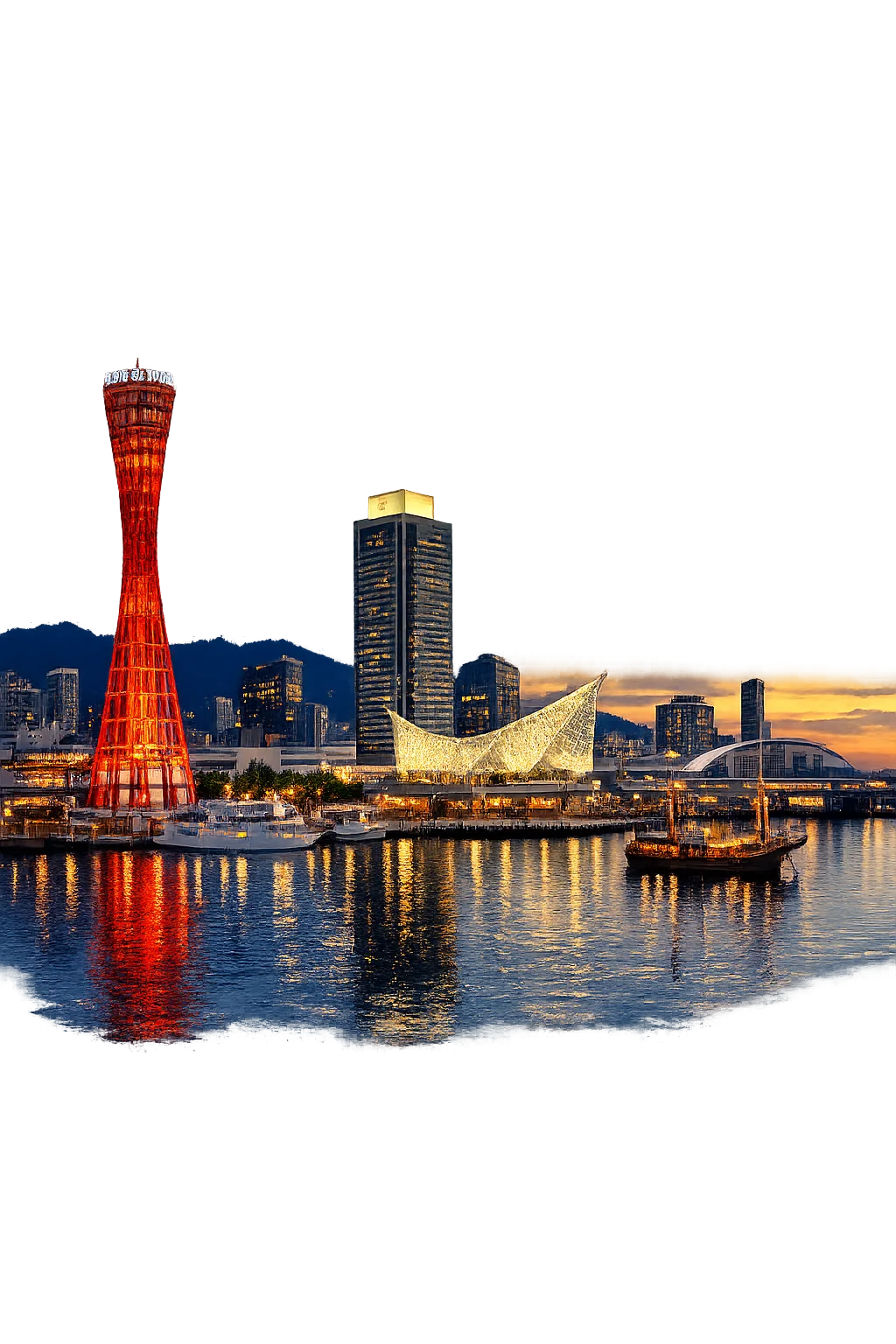
Stories of Kōbe
Kōbe has no myth in the divine sense — its lore is the documentary record of a port that became a threshold: a shrine estate whose serving families gave the city its name, a medieval harbour where a warlord briefly planted a capital, and a modern port-city rebuilt from earthquake ruins.
The foundation tradition recorded in the Nihon Shoki makes Empress Jingū the foundress of Ikuta Shrine in AD 201, on her return from the Korean campaign; the shrine enshrines Wakahirume, the heavenly weaving maiden. Its sacred grove, Ikuta-no-mori, stood at the only flat ground between the Rokkō mountains and the sea, and for sailors crossing the Inland Sea it was the landmark of shelter. The families hereditarily charged with the shrine's upkeep bore the title kanbe — written 神戸, 'god' plus 'door' or 'household' — and it was their title, not a ruler's, a battle, or a river, that became the city's name. The mythless fact is the striking one: a city named for its caretakers, a threshold that took the name of the people who kept it. Even now the shrine's spring rice-planting festival replays that founding, the caretakers' service renewed as civic ceremony.
By the Heian period the harbour below Ikuta appears in court records as Owada-no-tomari, the anchorage where ships bound between the capital and western Japan rode out the weather; it grew rich on Inland Sea tolls and, under the Taira, on trade with Song China. In 1180 Taira no Kiyomori — now the realm's chief minister — moved the imperial capital itself to his own estate at Fukuhara, in modern Kōbe, hoping to hold court and commerce in one hand (Heike monogatari; Azuma Kagami). The courtiers loathed the damp exile, the experiment collapsed within months, and the court returned to Kyōto amid the opening campaigns of the Genpei War. Yet Fukuhara's failure was diagnostic: everyone who tried to rule or trade there learned what Kōbe's bay offered — deep shelter one day's sail from the capital.
The Ansei Treaties of 1858 designated Hyōgo as one of Japan's open ports; political turmoil delayed the opening until 1 January 1868 — the very months in which the shogunate itself fell. Foreign merchants moved into the designated settlement and then onto the Yamate hills, building the ijinkan, the 'foreign mansions' whose verandas, clapboard and chimneys still climb the Kitano slopes. Consulates, churches, a synagogue, a mosque and the Chinese quarter of Nankinmachi followed; Kōbe became Japan's most cosmopolitan city, where bread, coffee, beef and baseball entered national life. The god-door of the kanbe had opened both ways at last: the city named for a shrine's threshold became the threshold of Japan itself, and its most famous product, Kōbe beef, is the flavour of that encounter. Few thresholds in Japanese history have been crossed so completely, or so irreversibly.
On 17 January 1995, at 5:46 in the morning, the Great Hanshin-Awaji Earthquake — magnitude 6.9, striking directly beneath the built-up city — killed 6,434 people, threw down the elevated expressway, burned the port's wards, and shattered what the war had spared (Japan Meteorological Agency and Hyōgo Prefecture records). The recovery became a global textbook: neighbourhoods self-organised faster than the state could move, volunteerism was written permanently into Japanese disaster law, and the port was rebuilt into one of the world's busiest container harbours. The same years gave the world the rebranded delicacies of survival — Kōbe beef from Tajima cattle, sake from the Nada breweries, Arima Onsen in the hills. On a literal fault line between mountain and sea, Kōbe has made fragility itself part of its civic character: a threshold city that knows every door can close, and opens it again.
Shrine Estate · Maritime Threshold · Global Crossroads
Kōbe stands where the Rokkō mountains meet the Inland Sea, a city whose name remembers the families who served the Ikuta Shrine and whose history has turned on thresholds: between shrine estate and port, between seclusion and openness, between destruction and recovery.
The ancient Shinto shrine whose kanbe families lent their title to the city; its forest is Kōbe's mythic origin point.
Owada-no-tomari and the medieval port made Kōbe the arrival point for continental envoys, Buddhism, and trade.
The 1868 opening of the port brought Western merchants to Kitano-ijinkan-gai, creating Japan's most cosmopolitan hillside.
The 1995 Great Hanshin Earthquake levelled districts and broke the port, yet Kōbe rebuilt as a model of urban recovery.
From the original script to the living URL
神戸
The name in its original Japanese form. Kōbe (神戸) is attested in the source tradition — “Door to the gods or support door”. Its macron-length vowels carry the full phonetic and orthographic weight of the source tradition.
kobe
Reduced to plain kobe, the name loses everything that made it specific: macron-length vowels. What remains is an ASCII string that machines can parse but that no longer speaks with its original voice.
Kōbe
The Unicode restoration recovers what ASCII flattened. Kōbe restores macron-length vowels, returning the name to its original written dignity. The domain encodes to Punycode, but the browser displays the truth.
Kōbe.com → xn--kbe-qxa.com
The non-ASCII characters in Kōbe are encoded while the ASCII remains visible. To the DNS, it is Punycode. To humanity, it is Kōbe.
Owned, ideal, and ASCII forms of Kōbe
Kōbe
Restores 神戸. The live temple domain — kōbe.com.
kobe
Flattens 神戸. The plain ASCII fallback — what DNS and legacy systems see.
How Kōbe was spoken
How Kōbe travels from ancient script to the modern URL
Japanese 神戸 Kōbe; from 神 kami “god, divine" + 戸 to “door", interpreted as “door to the gods" or “support door".
Port City, Hyōgo
The Unicode restoration Kōbe preserves the Hepburn macron; the kanji form is not registrable in .com.
The lore you have read is the living myth. Extended Lore opens the scholarly vault beneath it: the cult and its material remains, a history of the image, the name after antiquity, a meditation on what the name still means, and the full scholarly apparatus — etymology, orthography, sources.
Enter Extended Lore