
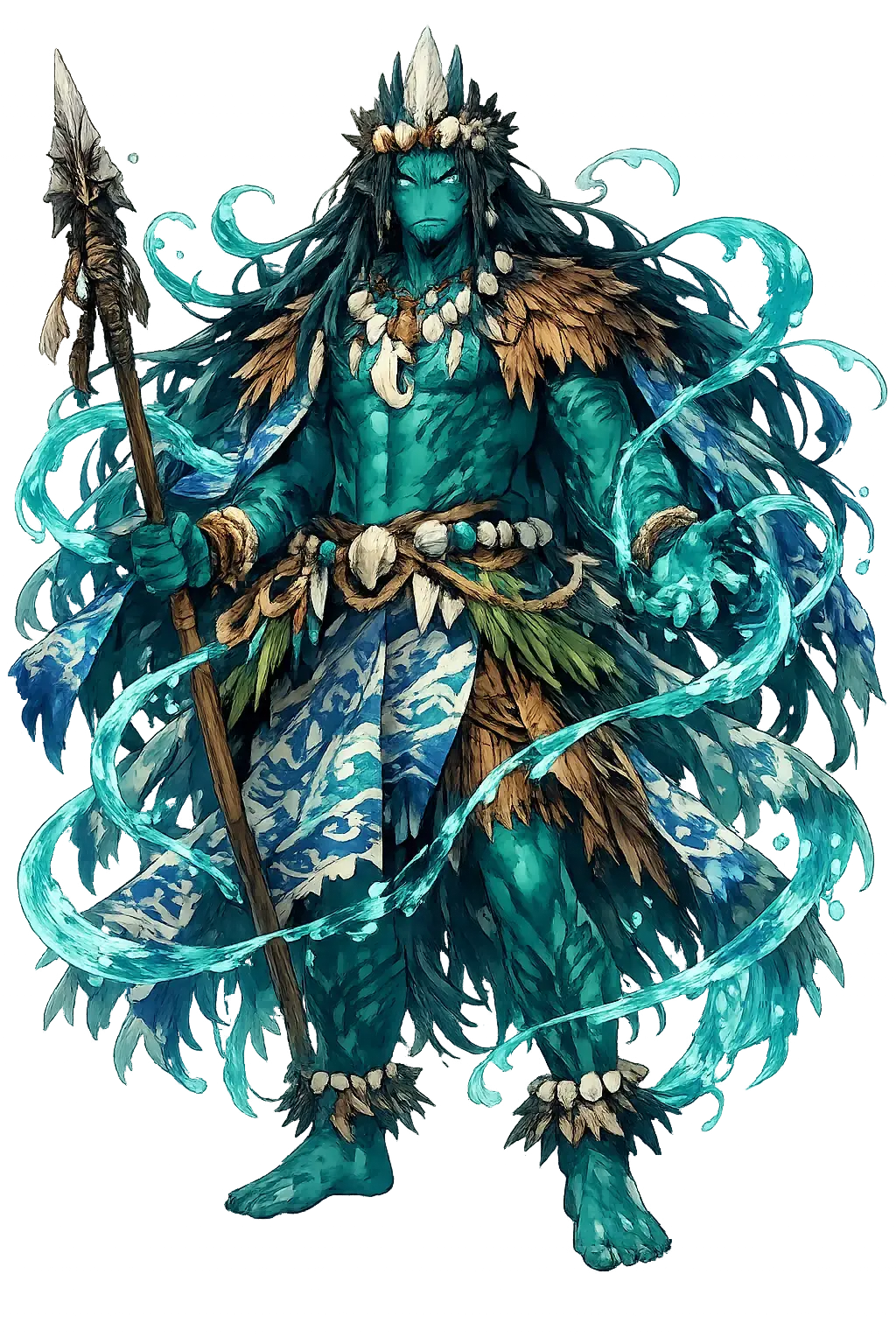
How Kanaloa found its canonical form
The ASCII form kanaloa is not missing anything that this name requires. Kanaloa is the canonical spelling supported by the scholarly record and the tradition's scholarly conventions. This post explains what that form preserves, how it is pronounced, which narratives surround it, and why consistency matters. There are no recovered accents to celebrate; there is something more useful — a spelling whose history can actually be checked.
At a Glance
- Canonical name: Kanaloa
- ASCII form: kanaloa
- Meaning: "Hawaiian god symbolized by the squid or by the octopus, typically associated with Kāne"
- Domain of influence: Ocean, Underworld
- Pantheon: Polynesian
- Restoration: ASCII-equivalent form
- Live domain: kānāloa.com
Overview
Kanaloa (kanaloa) — The Deep of the Pacific — belongs to the Polynesian tradition, where it is catalogued under the domain "Ocean, Underworld". The name means "Hawaiian god symbolized by the squid or by the octopus, typically associated with Kāne".
Kānāloa is the Hawaiian god of the deep ocean, the underworld, and healing. He is the companion and sometimes rival of Kāne, the creator; while Kāne governs fresh water and life, Kānāloa rules the salt sea and the mysteries beneath it. He is associated with the octopus, whose arms reach in all directions like ocean currents.
PuniCodex records the canonical scholarly spelling Kanaloa and serves its temple at kānāloa.com. The displayed form is ASCII-equivalent — a description computed from the displayed form itself. The plain ASCII form kanaloa contains the same letters: no recovered diacritics or special encoding is claimed. The work here is consistent citation, capitalization, provenance, and cultural context.
The Name
The name is attested in modern Polynesian orthographies; macron usage follows each tradition’s reference dictionaries. Etymologically the name means "Hawaiian god symbolized by the squid or by the octopus, typically associated with Kāne".
The canonical spelling Kanaloa matches the conventional scholarly romanization. The plain ASCII form kanaloa contains the same letters, so no lost diacritics or encoding transition is claimed. The editorial work is to fix one reviewed reference spelling, preserve capitalization and provenance, and keep the original evidence visible. The displayed form is ASCII-equivalent — a description computed from the displayed form itself.
The letter-by-letter transformation runs:
- k → K — Same, capitalized
- a → a — Same
- n → n — Same
- a → a — Same
- l → l — Same
- o → o — Same
- a → a — Same
Attested and derived spellings of the name:
- Kānāloa — owned form: Owned stylized form with conventional long-vowel marks; Pukui & Elbert and UH Mānoa write Kanaloa without kahakō
The project holds the domain kānāloa.com (xn--knloa-fwab.com) as the canonical home of this name.
The Original Script
No indigenous writing system is securely attested for individual polynesian names. The form shown is a modern scholarly transliteration.
The form Kanaloa is therefore a scholarly transliteration rather than an attested ancient spelling; it encodes the reconstructed sound of the name for modern use, and no mark in it is decorative.
Hawaiian had no indigenous writing system before European contact. The name is written in the Latin alphabet introduced by missionaries, with macrons added by modern scholars to mark long vowels. Kānāloa is composed of ka (article or intensifier) + nā (plural or intensifier) + loa ('long, vast, far'), together evoking vastness. PUNICODEX preserves both macrons because vowel length is phonemic in Hawaiian and the feature that gives the restored name its dignity, even though the mechanical tier rule keeps the name a plain restoration.
Pronunciation
The reconstructed pronunciation of the name is /kaːˈnaːloa/ — Hawaiian Reconstruction.
Phoneme by phoneme:
- K- — Voiceless velar stop [k], without aspiration.
- -ā- — Long open back unrounded vowel [aː], macron marking length.
- -na- — Alveolar nasal [n] followed by long [aː].
- -loa — [loa], 'vast' or 'far'; the name evokes the broad ocean.
For the modern speaker, the closest approximation is: 'kah-NAH-loh-ah' — both 'a' vowels are long, and the name flows like a slow wave.
Kindred and historical forms of the name:
- Hawaiian — Kānāloa, god of the ocean, the underworld, and healing.
- Polynesian — Tangaroa / Taʻaroa, the pan-Polynesian sea deity.
- Symbol — The octopus or squid (heʻe), his bodily form or kin.
Kānāloa preserves both features: the Hawaiian macrons on both ā's mark long vowels, the distinctive prosodic feature of the language. Without them the name collapses into a different rhythmic shape.
Mythology
Hawaiian myths present Kānāloa as a complementary power to Kāne, the creator. Their partnership structures much of traditional cosmology.
Kāne and Kānāloa (Creation)
In Hawaiian cosmogony, Kāne and Kānāloa are paired creator gods. Together they travel across the primordial ocean, striking the earth with their staffs to create springs and bring forth life. Kāne is the fresh water and the sunlight; Kānāloa is the salt sea that surrounds and sustains the islands. Their partnership is not hierarchy but dynamic balance.
The Discovery of Medicine (Healing)
Kānāloa fell ill, and no remedy could be found. Kāne prayed and was shown the healing plants of the forest and shore. After Kānāloa was cured, the two gods shared this knowledge with humankind, establishing the practice of lāʻau lapaʻau, traditional Hawaiian herbal medicine. Illness and cure both belong to Kānāloa's watery realm.
The Dark Realm (Underworld)
Kānāloa is also the lord of the underworld, the realm beneath the earth and sea where souls journey after death. Unlike the Christian hell, this realm is not primarily punitive; it is the mysterious mirror of the living world, governed by the same god whose waters feed the land above.
The Octopus Reaches the Land of Kāne (Ocean)
David Malo's Hawaiian Antiquities records a famous contention between the gods: the octopus — Kānāloa's kin — reaching into the islands, stretching its arms ashore and into the fresh waters that belong to Kāne. Kāne objects that the realm of land and fresh water is his; the octopus, and so Kānāloa, must keep to the sea. In the version Malo preserves, the octopus is ultimately driven back into the deep, the boundary between the brothers' domains drawn along the waterline itself. The story is told as a boundary dispute, but its subject is the frailty of every line humans draw between sea and shore — a line the tides and the heʻe's arms are always quietly redrawing. Kānāloa stays in the deep, but the deep, the myth insists, is never far.
Symbols & Iconography
The iconography associated with Kānāloa concentrates in a small set of recurring attributes, each a compressed statement about the name:
- Octopus (heʻe) — The many-armed creature of the deep, Kānāloa's kin or bodily form (kino lau); the creation chant Kumulipo remembers the octopus as a survivor held fast from an earlier world-age, and Hawaiian fishermen drew the heʻe from the reef with a cowrie-shell lure (leho heʻe) worked with the fingers like a living hand.
- Ocean waves — The visible movement of his vast body.
- ʻAwa (kava) — The ritual plant Piper methysticum, whose discovery tradition assigns to Kāne and Kānāloa together and whose infusion was offered to the gods before any human drank.
- Dark depths — The realm of the dead beneath land and sea, over which tradition places him as lord.
Modern lexicography counts him among the four great male gods of Hawaiʻi — Kāne, Kū, Lono, and Kānāloa — the fixed quartet of the temple cult. His own embodiment remains zoomorphic: the living octopus, not a carved figure.
- Kava plant — A plant of ritual and healing associated with him.
Archaeology & Evidence
No monument, inscription, or artifact in the current PuniCodex corpus is yet assigned to Kānāloa with certainty. That absence should be read honestly: for a Polynesian name of this type the material record is expected to be thin, and the primary evidence remains the textual testimony gathered in the Scholarly Sources section.
Were such evidence to surface, it would take recognizable forms: votive or dedicatory inscriptions naming Kānāloa, sanctuary or cult remains tied to ocean and iconography matching its traditional attributes (octopus (heʻe) and ocean waves). Each candidate would be weighed against the reconstructed form of the name before entering the scholarly record.
Realm & Domain
Kānāloa is the Hawaiian god of the deep ocean, the underworld, and healing. He is the companion and sometimes rival of Kāne, the creator; while Kāne governs fresh water and life, Kānāloa rules the salt sea and the mysteries beneath it. He is associated with the octopus, whose arms reach in all directions like ocean currents.
Vast Ocean
The Pacific itself is his body, source of food, travel, and the unknown.
Underworld
He receives the dead into the dark realm beneath land and sea.
Healer
Kānāloa and Kāne together discovered medicinal plants and healing arts.
Octopus Kin
The heʻe (octopus) is his animal, shape-shifting and intelligent.
Across Cultures
Kānāloa is clearly related to the pan-Polynesian Tangaroa / Taʻaroa, the great sea deity. In Hawaiian tradition, however, he is less a creator-from-void and more a partner of Kāne, a god of depth and healing. Christian missionaries sometimes identified him with Satan because of his underworld associations, but this identification distorts a figure who was primarily beneficent. Modern Hawaiian cultural revival has reclaimed Kānāloa as a symbol of oceanic sovereignty and ecological wisdom.
Kindred figures in the PuniCodex cross-tradition index include Hádēs, Kēr, Mōt, Persephonē, and Thánatos, each linked through underworld / death.
Cultural Legacy
Kānāloa's name is anchored in the Hawaiian landscape itself: the island of Kahoʻolawe, southwest of Maui, was traditionally named Kanaloa — more fully Kohemālamalama o Kanaloa — and revered as a kino lau (bodily form) of the god, a sacred centre where navigators and kahuna trained for voyages toward the ancestral homeland along the channel Kealaikahiki, 'the path to Kahiki'.
The island's modern history turned the god's name into a rallying cry. Used by the United States Navy as a live-fire training range from 1941 to 1990, Kahoʻolawe was occupied intermittently by Protect Kahoʻolawe ʻOhana activists from 1976, and control was returned to the State of Hawaiʻi in 1994, to be held in trust for a future sovereign Native Hawaiian entity; restoration of the island proceeds explicitly under the name and protection of Kanaloa.
Beyond the island, Kānāloa survives in Hawaiian place names, in the liturgy of the voyaging revival, and in marine-conservation discourse; the octopus, his kin, has become an emblem of intelligent, adaptable life in the Pacific.
The Scholarly Record
The account of Kānāloa given in this edition rests on the witnesses and reference works listed below. The Hawaiian record is unusual in the Pacific for being written substantially by Hawaiians themselves: Malo and Kamakau were Native Hawaiian scholars recording their own tradition in their own language, and the archive they built is the primary witness to the Kāne–Kānāloa cycle.
- Beckwith, Martha Warren, Hawaiian Mythology (Yale University Press, 1940) — the standard English synthesis of Hawaiian tradition, including the Kānāloa chapters.
- Malo, David, Hawaiian Antiquities (Moʻolelo Hawaiʻi), trans. Nathaniel B. Emerson (Bishop Museum, 1903) — the foundational insider account, composed in Hawaiian in the 1830s–40s by a Lahainaluna-educated scholar of chiefly rank.
- Kamakau, Samuel Mānaiakalani, Ka Poʻe Kahiko: The People of Old, trans. Mary Kawena Pukui, ed. Dorothy B. Barrère (Bishop Museum Press, 1964) — traditional history serialized in Hawaiian-language newspapers, 1865–71.
- Valeri, Valerio, Kingship and Sacrifice: Ritual and Society in Ancient Hawaii (University of Chicago Press, 1985) — the major modern structural study of Hawaiian religion and kingship.
- Polynesian Lexicon Project Online (Pollex-Online), founded by Bruce Biggs, ed. Ross Clark — the standard comparative lexicon securing the name's pan-Polynesian cognates.
A Meditation
Kānāloa is the god of what we cannot see from the surface. His realm begins where the light fails and the pressure grows. To think of him is to remember that most of the living world is ocean, and that our small islands of land are exceptions to a watery rule.
In an age of rising seas, Kānāloa is not an abstraction. He is the Pacific that is warming, acidifying, and rising around the islands that bear his name. The old stories say he sustains life; the new stories ask whether we are still worthy of that sustenance. The octopus watches from the deep, arms reaching in every direction, waiting to see what we will do.
The Canonical Spelling
Kanaloa is the canonical spelling used by this temple. The plain ASCII form kanaloa contains the same letters, so there are no lost diacritics to recover and no special encoding transition to explain. What the temple preserves is the reviewed reference form: capitalization, conventional romanization, original evidence, and a stable place to inspect them. The value here is not added decoration; it is fidelity to the attested record.
Name Variations
The lexicon records 1 additional form of the name:
- Kānāloa (owned) — Owned stylized form with conventional long-vowel marks; Pukui & Elbert and UH Mānoa write Kanaloa without kahakō
The temple uses Kanaloa as its primary form because the evidence and the relevant scholarly convention make it the clearest public reference.
Character by Character
The canonical form Kanaloa and the plain ASCII form kanaloa share the same letters. The character list therefore documents continuity rather than recovery: every character is carried forward deliberately, with capitalization serving as the proper-noun convention. No additional mark is inserted merely to make the restoration appear more elaborate.
The Domain Name
The canonical name has a working digital address at kānāloa.com. Because the spelling already uses ordinary Latin letters, visitors and machines read the same address without a special encoding step. The important engineering fact is not transformation but continuity: the temple's public address preserves the reviewed spelling exactly as written.
The Polynesian Pantheon
Kanaloa is one of 24 entries the PuniCodex lexicon catalogues under the Polynesian pantheon. The Pantheon page gathers the tradition's major figures in one place, and the Lexicon lets you filter all 983 restorations by tradition or script — the fastest way to see where this name sits among its kin.
Frequently Asked Questions
What does Kanaloa mean? The traditional gloss is "Hawaiian god symbolized by the squid or by the octopus, typically associated with Kāne."
Which tradition does Kanaloa belong to? Kanaloa is catalogued in the Polynesian pantheon of the PuniCodex lexicon.
Does this name need recovered diacritics? No. Kanaloa is already an ASCII-form canonical spelling. The scholarly work is to preserve the attested convention and its evidence, not to add marks.
Can I use Kanaloa in a normal browser? Yes. The spelling works directly in an ordinary browser, and the type tool can confirm and copy the canonical form.
Where does the scholarly information come from? The entry is built from lexica, inscriptional evidence, and reviewed scholarly sources listed in the Scholarly Edition.
Typing Kanaloa
You do not need a special keyboard to use this name. Kanaloa already uses ordinary Latin letters. The PuniCodex Type Tool lets you confirm the canonical spelling and copy it cleanly, while the original-script notes in the temple show the evidence behind the romanization.
Sister Temples
Other temples in the Polynesian pantheon include Tagaloa, Tāne, and Tangaroa — each with its own restoration story, its own scholarly record, and its own place in the lexicon.
Why This Record Matters
The letters in Kanaloa were never lost, and no replacement marks are needed to make them whole. The burden is instead one of fidelity: every use should carry the same attested spelling and the history attached to it. The PuniCodex temple keeps that form in circulation — as a digital address, a dataset entry, and a scholarly argument — so consistency becomes the easy choice rather than an accident of citation.
Explore Further
This post is one doorway into the temple. The home page carries the full character breakdown and the ambient canvas; the lore page tells the myths in long form; the Scholarly Edition preserves the sources, pronunciation data, and revision history; and the patron wall supports the restoration directly. For the wider map, browse the Lexicon, explore the Pantheon, or return to the PuniCodex blog.
A Closer Look at the Spelling
A canonical name is a small map. In the case of Kanaloa, the route does not lead through diacritics or special letters, because the conventional scholarly spelling already uses the Latin alphabet. The original evidence — the tradition's transmitted record — carries semantic and phonetic information that no romanization can fully reproduce.
By fixing one reviewed spelling as the public reference, the project prevents the drift that occurs when a name is romanized differently in every article, map, and database. The character list shows exactly what is carried forward. "No change" here means a deliberate choice to keep the name stable, searchable, and faithful to the record.
Related Names
Sources
The full scholarly apparatus — every citation, revision, and review — lives in the Scholarly Edition. Key references for this post:
- Kahoʻolawe Island Reserve Commission, Ola i ke Kai o Kanaloa (State of Hawaiʻi).
- Beckwith, Hawaiian Mythology.
- Malo, Hawaiian Antiquities.
- Beckwith, Martha, Hawaiian Mythology (1940), on the Kāne–Kānāloa cycle and the ʻawa tradition.
- Beckwith, Martha, ed., The Kumulipo: A Hawaiian Creation Chant (1951); Buck, Peter (Te Rangi Hiroa), Arts and Crafts of Hawaii (1957), on the leho heʻe octopus lure.
- Lexicon authorities for this entry: Beckwith, Malo.