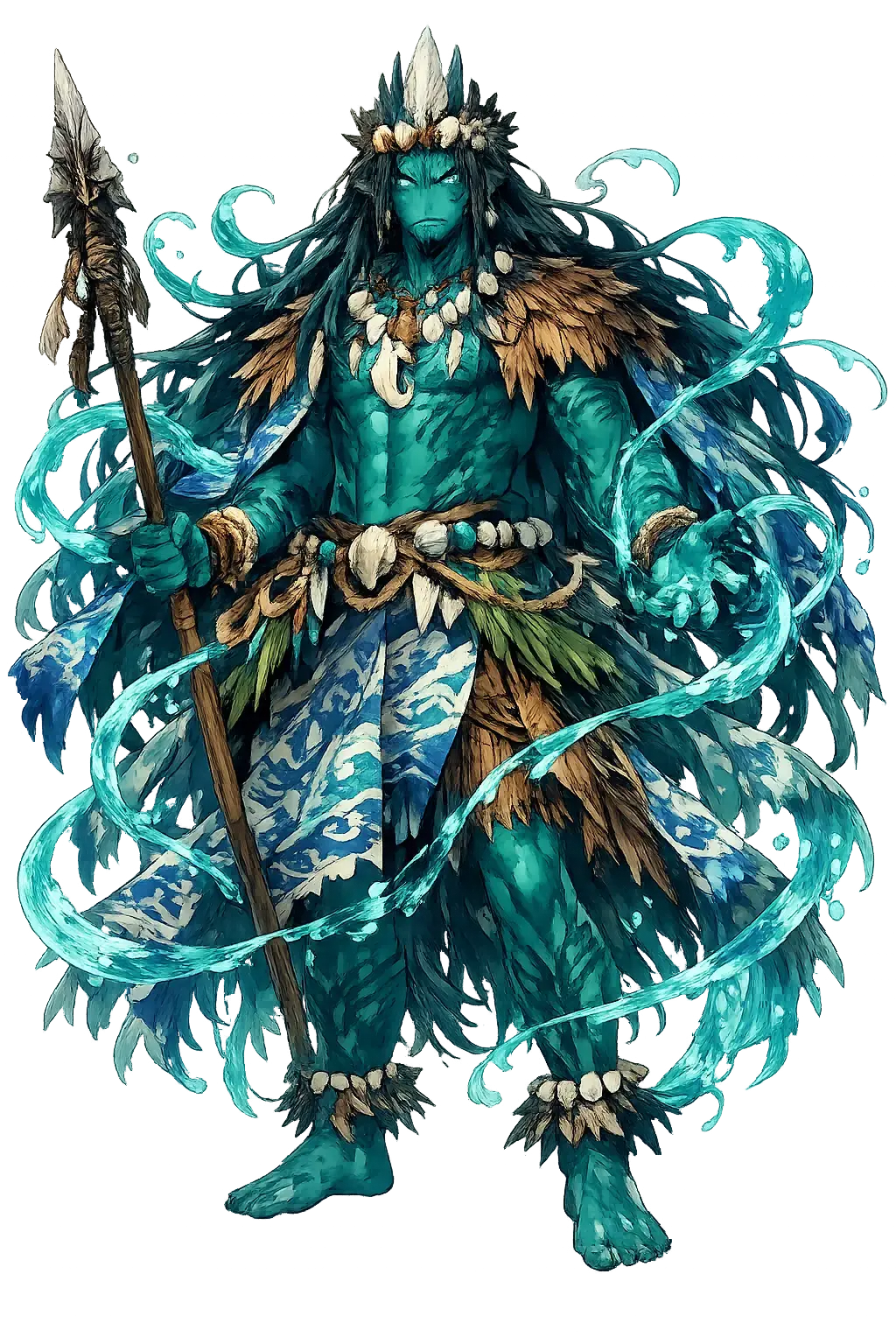
Stories of Kanaloa
Hawaiian myths present Kānāloa as a complementary power to Kāne, the creator. Their partnership structures much of traditional cosmology: one god of fresh water and daylight, one of salt sea and depth, together covering the whole of the living world.
In Hawaiian cosmogony, Kāne and Kānāloa are paired creator gods. Beckwith's Hawaiian Mythology preserves the tradition that the two traveled together across the primordial ocean, striking the earth with their staffs to open springs of fresh water — Kāne's gift of life in the midst of Kānāloa's salt realm — and calling forth the plants and creatures of the islands. Kāne is the fresh water and the sunlight; Kānāloa is the salt sea that surrounds and sustains the land. Their partnership is not hierarchy but dynamic balance: no island exists without both the spring and the surrounding ocean, and the two gods are invoked together so often that the pairing itself became a formula of blessing. The myth encodes an ecological truth the Hawaiians lived by — life on an island is a negotiation between land and sea, and neither partner can be dispensed with.
The healing tradition, recorded by Kamakau and Malo, begins with Kānāloa himself falling ill, and no remedy in the world able to help him. Kāne prayed and was shown the healing plants of the forest and shore; after Kānāloa was cured, the two gods shared this knowledge with humankind, establishing the practice of lāʻau lapaʻau, traditional Hawaiian herbal medicine, and ordaining the kahuna lāʻau lapaʻau who guarded the recipes — which plant for fever, which for broken bone, which for the sickness of the soul — as a sacred trust handed down within families. Illness and cure both belong to Kānāloa's watery realm — the same depths that take life also restore it. The story makes the underworld-god the founder of medicine: only the power that rules decay understands how to reverse it.
David Malo's Hawaiian Antiquities records a famous contention between the gods: the octopus — Kānāloa's kin — reaching into the islands, stretching its arms ashore and into the fresh waters that belong to Kāne. Kāne objects that the realm of land and fresh water is his; the octopus, and so Kānāloa, must keep to the sea. In the version Malo preserves, the octopus is ultimately driven back into the deep, the boundary between the brothers' domains drawn along the waterline itself. The story is told as a boundary dispute, but its subject is the frailty of every line humans draw between sea and shore — a line the tides and the heʻe's arms are always quietly redrawing. Kānāloa stays in the deep, but the deep, the myth insists, is never far.
Kānāloa is also lord of the underworld, the realm beneath the earth and sea where souls journey after death — a kingdom often imagined, as Beckwith notes, as a great house of coral and shell at the bottom of the sea. Unlike the Christian hell, this realm is not primarily punitive; it is the mysterious mirror of the living world, governed by the same god whose waters feed the land above. The kahuna, in the tradition recorded by Kamakau, addressed prayers to Kānāloa when illness dragged a soul toward that dark kingdom, asking the god who rules both healing and the deep to give the sick back to the sunlit world. Death, in his keeping, is less an ending than a change of address — from the island of Kāne to the house of Kānāloa.
Sea, Underworld, and Healing
Kānāloa is the Hawaiian god of the deep ocean, the underworld, and healing. He is the companion and sometimes rival of Kāne, the creator; while Kāne governs fresh water and life, Kānāloa rules the salt sea and the mysteries beneath it. He is associated with the octopus, whose arms reach in all directions like ocean currents.
The Pacific itself is his body, source of food, travel, and the unknown.
He receives the dead into the dark realm beneath land and sea.
Kānāloa and Kāne together discovered medicinal plants and healing arts.
The heʻe (octopus) is his animal, shape-shifting and intelligent.
From the original script to the living URL
Kanaloa
The name survives in scholarly transliteration. Kanaloa is the standard Polynesian romanisation, documented in academic sources — “Hawaiian god symbolized by the squid or by the octopus, typically associated with Kāne”. Because the spelling uses only Latin letters, the form is the same in both ASCII and Unicode.
No indigenous writing system is securely attested for individual polynesian names. The form shown is a modern scholarly transliteration.
kanaloa
The plain kanaloa form is identical to the Unicode restoration. Because this name is already written in Latin letters, no diacritics, stress, or script information were lost — only capitalization differs.
Kanaloa
The Unicode restoration does not need to recover lost marks for Kanaloa. Its value is canonical spelling and consistent cataloguing, not the reconstruction of erased orthography. The domain is readable as-is to both DNS and humanity.
Kanaloa.com
This restoration is written entirely in ASCII letters — no Punycode encoding stands between Kanaloa and the DNS. The domain reads identically to machines and to human eyes.
Owned, ideal, and ASCII forms of Kanaloa
Kānāloa
The live temple domain — kānāloa.com.
kanaloa
The plain ASCII fallback — what DNS and legacy systems see.
How Kanaloa was spoken
How Kanaloa is preserved in writing
No indigenous writing system is securely attested for individual polynesian names. The form shown is a modern scholarly transliteration.
Contribute scholarly provenance →The lore you have read is the living myth. Extended Lore opens the scholarly vault beneath it: the cult and its material remains, a history of the image, the name after antiquity, a meditation on what the name still means, and the full scholarly apparatus — etymology, orthography, sources.
Enter Extended Lore