
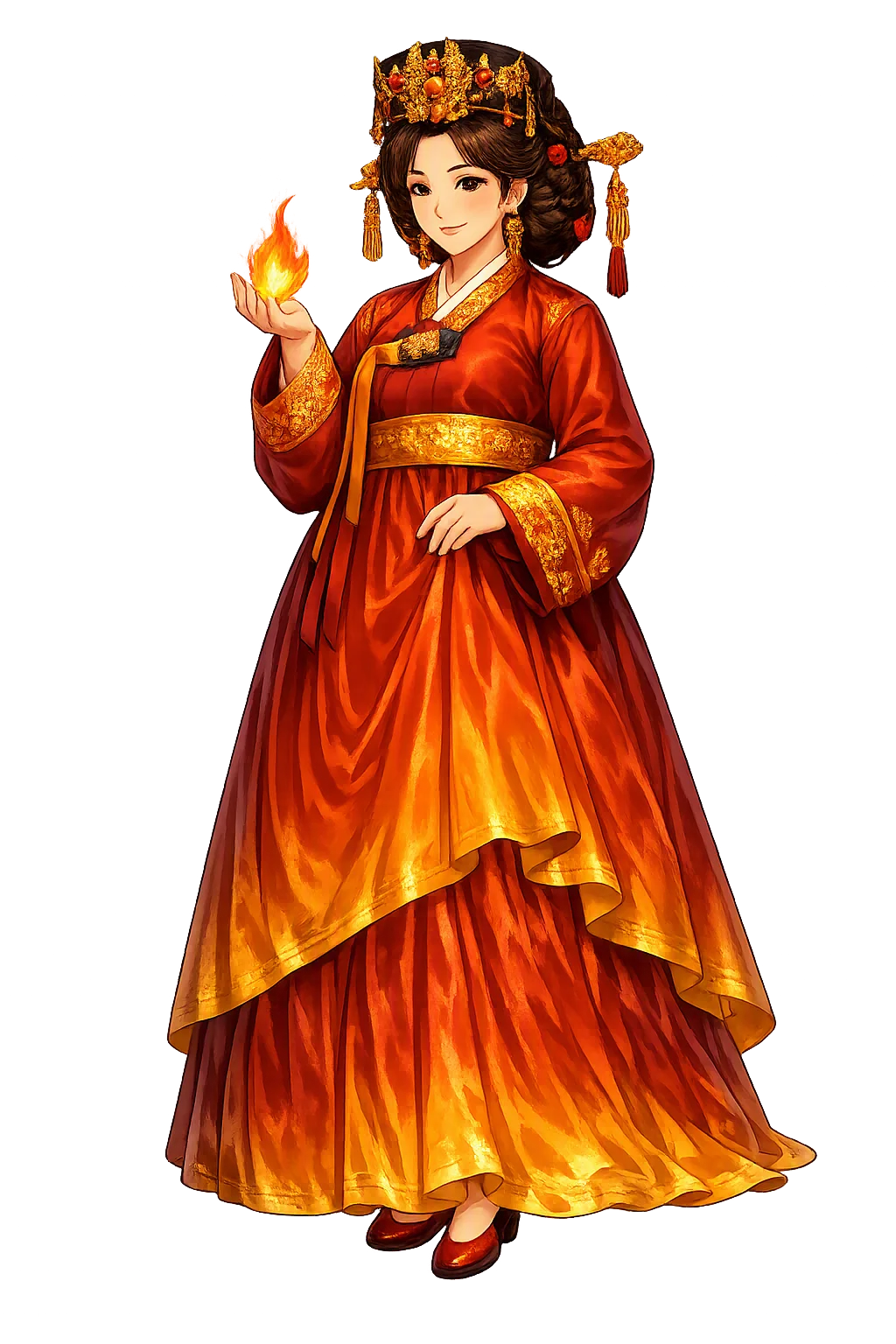
Jowangshin: the stories first, then the spelling
The marks in Jowangshin make the most sense standing next to the myths they have to carry. So the myths come first.
The Stories That Carry the Name
The Munjeon Bonpuri: Yeosan Buin's Death and Return. The fullest origin myth of the hearth goddess is the Jeju epic Munjeon Bonpuri, chanted by the island's shamanic simbang. Its heroine — Yeosan Buin in most versions, Noga-danpung-agissi in others — marries Mun-doryeong and suffers at the hands of her mother-in-law, who slanders her until the household casts her out; she dies unjustly and her small sons are left to wander. The boys win help from Sumyeong-janggun, the god of longevity, whose mugwort water raises the dead: she rises, and in the epic's decisive scene the heavenly king Cheonjiwang assigns the couple their posts — she becomes Jowang, the kitchen goddess who keeps watch over every hearth, and her husband becomes Seongju, the guardian of the house-site itself.
The Five Taboos of the Hearth. Around Jowangshin grew a code of kitchen conduct, the so-called five taboos, recorded in folklore collections and still repeated by older Koreans: do not curse or quarrel in the kitchen; do not sit on the hearth; do not rest your feet on the hearth or against the cooking pots; keep the kitchen clean; and never act disrespectfully before the fire. Each rule worked twice. Practically it kept the cooking space sanitary and the fire safe; spiritually it kept the household's daily conduct out of the report the kitchen god was compiling.
Songje: Sending the Report to Heaven. On the last day of the lunar year — the twenty-third or twenty-fourth of the twelfth month in most regions — the household held Songje, the rite of sending the kitchen god up to file his annual report on the family. The house was cleaned, the kitchen made spotless, and a quiet offering laid out: rice, water, fruit, and above all yeot, malted taffy, offered in the hope that the god's account of the year's quarrels would stick sweetly in his mouth and come out smooth. Some families burned the god's paper image so he could ascend with the smoke, and welcomed a fresh image back after the New Year.
And Here Is What the Spelling Preserves
At a Glance
- Restored name: Jowangshin
- ASCII form: jowangshin
- Meaning: "Kitchen king spirit"
- Domain of influence: Kitchen, Hearth
- Pantheon: Korean
- Classification: Tier 2
- Original script: 조왕신 (竈王神)
- Series: The Restoration Files, No. 250 of 548
The Name Travels
Jowangshin is closely parallel to the Chinese Zao Jun (Kitchen God), and the two figures influenced each other across a thousand years of Sino-Korean exchange — the Korean name itself is a translation of the Chinese title, and the Songje date sits near the Chinese 'Little New Year' sending-off of the Stove God on the twenty-third of the twelfth month. Yet the Korean figure has her own origin epic, the Munjeon Bonpuri, and is embedded in a distinct shamanic ritual world.
The Address It Earned
The temple of Jowangshin stands at /jowangshin/ — lore, scholars, patterns — because a name carrying this much story deserves more than a parking page. The restoration keeps one feature the ASCII form drops. One is enough to matter, and the label says so plainly: Tier-2.
The File Continues
Read the founding dispatch for the name's full story, the Resonance File for the archetype at work — or the whole archive in one sitting.
Continue the series — previous file: Jötunheimr (read it here) · next file: Kꜣ (read it here).
The Restoration Files are written from the same canonical record as the temples themselves: the lexicon, the lore catalog, the pattern atlas, and the cited scholarly sources. If a file ever disagrees with its temple, the temple is right — tell us, and the file will be corrected.