
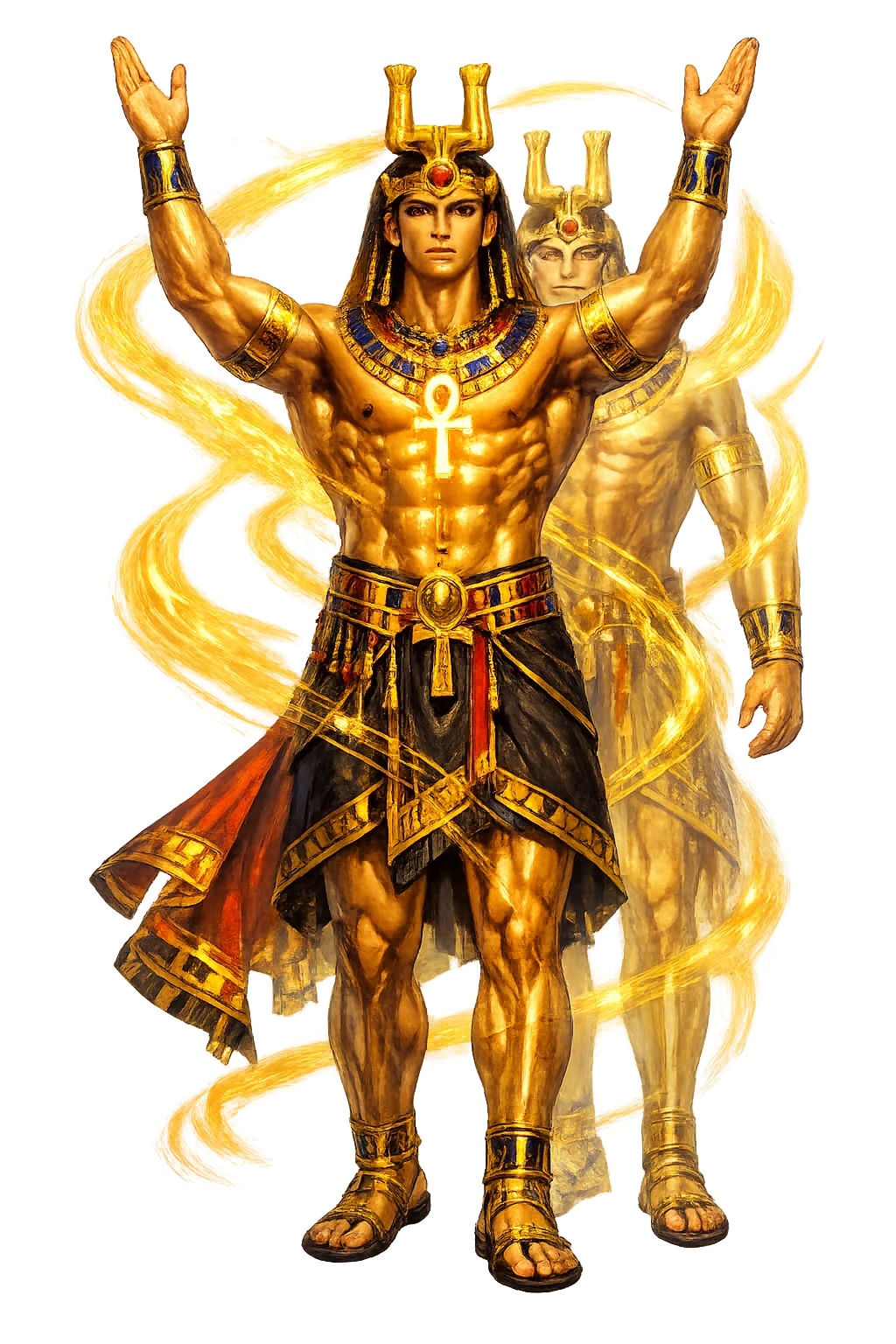
Kꜣ: the stories first, then the spelling
Before the spelling, the story. Kꜣ earns its restoration the old way — through what was actually told.
The Stories That Carry the Name
The Ka Created at Birth. Egyptian texts make the ka a companion formed together with the body itself. In the divine-birth scenes at Deir el-Bahari and Luxor, the ram-headed Khnum fashions the royal child and its ka on the potter's wheel while the frog-headed Heket breathes life into the finished form. The idea is far older than these New Kingdom reliefs: Pyramid Texts utterances already promise the king that his ka will stand at his side among the gods (Pyramid Texts, Utterance 213), and Coffin Texts Spell 80 bears the title 'for making the ka live'.
The Ka After Death. Death divides the person but does not dismiss the ka. The vital force leaves the corpse yet remains bound to it, returning to the mummy or to a statue made in the deceased's likeness — which is why every fine tomb of the Old Kingdom sets a reserve head or ka-statue in the serdab, a sealed chamber with an eye-slot through which the image could watch the sun rise and the offerings arrive. The rite that made this habitation lawful was the Opening of the Mouth, performed before mummy and statue alike: the adze touched the lips, and the ka could again receive breath, water, and bread.
The Ka and the Gods. Kings possess not one ka but many: the royal titulary itself is ka-stuff, and the Horus-name lives as the king's divine double on earth, while Pyramid Texts utterances multiply the king's kas before Atum and the Ennead. The gods keep kas as well — 'Amun, his ka' is a standing formula of the Theban theology, and the ka of Ptah is invoked across the Memphite tradition. This is the ka's deepest office: it is the theological machinery of presence.
And Here Is What the Spelling Preserves
At a Glance
- Restored name: Kꜣ
- ASCII form: ka
- Meaning: "The vital essence, life force, or double of a person. Created at birth and surviving death."
- Domain of influence: Vital Essence, Life Force
- Pantheon: Egyptian
- Classification: Tier 1
- Original script: 𓂓𓏤
- Series: The Restoration Files, No. 250 of 546
The Name Travels
The ka has no direct counterpart in Greek or Roman religion, but related ideas circulated. Greek authors sometimes interpreted Egyptian ka-statues as 'doubles' or 'guardian spirits,' and the Roman genius and Juno concepts may have faintly echoed the idea of a personal life-force.
The Address It Earned
The temple of Kꜣ stands at /ka/ — lore, scholars, patterns — because a name carrying this much story deserves more than a parking page. Tier-1 is not a compliment; it is a measurement. This restoration keeps something the ASCII form provably loses, and the measurement is repeatable.
The Sources Are Open
The myths above are retold from the temple's record; the primary voices are in the Sacred Texts: The Book of the Dead. Nothing in this file outranks them.
The File Continues
Read the founding dispatch for the name's full story, the Resonance File for the archetype at work — or the whole archive in one sitting.
Continue the series — previous file: Jowangshin (read it here) · next file: Kagutsuchi (read it here).
The Restoration Files are written from the same canonical record as the temples themselves: the lexicon, the lore catalog, the pattern atlas, and the cited scholarly sources. If a file ever disagrees with its temple, the temple is right — tell us, and the file will be corrected.