Stories of Jowangshin
The mythology of Jowangshin survives in Korean shamanic epic, household custom, and folklore collections rather than in court chronicles. Its fullest text is the Jeju Munjeon Bonpuri, chanted by simbang; its daily life is the code of the kitchen — taboos, offerings, and the year-end report to heaven.
The fullest origin myth of the hearth goddess is the Jeju epic Munjeon Bonpuri, chanted by the island's shamanic simbang. Its heroine — Yeosan Buin in most versions, Noga-danpung-agissi in others — marries Mun-doryeong and suffers at the hands of her mother-in-law, who slanders her until the household casts her out; she dies unjustly and her small sons are left to wander. The boys win help from Sumyeong-janggun, the god of longevity, whose mugwort water raises the dead: she rises, and in the epic's decisive scene the heavenly king Cheonjiwang assigns the couple their posts — she becomes Jowang, the kitchen goddess who keeps watch over every hearth, and her husband becomes Seongju, the guardian of the house-site itself. The epic was transcribed from living simbang in the 1930s (Akamatsu & Akiba, 1938), and its versions differ in detail, but the through-line is constant: the hearth goddess earned her office through suffering, death, and a mother's vindication. The myth makes the kitchen the one room where a woman who was wronged by her own household now sees everything — and tells heaven.
Around Jowangshin grew a code of kitchen conduct, the so-called five taboos, recorded in folklore collections and still repeated by older Koreans: do not curse or quarrel in the kitchen; do not sit on the hearth; do not rest your feet on the hearth or against the cooking pots; keep the kitchen clean; and never act disrespectfully before the fire. Each rule worked twice. Practically it kept the cooking space sanitary and the fire safe; spiritually it kept the household's daily conduct out of the report the kitchen god was compiling. The taboos fell most heavily on the women who ran the kitchen, and Koreanist scholarship — above all Laurel Kendall's fieldwork — reads Jowangshin as the spirit who made women's unpaid labor cosmically significant: the meal was liturgy, the hearth an altar, and the cook its officiant (Kendall, Shamans, Housewives, and Other Restless Spirits, 1985). The taboo system encodes a theology of the everyday: that no room is too small to be watched, and no task too plain to be sacred.
On the last day of the lunar year — the twenty-third or twenty-fourth of the twelfth month in most regions — the household held Songje, the rite of sending the kitchen god up to file his annual report on the family. The house was cleaned, the kitchen made spotless, and a quiet offering laid out: rice, water, fruit, and above all yeot, malted taffy, offered in the hope that the god's account of the year's quarrels would stick sweetly in his mouth and come out smooth. Some families burned the god's paper image so he could ascend with the smoke, and welcomed a fresh image back after the New Year. The rite is documented from the Chosŏn period onward and remained standard into the twentieth century; it survives today in rural households and in the softer custom of keeping the kitchen clean and well-fed at year's end. Songje turns the calendar into a courtroom drama in miniature: once a year, your own hearth testifies — and the household's best defense is taffy.
Before a family moved into a new house, opened a restaurant, or began any enterprise that would feed people, Koreans held a gosa — a 'praying-to-spirits' rite — and its principal guest was Jowangshin. Kendall's fieldwork in the 1970s describes the gosa table: boiled rice, clear water, dried fish, fruit, and a little alcohol, laid before the hearth or the new stove while the officiant — a shaman in the formal version, the householder in the everyday one — invited the kitchen god to take up residence and asked the blessing of the ancestors (Kendall, 1985). The rite remains visible in modern Korea: many restaurants and homes keep a small shrine shelf near the kitchen, and gosa are still held at openings, moves, and first days. The gosa marks the threshold where a building becomes a home: until the hearth-spirit has been fed, the kitchen is only a room, and a business only an address.
guardian of the hearth, food, and household fortune
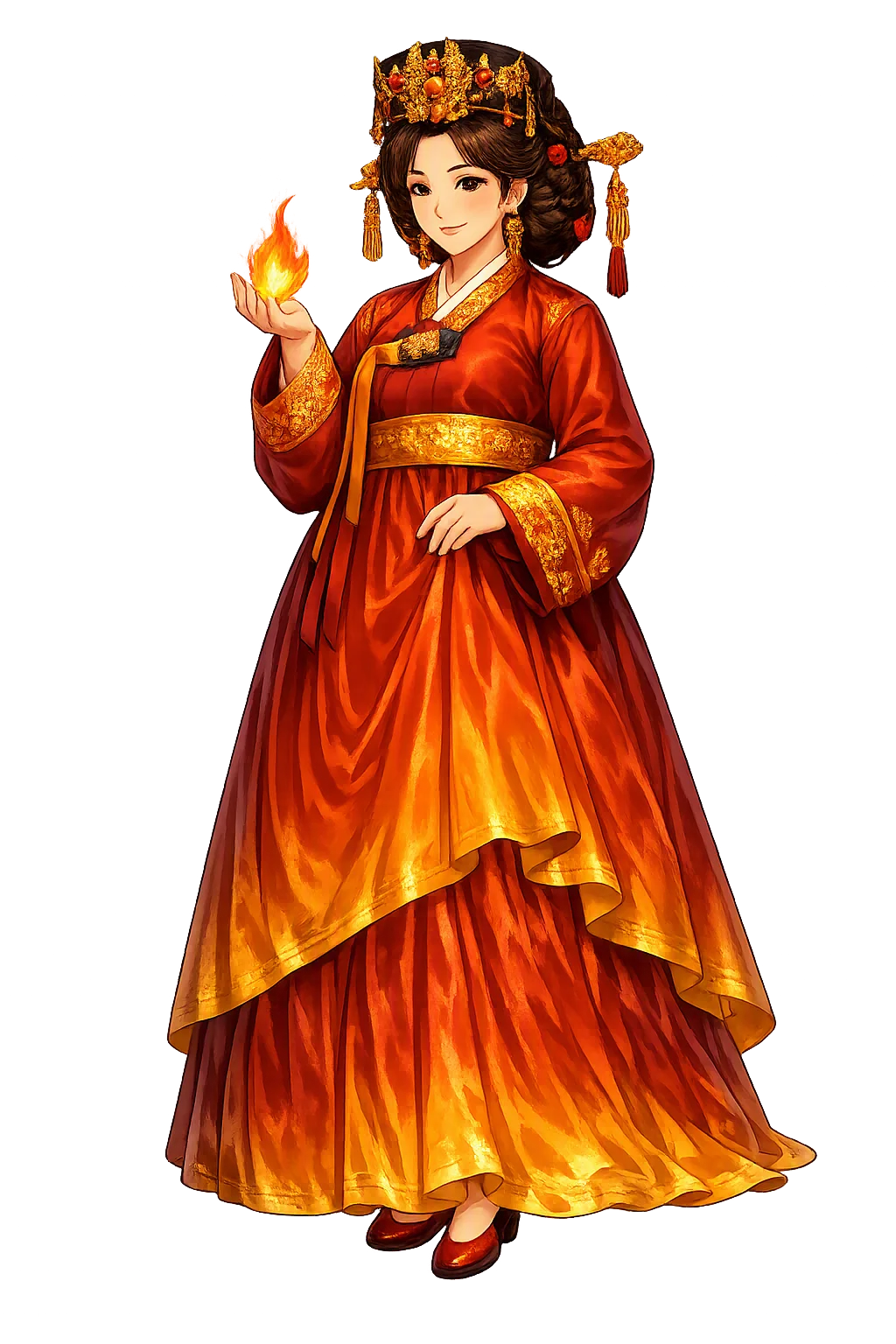
Jowangshin is the kitchen king spirit who protects the hearth, supervises the preparation of food, and reports on the household to heaven in Korean tradition. Jowangshin is the sovereign spirit of the domestic hearth, one of the most important household deities in Korean folk religion. The figure is believed to record the affairs of the household and report them to heaven, so housewives observed taboos such as not cursing in the kitchen and keeping the hearth clean.
Jowangshin rules the hearth as a sovereign deity of the domestic realm.
The fire is both a practical tool and a sacred presence that must be honoured.
Rules of conduct in the kitchen protect the household from spiritual and practical harm alike.
The spirit records household affairs and reports them to the celestial authorities once a year.
From the original script to the living URL
조왕신 (竈王神)
The name in its original Korean form. Jowangshin (조왕신 (竈王神)) is attested in the source tradition — “Kitchen king spirit”. Its original diacritics and script distinctions carry the full phonetic and orthographic weight of the source tradition.
jowangshin
The plain jowangshin form is identical to the Unicode restoration. Because this name is already written in Latin letters, no diacritics, stress, or script information were lost — only capitalization differs.
Jowangshin
The Unicode restoration does not need to recover lost marks for Jowangshin. Its value is canonical spelling and consistent cataloguing, not the reconstruction of erased orthography. The domain is readable as-is to both DNS and humanity.
Jowangshin.com
This restoration is written entirely in ASCII letters — no Punycode encoding stands between Jowangshin and the DNS. The domain reads identically to machines and to human eyes.
Owned, ideal, and ASCII forms of Jowangshin
Jowangshin
Restores 조왕신 (竈王神). The full Unicode restoration. jowangshin.com is not in the PuniCodex collection — it is watched for release; if it drops, this temple upgrades to an owned flagship.
How Jowangshin was spoken
How Jowangshin travels from ancient script to the modern URL
The lore you have read is the living myth. Extended Lore opens the scholarly vault beneath it: the cult and its material remains, a history of the image, the name after antiquity, a meditation on what the name still means, and the full scholarly apparatus — etymology, orthography, sources.
Enter Extended Lore