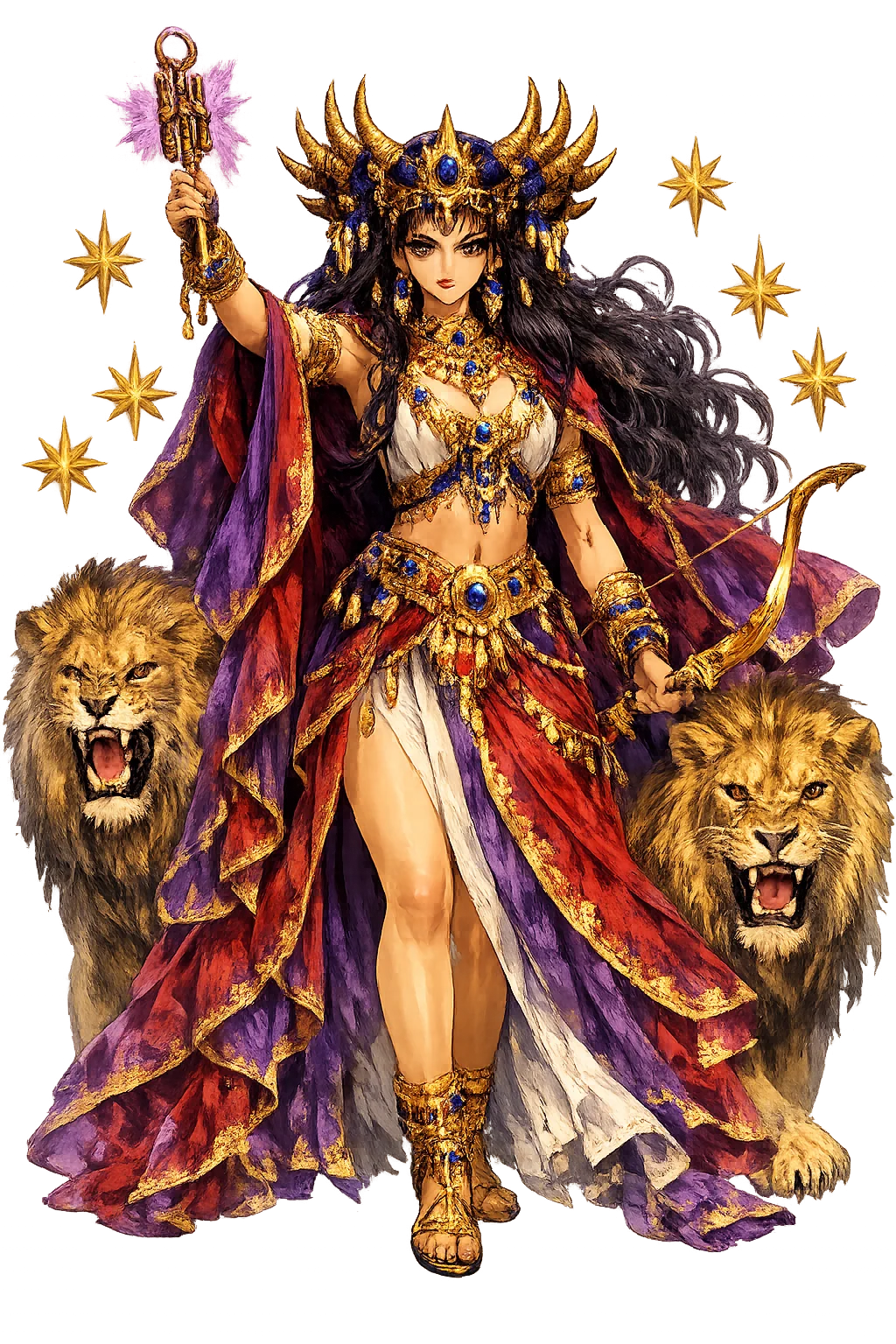
Stories of Ištar
Ištar's myths are stories of extremity: descent into death, demand for the impossible, and the transformation of gender and power. She is never merely an object of desire; she is desire in motion, war in motion, the star that crosses the boundary between heaven and the underworld.
In the Sumerian Descent of Inanna (ETCSL 1.4.1) and its Akkadian retelling, the Descent of Ishtar, the goddess abandons heaven and earth to descend to the netherworld ruled by her sister Ereškigal. At each of the seven gates the porter strips her of a garment or ornament — crown, beads, robe, until she stands naked before the throne of the dead. The Anunnaki fasten on her 'the eye of death'; she is killed and hung on a hook. Her faithful servant Ninšubur pleads at the great gods' doors until Enki fashions two sexless beings who slip past Ereškigal's grief and revive Inanna with the food and water of life. The price of her return is a substitute, and her own husband Dumuzi is sent down in her place. The myth means that descent is survivable but not free: everything that goes down must be ransomed by something of equal value.
In Tablet VI of the Epic of Gilgamesh, Ištar proposes marriage to Gilgameš, king of Uruk — who answers with the most impudent speech in the epic, cataloguing the fates of her previous lovers: Dumuzi, doomed to the underworld year after year; the shepherd, changed into a wolf; the horse, driven to death; and the gardener Išullanu, turned into a frog. Enraged, Ištar ascends to heaven and demands the Bull of Heaven from Anu, threatening to raise the dead to devour the living if refused. The bull descends on Uruk and kills hundreds with its snort before Gilgameš and Enkidu slay it — and Enkidu's ensuing death, decreed by the gods for the insult to Ištar, is the hinge on which the whole epic turns. The myth means that to refuse a goddess is to trigger a chain of consequences no hero can outrun.
The Sumerian sacred-marriage songs (especially the songs of Iddin-Dagan of Isin, ETCSL 2.5.3) celebrate the union of Inanna and Dumuzi, the shepherd-king: the goddess chooses the king as her bridegroom, and their lovemaking guarantees the fertility of the land and the legitimacy of his rule. But the Descent adds the darker clause: when Inanna needs a substitute in the netherworld, her gaze falls on Dumuzi, 'the young man for whom she had cried,' and he is dragged below — until his sister Geštinanna offers to share his exile, so that the two alternate half the year each. The cycle of presence and absence, presence and absence, becomes the rhythm of the agricultural year. The myth means that love and loss are not opposites but a seasonal alternation built into the world's contract.
A hymn known in Old Babylonian and later recensions as Ištar and Ebih tells how the great mountain range refused to bow to the goddess — 'it did not revere me in glory, it did not set its neck to the ground.' Ištar, 'the queen of Heaven and Earth,' arms for war against the landscape itself: she demands weapons from Anu, marches on Ebih, and 'raised my torch, scorched the mountain, poured flame over it,' finishing by laying the rebellious range flat and flooding its valleys. The poem, long read as a hymn to Ištar of Agade's martial triumphs, works at two levels: the goddess's sovereignty extends even over geography, and insubordination — in a person or a mountain — is the one thing she never forgives. The myth means that her dominion is not a metaphor: the world itself is her subject.
The Sumerian city-laments — above all the Lament for Ur (ETCSL 2.2.2), mourning the city's sack by the Elamites around 2004 BCE — give Ištar/Inanna her most haunting role. Before the destruction she leaves her temple, 'like a bird she flew off,' and the city is stripped of its protecting goddess; the Elamite and Shimashki troops move through the unguarded streets while the moon sets on the empty shrines. After the catastrophe she returns and walks through the ruins weeping, while the lament's singer asks her to rebuild the destroyed shrines. The genre means something the love-and-war epics never say plainly: a goddess can leave, and when she leaves, the walls, the canals, and the granaries are all just bricks and dust. Ištar's presence is the condition of the city's reality; her absence is its end.
Love, War, Fertility, Venus
Ištar is the most volatile of the great Mesopotamian goddesses. She is the planet Venus, the morning and evening star; she is sexual desire and reproductive power; she is the frenzy of battle and the protector of kings. No other deity in the ancient Near East so thoroughly unites what later cultures would separate into Aphrodítē and Árēs.
The eight-pointed star of Venus; Ištar is the brightest planet and the celestial sign of the goddess.
The sacred marriage, the life-giving womb, the power that turns desire into offspring and fields into harvest.
She rides into battle with weapons at her shoulders; kings claim her as their divine patron in war.
The lion is her warlike aspect; the dove is her amorous aspect — power and tenderness in one deity.
From the original script to the living URL
𒀭𒀹𒁯
The name in its original Mesopotamian form. Ištar (𒀭𒀹𒁯) is attested in the source tradition — “Lady of Heaven (Akkadian Ištar)”. Its original diacritics and script distinctions carry the full phonetic and orthographic weight of the source tradition.
ishtar
Reduced to plain ishtar, the name loses everything that made it specific: original diacritics and script distinctions. What remains is an ASCII string that machines can parse but that no longer speaks with its original voice.
Ištar
The Unicode restoration recovers what ASCII flattened. Ištar restores original diacritics and script distinctions, returning the name to its original written dignity. The domain encodes to Punycode, but the browser displays the truth.
Ištar.com → xn--itar-g6a.com
The non-ASCII characters in Ištar are encoded while the ASCII remains visible. To the DNS, it is Punycode. To humanity, it is Ištar.
Owned, ideal, and ASCII forms of Ištar
Ištar
Restores 𒀭𒀹𒁯. The live temple domain — ištar.com.
ishtar
Flattens 𒀭𒀹𒁯. The plain ASCII fallback — what DNS and legacy systems see.
How Ištar was spoken
How Ištar travels from ancient script to the modern URL
Akkadian Ištar continues Sumerian Inanna; the name is associated with the planet Venus and with the twin domains of love and war.
Love, War, Fertility, Venus
The Unicode restoration Ištar preserves vowel length; the cuneiform form is not registrable in .com.
The lore you have read is the living myth. Extended Lore opens the scholarly vault beneath it: the cult and its material remains, a history of the image, the name after antiquity, a meditation on what the name still means, and the full scholarly apparatus — etymology, orthography, sources.
Enter Extended Lore