PuniCodex

Extended Lore

𒀭𒀹𒁯 Ištar

Etymology · Orthography · Cult · Iconography · Reception · Sources

Tier 1 Ištar.com
Ištar — Love, War, Fertility, Venus
01

Quick Facts

Essential information about Ištar, Love, War, Fertility, Venus

Original Script𒀭𒀹𒁯
Unicode RestorationIštar
Reconstructed Pronunciation/ˈiʃ.tar/
PantheonMesopotamian
DomainLove, War, Fertility, Venus
MeaningLady of Heaven (Akkadian Ištar)
ClassificationTier 1
Primary DomainIštar.com
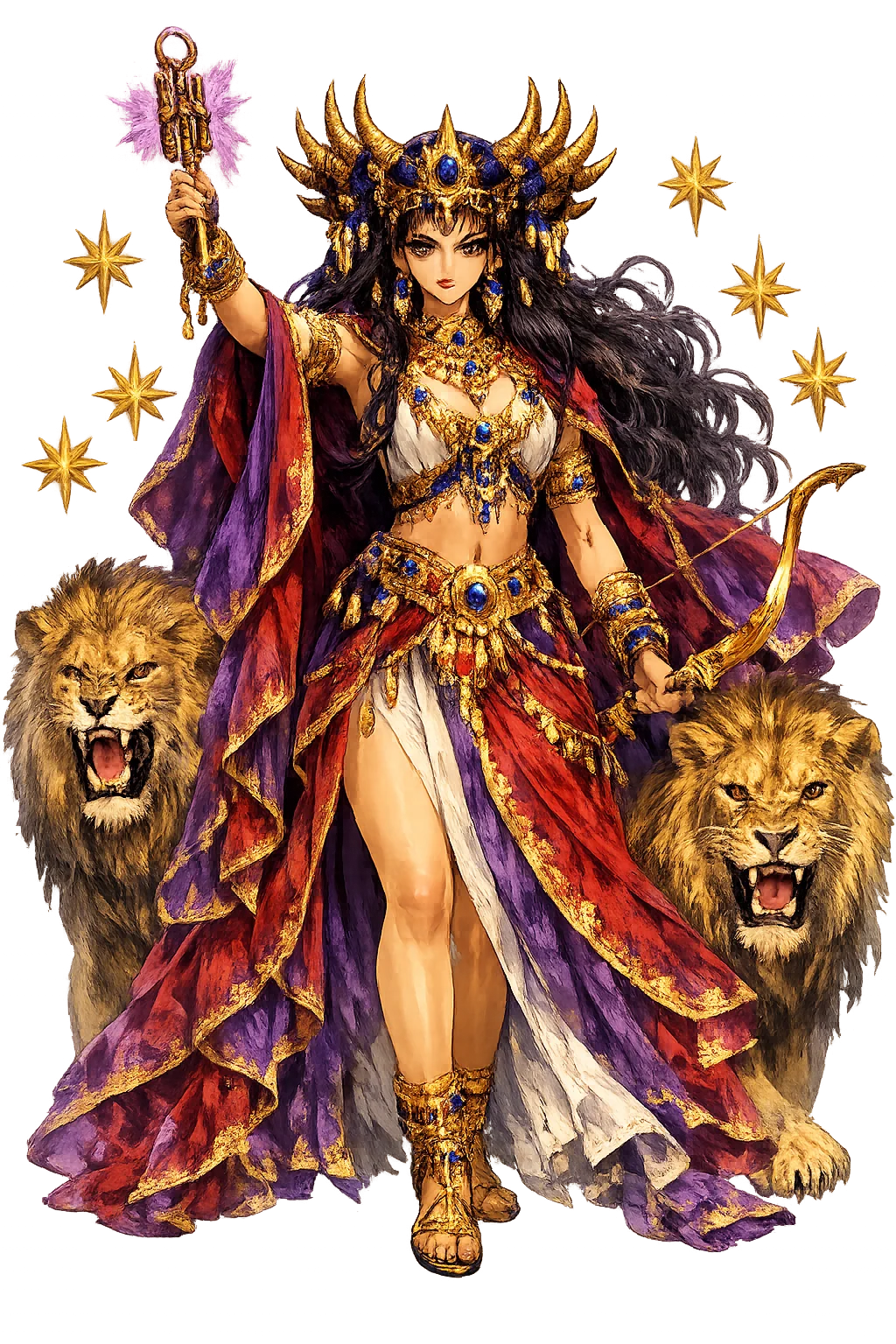
Sacred SymbolsEight-pointed star, Lion, Dove, Rosette, Weapons on shoulders
02

Etymology & Word Family

From original script to Unicode restoration

Unknown unknown Lady of Heaven
Original Script 𒀭𒀹𒁯 Ištar — "Lady of Heaven (Akkadian Ištar)"
Unicode Restoration Ištar Restored stress, length, and script
Modern ASCII ishtar Plain-ASCII fallback

The divine name Ištar is not Semitic in origin and likely derives from a Sumerian divine title associated with the planet Venus; it became the Akkadian goddess of love, war, and the morning/evening star

03

Unicode Character Breakdown

Character-by-character philological analysis

CharacterUnicodeNameBlockPhonetic Role
IU+0049Latin Capital Letter IBasic LatinSame
šU+0161Latin Small Letter S with CaronLatin Extended-AS-caron: voiceless postalveolar /ʃ/
—N/ADropped characterMesopotamian orthographyDropped: digraph simplified
tU+0074Latin Small Letter TBasic LatinSame
aU+0061Latin Small Letter ABasic LatinSame
rU+0072Latin Small Letter RBasic LatinSame

The Tier 1 classification reflects how much of the original phonology this restoration preserves — stress and vowel length for Greek names, distinctive letters and diacritics for every other tradition.

04

Cult & Worship

How the sacred was kept — rites, sanctuaries, remains

The Cult

Ištar's cult ran on two engines, bed and battle. At Uruk the Eanna precinct — excavated from its fourth-millennium foundations upward — housed her temple household, where kings of Isin and Ur enacted the sacred marriage with the goddess in New Year liturgies that the hymns of Iddin-Dagan still sing. In the early second millennium her prophets spoke politics: the archives of Mari record male and female ecstatics delivering Ištar's oracles straight into King Zimri-Lim's war councils. Assyria made her the king's battle patron: Sennacherib rebuilt her temple Emašmaš at Nineveh, and Esarhaddon praises 'Ištar who dwells in Arbela' for deciding his wars. The votive evidence is dense: the Uruk (Warka) Vase carries her earliest processional image; thousands of Old Babylonian terracotta plaques show the nude goddess; cylinder seals press her armed image into clay tens of thousands of times. The Akitu festival turned the whole city into her liturgy — and this catalog's own mythology shows what her absence meant.

In the Earth

The glazed-brick Ishtar Gate, excavated at Babylon by Robert Koldewey and now in Berlin's Pergamon Museum, displays lions, aurochs, and mušḫuššu-dragons marking the goddess's processional way. At Uruk, the Eanna precinct preserves the sequence of Inanna temples from the Uruk period onward, source of the archaic seals that first display her star, lion, and rosette; at Assur, the Assyrian Ishtar temple yielded votive inscriptions of Sennacherib and Esarhaddon. Countless cylinder seals, terracotta plaques, and ivory panels show her as armed goddess, nude fertility figure, and eight-pointed star, and the Isin sacred-marriage hymns anchor her bridal cult in a datable royal liturgy.

05

Iconography

How Ištar was imaged across the ages

The Image

Learn Ištar by her signs and she is unmistakable: the eight-pointed star of Venus, the lion at her feet, the dove, the reed ring-post that stands on Uruk-period seals like a trademark, and — most striking — weapons sprouting from her shoulders. That armed image takes clear shape on Old Akkadian cylinder seals, where a winged goddess draws a bow with maces rising from her shoulders; not every such figure is certainly Ištar, but the type flows directly into her canonical Neo-Assyrian form: a woman in flounced robe, star overhead, lion leashed at her side. Nude images run parallel from the third millennium down to the terracotta plaques of Old Babylonian houses. The great outlier is the so-called Queen of the Night, a fired-clay relief acquired by the British Museum in 1935: a winged, nude goddess with lions and owls, identified with Ištar since acquisition, though some scholars argue for her underworld sister Ereškigal instead. Across three thousand years the iconography stays astonishingly conservative — star, lion, gate-post, weapon.

06

Reception & Transformation

The name after its own age — transmission, translation, survival

Afterlives

Ištar slept for two millennia under the mounds of Iraq, then returned through decipherment. When George Smith announced his reading of the Gilgamesh tablets in 1872, Tablet VI — the goddess spurned, the Bull of Heaven loosed on Uruk — made her briefly the most discussed woman in Europe, and Layard's Nineveh excavations had already filled the British Museum with her lions. Koldewey's dig at Babylon (1899–1917) recovered her glazed-brick processional beasts, reconstructed in Berlin's Pergamon Museum as one of archaeology's great set-pieces. Philology then rebuilt the cult behind the myths: Thorkild Jacobsen's readings of the sacred-marriage hymns, and the Electronic Text Corpus of Sumerian Literature, which put Inanna's own words on screens, transformed her from a decorative 'love goddess' into a theological problem. Comparative study reached further back still — her descent now stands beside Orpheus and Persephone in every course on the katabasis — and the storm of scholarship has never quite settled whether the queen of heaven or the queen of the netherworld is the truer Ištar. The star that crossed every boundary crossed into scholarship, where it has never set.

Identifications Across Traditions

Ištar absorbed the Sumerian Inanna so completely that the two are now treated as a single deity across the ancient Near East. She was identified with the Canaanite Astarte, the Hurrian Šauška, the Egyptian Qudshu, the Greek Aphrodítē (especially in her eastern, armed form), and the Persian Anahita. The Hellenistic cult of Aphrodite Ourania at Ascalon and elsewhere preserves strong Ištar/Astarte elements. In later Gnostic and magical texts, Ištar's star became an emblem of celestial femininity and erotic power.

Modern Legacy

A popular claim derives English Easter from Ištar's name, but the derivation is not supported by scholarship: Bede explains the month-name Eosturmonath from a Germanic goddess Eostre, and no historical or linguistic chain connects Eostre with Ištar or Astarte; the resemblance is coincidence. Her genuine afterlife runs through the figure of the Whore of Babylon in the Book of Revelation and countless depictions of the love-and-war goddess. The Epic of Gilgamesh made her a byword for dangerous female desire, though the Sumerian sources present a far more complex figure. Her eight-pointed star survives in Islamic and occult iconography, and her lions and doves still decorate the borders between sexuality and power. The name still means: the star that crosses every boundary.

07

The Meditation

What Ištar means — beyond the dictionary

Ištar refuses to be one thing. She is the morning star and the evening star, the lover and the warrior, the goddess who descends into death and returns clothed in her own power. In a world that likes its deities sorted by function, she is a reminder that the most ancient sacred forces were polymorphous: desire and violence, fertility and mourning, all braided into a single brilliant light.

To restore the name Ištar is to refuse the flattening of the feminine divine into mere beauty or mere nurturing. She is the terror of the battlefield and the tenderness of the bridal chamber; the goddess who weeps over a ruined city and sends the Bull of Heaven to avenge her pride. Her star still rises. It still crosses from day into night, from life into death, and back again.

08

Screen & Culture

Where Ištar echoes through film, television, and games — and how

09

Frequently Asked Questions

Common questions about Ištar, Love, War, Fertility, Venus, and Unicode restoration

01How do you pronounce Ištar?

In reconstructed pronunciation, Ištar is /ˈiʃ.tar/ — approximately 'EESH-tar' — the š is like the sh in 'ship,' and the final syllable is slightly drawn out.

02What does Ištar mean?

Ištar means Lady of Heaven (Akkadian Ištar) in the mesopotamian tradition.

03What are the symbols of Ištar?

Ištar is associated with Eight-pointed star (Venus and the celestial throne of the goddess; the star writes her name in cuneiform), Lion (War, royal power, and the dangerous side of desire; she strides upon lions on cylinder seals), Dove (Love, sexuality, and the goddess's eastern cult), Rosette (Fertility and the blooming of life, attached to her cult from the Uruk-period seals onward), Weapons on shoulders (The warrior goddess armed for battle — bows, maces, and quivers strapped across her back).

04Why are there different spellings of Ištar?

Each form is a historically attested restoration rather than a mistake: ištar is the owned form (Owned lowercase Unicode domain label); Inanna is the alt form (Sumerian counterpart). PUNICODEX registers the full set so the tradition is preserved under every defensible spelling.

05Why restore Ištar in Unicode?

Plain ASCII ishtar strips the stress, length, and script that make the name specific. Unicode restoration returns the name to its original written dignity.

06What is the most important myth about Ištar?

“Inanna's Descent to the Underworld” — the Descent story that anchors the mythology of Ištar, told in full on the lore page.

10

Scholarly Sources

The philological foundations of this restoration

Every claim on this page is grounded in established scholarship. The orthographic restorations follow disciplinary convention. The etymological chain follows the best available reference works. This is not invention — it is resurrection through scholarship.

◈

Lexicography & Philology

  • CAD
  • AHw
◎

Primary Texts

  • Epic of Gilgamesh, Tablet VI (the proposal and the Bull of Heaven)
◉

Archaeology & Art History

  • Material evidence — iconography, inscriptions, and temple archaeology — for Ištar and related cults.
✦

Religious Studies

  • Descent of Inanna, ETCSL 1.4.1; Descent of Ishtar (Akkadian)
  • Ištar and Ebih (Old Babylonian hymn, two recensions)
  • Lament for Ur, ETCSL 2.2.2; Iddin-Dagan sacred-marriage songs, ETCSL 2.5.3
  • Black & Green, Gods, Demons and Symbols of Ancient Mesopotamia
  • Jacobsen, The Treasures of Darkness
Return

The Surface Awaits

You have traced the name from its earliest attestation to its Unicode restoration. Now return to the myth. The story is where the name lives.

Back to Lore
Ištar mascot