
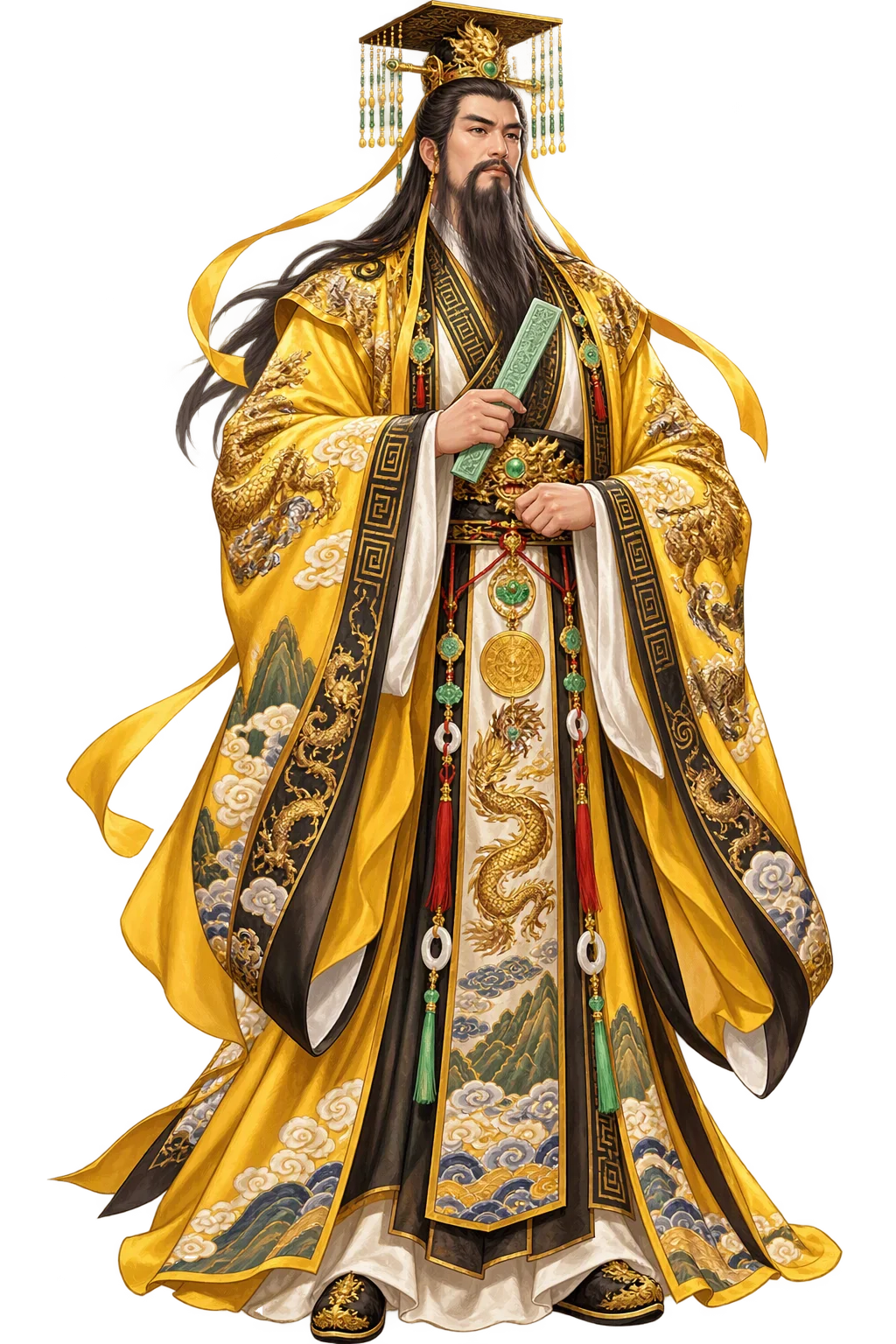
Huángdì: the stories first, then the spelling
The marks in Huángdì make the most sense standing next to the myths they have to carry. So the myths come first.
The Stories That Carry the Name
Xuānyuán of the Bear Clan. “The Yellow Emperor was a son of Shǎodiǎn, surnamed Gōngsūn, and his name was Xuānyuán. ” So the Shiji opens the first reign of Chinese history (ch. 1): born head of the Yǒuxióng, the Bear clan, praised in the formula of sage-birth legend — “born divine, he spoke early, and as an infant was quick-witted” — and handed an army, not a cradle.
Banquan and Zhuolu. The founding required two victories. First, three battles at Banquan, after which “the hosts of the world gave allegiance to him where the Flame Emperor was concerned” (Shiji 1): Yándì, defeated, became not an enemy but the first subject — and, in time, the twin ancestor beside him. Then the great battle: Chīyóu of the Jiǔlí raised a fog over the field at Zhuolu, and the army lost its way — later tradition answered with the south-pointing chariot that always faced south, however the carriage turned.
The Charter of Civilization. What the Shiji celebrates most is not conquest but administration — a single reign made to carry the list of inventions. “He took the clouds as his emblem and named his officers from the clouds” — the first bureaucracy. He obtained the precious tripod and “calculated the sun with counting-rods”; his chronologer Dà Náo fixed the sixty-year cycle of stems and branches that still names traditional years.
And Here Is What the Spelling Preserves
Against those stories, the attestation: 黄帝, in the attestation Sima Qian, Shiji 1, “Basic Annals of the Five Emperors” (Wudi benji) and Sima Qian, Shiji 28, “Treatise on the Feng and Shan Sacrifices” (the ascent at Jingshan) give us. The name means "Yellow emperor".
The restoration keeps 2 features the ASCII form huangdi cannot show:
- a → á — Stress on a: where the voice peaks.
- i → ì — Stress on i: where the voice peaks.
A storyteller pronouncing the name would restore every one of them by instinct. The file only writes down what the voice already knows.
At a Glance
- Restored name: Huángdì
- ASCII form: huangdi
- Meaning: "Yellow emperor"
- Domain of influence: Yellow Emperor, Ancestor
- Pantheon: Chinese
- Classification: Tier 1
- Original script: 黄帝
- Series: The Restoration Files, No. 220 of 548
The Name Travels
Huángdì's true temple is a library — the most syncretic figure in the Chinese canon, claimed by every school that needed a founder. The Zhuāngzǐ made him the philosophical sovereign who must unlearn rule; the early Han made him a political program: the Huáng-Lǎo 黃老 school, “the Yellow Emperor and Lǎozǐ,” which guided the recovered economy of Emperors Wén and Jǐng, and whose lost scriptures — the Four Classics of the Yellow Emperor, recovered from the Mawangdui silk library in 1973 — show how literally the school took him as lawgiver.
The Address It Earned
The temple of Huángdì stands at /huangdi/ — lore, scholars, patterns — because a name carrying this much story deserves more than a parking page. The restoration preserves more than the ASCII form can express — stress, length, or a letter the Latin keyboard lost — which places it, mechanically, in Tier-1.
The Sources Are Open
The myths above are retold from the temple's record; the primary voices are in the Sacred Texts: Tao Te Ching. Nothing in this file outranks them.
The File Continues
Read the founding dispatch for the name's full story, the Resonance File for the archetype at work — or the whole archive in one sitting.
Continue the series — previous file: Hrungnir (read it here) · next file: Huītzilōpōchtli (read it here).
The Restoration Files are written from the same canonical record as the temples themselves: the lexicon, the lore catalog, the pattern atlas, and the cited scholarly sources. If a file ever disagrees with its temple, the temple is right — tell us, and the file will be corrected.