PuniCodex

Extended Lore

黄帝 Huángdì

Etymology · Orthography · Cult · Iconography · Reception · Sources

Tier 1 Huángdì.com
Huángdì — Yellow Emperor, Ancestor
01

Quick Facts

Essential information about Huángdì, Yellow Emperor, Ancestor

Original Script黄帝
Unicode RestorationHuángdì
Reconstructed Pronunciation/xua˧˥ŋ. ti˥˩/
PantheonChinese
DomainYellow Emperor, Ancestor
MeaningYellow emperor
ClassificationTier 1
Primary DomainHuángdì.com
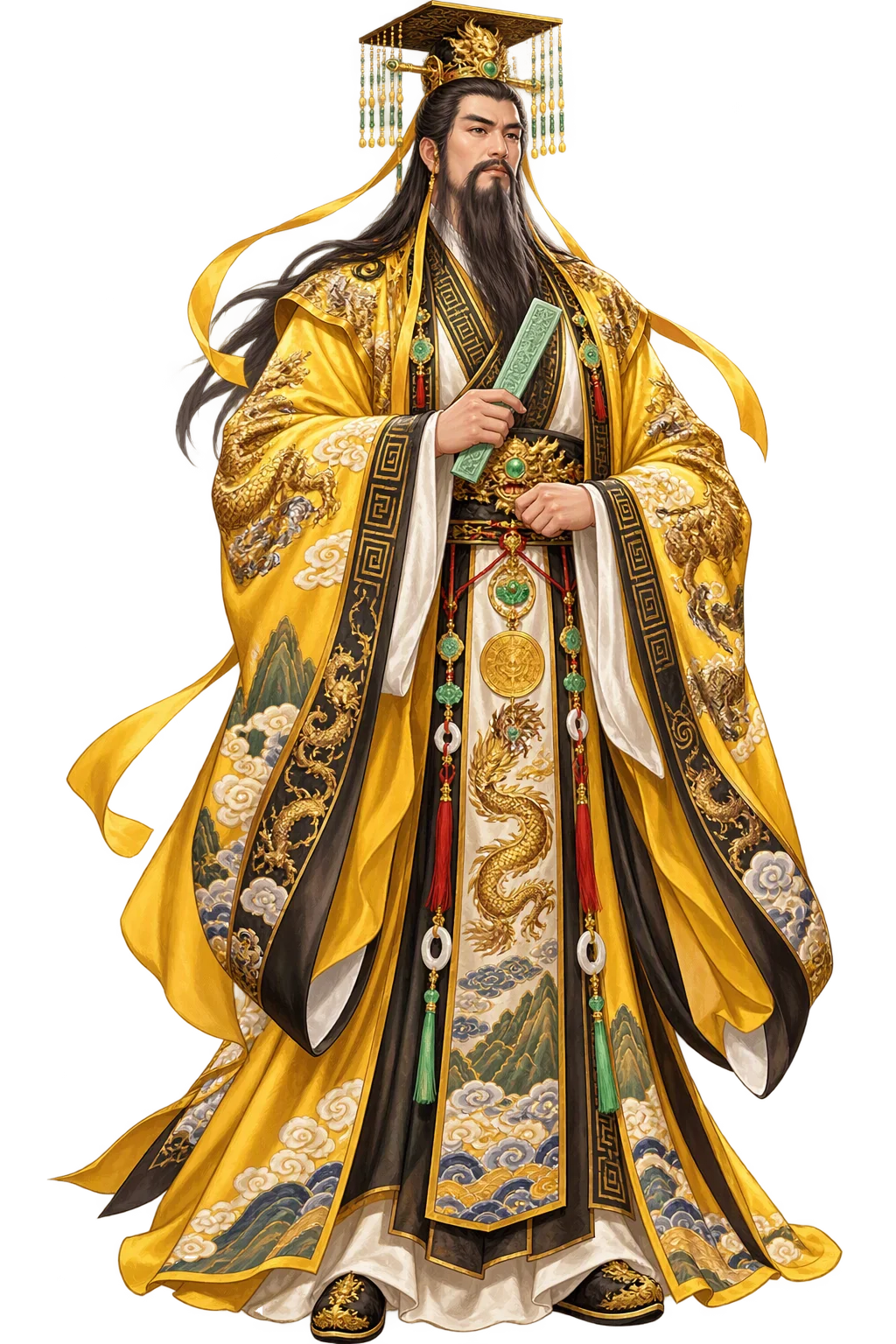
Sacred SymbolsThe Yellow Dragon, The color yellow and the Center, The clouds as emblem, The south-pointing chariot, Bears, tigers, and the war-beasts
02

Etymology & Word Family

From original script to Unicode restoration

Original Script 黄帝 Huángdì — "Yellow emperor"
Unicode Restoration Huángdì Restored stress, length, and script
Modern ASCII huangdi Plain-ASCII fallback

The name Huángdì carries the orthographic signature of the chinese tradition: 黄帝. Unicode restoration recovers what ASCII flattens.

03

Unicode Character Breakdown

Character-by-character philological analysis

CharacterUnicodeNameBlockPhonetic Role
HU+0048Latin Capital Letter HBasic LatinSame, capitalized
uU+0075Latin Small Letter UBasic LatinSame
áU+00E1Latin Small Letter A with AcuteLatin-1 SupplementStress on a
nU+006ELatin Small Letter NBasic LatinSame
gU+0067Latin Small Letter GBasic LatinSame
dU+0064Latin Small Letter DBasic LatinSame
ìU+00ECLatin Small Letter I with GraveLatin-1 SupplementStress on i

The Tier 1 classification reflects how much of the original phonology this restoration preserves — stress and vowel length for Greek names, distinctive letters and diacritics for every other tradition.

04

Cult & Worship

How the sacred was kept — rites, sanctuaries, remains

The Cult

The Yellow Emperor's cult is the ancestral cult of an entire people. The tomb at Qiaoshan drew recorded imperial attention from Emperor Wu of Han's offering in 110 BCE onward, and the rite became a spring observance. The modern state made it national: in 1912 the infant Republic sent a delegation of fifteen to sacrifice at the tomb and proclaim the Yellow Emperor the ancestor of the whole nation; in 1937 the Qingming rites became a rare joint act of Kuomintang and Communists, for which both governments published sacrificial odes — the most famous the Ji Huangdi Ling Wen issued in Mao Zedong's name. Since 2008 the People's Republic has held formal public ancestor rites at the mausoleum on Qingming itself, with Taiwanese delegations and diaspora associations maintaining parallel observances. The liturgy has changed dynasty by dynasty; the addressee has not.

In the Earth

Mount Qiao in Huangling County, Shaanxi, is the material anchor: a tomb-mound said to hold only the Yellow Emperor's bow, cap, and robes, honored as the First Tomb Under Heaven. The earliest secure state visit recorded is Emperor Wu of Han's northern tour of 110 BCE, when the Shiji (ch. 28) has him pause to offer at the tomb on Qiaoshan — though the same chapter shows the age already puzzled by how a man who ascended on a dragon came to have a grave. The honest caveat is essential: no archaeological culture can be securely identified with the Yellow Emperor, and identifications of his people with this or that Neolithic horizon — Yangshao and its cousins — are conjectures driven by the myth more than by the trowel. What is genuinely ancient is the address of the cult: a real mountain in the loess of Shaanxi, pointed at by texts two thousand years old.

05

Iconography

How Huángdì was imaged across the ages

The Image

No image of the Yellow Emperor predates the Han, and the image everyone knows is imperial projection: the yellow-robed, dragon-throned sovereign is the iconography of Tang and Ming emperors read backward onto the founder — a process the Han began, when funerary shrines carved galleries of ancient sovereigns. The Wu Liang shrine's stone reliefs (Shandong, 151 CE) are the great surviving cycle of the culture-heroes, and scholars generally include a Yellow Emperor among its ancient rulers, though the panels' identifications are reconstructed and should be claimed cautiously. The modern mausoleum completes the type in bronze — the great seated statue at Qiaoshan is a twentieth-century imperial icon wearing a third-millennium name. He is less a portrait than a throne: whatever century imagines him, it imagines itself sitting in it.

06

Reception & Transformation

The name after its own age — transmission, translation, survival

Afterlives

The Zhuangzi's philosophical Yellow Emperor — the ruler taught by Guangchengzi, the loser of the dark pearl found only by the imageless one — is his earliest and most subversive afterlife, and the seed of the Huáng-Lǎo synthesis that governed the early Han in his name and Laozi's together. The medical canon gave him a second: for two thousand years every physician of the Chinese tradition has learned his art as the Yellow Emperor's questions to Qibo, so that his name opens the first page of East Asia's medicine as Hippocrates' opens the West's. The modern era turned him into the nation: Sun Yat-sen's 1912 delegation, the joint KMT–CCP rites of 1937, and the restored ceremonies at Qiaoshan from 2008 forward all rest on one foundation — the claim that the children of Yán and Huáng are one family, addressed by one name. He began as a Han dynasty charter; he has never stopped being read.

Identifications Across Traditions

Huángdì's true temple is a library — the most syncretic figure in the Chinese canon, claimed by every school that needed a founder. The Zhuāngzǐ made him the philosophical sovereign who must unlearn rule; the early Han made him a political program: the Huáng-Lǎo 黃老 school, “the Yellow Emperor and Lǎozǐ,” which guided the recovered economy of Emperors Wén and Jǐng, and whose lost scriptures — the Four Classics of the Yellow Emperor, recovered from the Mawangdui silk library in 1973 — show how literally the school took him as lawgiver. The medical tradition made him a student: the Huángdì Nèijīng casts its whole science as his interrogation of the physician Qí Bó. And the people made him a pair: with the Flame Emperor he forms the twin root 炎黃 — rivals at Banquan, brothers in the bloodline.

Modern Legacy

The name 炎黃子孫 — “descendants of Yán and Huáng” — is his living monument: the self-designation of the Chinese people in the twentieth century and beyond. His second is the Huángdì Nèijīng 黃帝內經, the Inner Canon of the Yellow Emperor: a Han compilation in the Suwen and Lingshu books, cast as dialogues between the sovereign and Qí Bó, and still the foundational text of traditional Chinese medicine — perhaps the only medical classic framed as debate between ruler and physician. Imperial yellow — reserved to the throne from Tang times onward — took its sanction from his name. Modernity keeps re-engraving him: 軒轅 Xuānyuán is a personal name again, and the Xuānyuánjiàn 軒轅劍 game series carries the founder's name into global entertainment.

07

The Meditation

What Huángdì means — beyond the dictionary

Every civilization invents its own beginning; the Chinese invention is unusually honest about what it is doing. The Yellow Emperor is not a memory of a man — the scholarly consensus is firm — but a theory of what a beginning should be: a single reign in which war was won, writing invented, the calendar fixed, music tuned, silk taught, and the ruler carried to Heaven on a dragon rather than buried like the rest of us. The Shiji's chapter on him is a constitution disguised as a chronicle.

It is fitting that his name is exactly where Mandarin's distinctive feature lives. Tone is not decoration on Huángdì; it is the difference between the Yellow Emperor and a noise. The tradition that credits him with the invention of writing knew what this project also knows: orthography is the foundation of the Way. To write Huángdì — rising á, falling ì — is to keep the founder's name the way the Shiji kept his reign: completely, and on purpose.

08

Screen & Culture

Where Huángdì echoes through film, television, and games — and how

09

Frequently Asked Questions

Common questions about Huángdì, Yellow Emperor, Ancestor, and Unicode restoration

01How do you pronounce Huángdì?

In reconstructed pronunciation, Huángdì is /xua˧˥ŋ. ti˥˩/ — approximately 'HWAHNG-dee' — 'hwang' rising as though the syllable itself were climbing, 'dee' dropping decisively: rise, then fall.

02What does Huángdì mean?

Huángdì means Yellow emperor in the chinese tradition.

03What are the symbols of Huángdì?

Huángdì is associated with The Yellow Dragon (At the end of his reign a dragon descended to carry him to Heaven (Shiji 28) — the animal that is China itself, come to fetch the man who made it; 'descendants of the dragon' is the people's other name.), The color yellow and the Center (In five-phase cosmology yellow belongs to the Earth phase and the center of space — the axis he holds among the Five Emperors; dynasties claimed imperial yellow as his inheritance.), The clouds as emblem (The Shiji says he 'took the clouds as his emblem and named his officers from the clouds' — Heaven's weather turned into a ministry, the first charter of bureaucracy.), The south-pointing chariot (Later tradition credits him with the zhǐnánchē, the compass cart said to have led his army out of the fog Chīyóu raised at Zhuolu — a magnetic legend, whatever its date.), Bears, tigers, and the war-beasts (For Zhuolu he 'tamed bears, brown bears, leopards, and tigers' to fight for him (Shiji 1) — the culture-hero as master of the wild; his clan name is the Bear (Yǒuxióng).).

04Why restore Huángdì in Unicode?

Plain ASCII huangdi strips the stress, length, and script that make the name specific. Unicode restoration returns the name to its original written dignity.

05What is the most important myth about Huángdì?

“Xuānyuán of the Bear Clan” — the The Origins story that anchors the mythology of Huángdì, told in full on the lore page.

10

Scholarly Sources

The philological foundations of this restoration

Every claim on this page is grounded in established scholarship. The orthographic restorations follow disciplinary convention. The etymological chain follows the best available reference works. This is not invention — it is resurrection through scholarship.

◈

Lexicography & Philology

  • Shiji
  • Chinese classics
◎

Primary Texts

  • Primary sources in the chinese tradition for Huángdì.
◉

Archaeology & Art History

  • Material evidence — iconography, inscriptions, and temple archaeology — for Huángdì and related cults.
✦

Religious Studies

  • Sima Qian, Shiji 1, “Basic Annals of the Five Emperors” (Wudi benji)
  • Sima Qian, Shiji 28, “Treatise on the Feng and Shan Sacrifices” (the ascent at Jingshan)
  • Zhuangzi, chapters 11 (Guangchengzi of Mount Kongtong), 12 (the Dark Pearl), 13 (Xuanyuan asks about the Dao)
  • Huangdi Neijing Suwen (Inner Canon of the Yellow Emperor, Basic Questions)
  • Huainanzi (the omen of Cang Jie's writing)
  • Hanyu Da Zidian (characters 黃 and 帝); Unihan Database readings
  • Michael Puett, The Ambivalence of Creation: Debates Concerning Innovation and Artifice in Early China (2001)
Return

The Surface Awaits

You have traced the name from its earliest attestation to its Unicode restoration. Now return to the myth. The story is where the name lives.

Back to Lore
Huángdì mascot