The Living Myth
Yellow Emperor, Ancestor · The Yellow Emperor · Lord of the Center
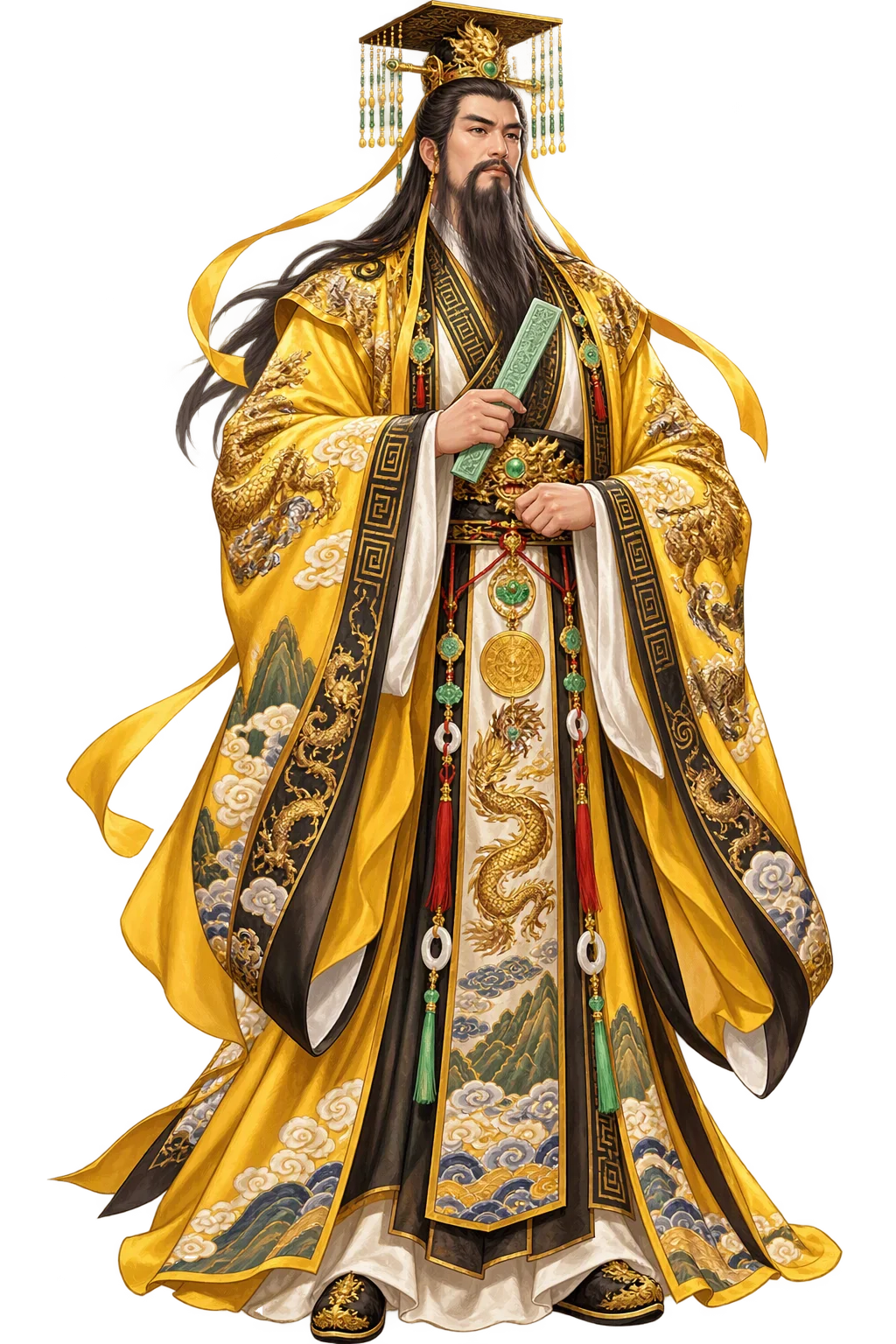
Stories of Huángdì
The Yellow Emperor is the archaeologist's dream of a beginning: warlord, inventor, lawgiver, and immortal in one. Sīmǎ Qiān's Shǐjì (ch. 1) gives him his biography; the Zhuāngzǐ gives him his soul. Between the two stands the mythic sovereign — victorious at Banquan and Zhuolu, ordering all the arts of life, and refusing to die in the ordinary way.
“The Yellow Emperor was a son of Shǎodiǎn, surnamed Gōngsūn, and his name was Xuānyuán.” So the Shiji opens the first reign of Chinese history (ch. 1): born head of the Yǒuxióng, the Bear clan, praised in the formula of sage-birth legend — “born divine, he spoke early, and as an infant was quick-witted” — and handed an army, not a cradle. Modern scholarship reads the story plainly: not an excavable biography but a Warring States and Han construction, its earliest layers barely older than the fourth century BCE. The tradition never asked to be believed as chronicle, only honored as charter.
The founding required two victories. First, three battles at Banquan, after which “the hosts of the world gave allegiance to him where the Flame Emperor was concerned” (Shiji 1): Yándì, defeated, became not an enemy but the first subject — and, in time, the twin ancestor beside him. Then the great battle: Chīyóu of the Jiǔlí raised a fog over the field at Zhuolu, and the army lost its way — later tradition answered with the south-pointing chariot that always faced south, however the carriage turned. The Shiji compresses the war into one sentence of terrible calm: he “waged battle with Chīyóu at Zhuolu and captured and killed him.” Banquan made him sovereign of the willing; Zhuolu made him sovereign of the wild.
What the Shiji celebrates most is not conquest but administration — a single reign made to carry the list of inventions. “He took the clouds as his emblem and named his officers from the clouds” — the first bureaucracy. He obtained the precious tripod and “calculated the sun with counting-rods”; his chronologer Dà Náo fixed the sixty-year cycle of stems and branches that still names traditional years. His music-master Líng Lún tuned the twelve pitch-pipes in the valley of Xiédù; his wife Léi Zǔ taught the rearing of silkworms, and silk clothed an empire. His historian Cāng Jié invented writing — and the Huáinánzǐ attaches to the deed one of the most haunting sentences in Chinese myth: “when Cāng Jié invented writing, grain rained from Heaven and the ghosts wailed at night.” The Shiji's list is the charter every guild of inventors shared.
No hero of this size is allowed an ordinary death. Tradition credits him with a century of rule; then, the Shiji says (ch. 28), he cast a great cauldron from Shǒushān copper beneath Mount Jīng — and when it was finished, a dragon descended, beard trailing low, to carry him up. He mounted with seventy of his officers and households; those who could not climb seized his bow and his robe, and the dragon rose anyway. The bow and clothes they buried at Mount Qiao — which, the Shiji explains, is why the tomb on Qiaoshan stands though no body lies in it. The myth is the hinge of his cult: a sovereign who ascends is a sovereign who watches. Every dynasty that offered at his tomb was filing a report with the founder.
The Zhuāngzǐ keeps a second, older Yellow Emperor — not the inventor of everything but the man who had to be unmade. Desiring to govern all under Heaven well, Xuānyuán went up Mount Kōngtóng to ask Guǎngchéngzǐ about the essence of the great Way. The first interview failed: “you govern all under Heaven, and see that the clouds do not gather before they should rain, the trees shed their leaves before they turn yellow, the sun and moon give light more and more dimly — a mind like yours is unfit to speak of the great Way.” The Emperor went away, gave up the throne, built a solitary hut, and fasted from inquiry for three months. When he returned, Guǎngchéngzǐ taught him: keep the essence of your complete being, guard the One, live twelve hundred years without decline. The story is the Daoist canon at its most subversive: the sovereign must shed sovereignty to find what sovereignty is for — the maker of the state taught by the man who refused it.
In another Zhuangzi parable (ch. 12) Xuānyuán, wandering north of the Red Waters, lost his dark pearl — the xuánzhū, the mysterious pearl of the Way. He sent Knowledge to find it; Knowledge could not. He sent keen-eyed Sight; Sight could not. He sent quick-tongued Discourse; Discourse could not. At last he sent Formless-and-Actionless, xiàngwǎng — and xiàngwǎng found it. The parable is the whole Zhuangzi in miniature: the man whose reign organized knowledge, sight, and words into instruments of state learns that the pearl of the Way is recovered only by the one who stops grasping. The emperor who named every office bows to the nameless.
Founding Sovereign, First Ancestor, and Giver of Civilization
Huángdì — the Yellow Emperor, Xuānyuán of the Bear clan — is the founding ancestor the Chinese tradition gave itself: the sovereign who won the land at Banquan and Zhuolu, ordered the calendar and the script, and rode a yellow dragon up to Heaven when his work was done. A culture-hero of the late Warring States imagination, he became what the Shiji made him: the first of the Five Emperors, ancestor of all who call themselves children of Yán and Huáng.
Three victories at Banquan over the Flame Emperor Yándì, then the great battle at Zhuolu where Chīyóu fell — the two wars by which the Shiji says the realm was first united (Shiji 1).
炎黃子孫 yánhuáng zǐsūn, 'descendants of Yán and Huáng' — the name a fifth of humanity calls itself; his tomb at Qiaoshan is honored as the ancestral root of the entire people.
Writing by his scribe Cāng Jié, the sixty-year cycle by Dà Náo, the twelve pitch-pipes by Líng Lún, silk by his wife Léi Zǔ, medicine in his dialogues with Qí Bó — civilization chartered in one reign.
The golden-age sovereign: 'he made the officials by the clouds and the hosts by the signs' — the template every dynasty measured itself against, the face on the Huáng-Lǎo school's banner.
From the original script to the living URL
黄帝
The name in its original Chinese form. Huángdì (黄帝) is attested in the source tradition — “Yellow emperor”. Its acute stress marks carry the full phonetic and orthographic weight of the source tradition.
huangdi
Reduced to plain huangdi, the name loses everything that made it specific: acute stress marks. What remains is an ASCII string that machines can parse but that no longer speaks with its original voice.
Huángdì
The Unicode restoration recovers what ASCII flattened. Huángdì restores acute stress marks, returning the name to its original written dignity. The domain encodes to Punycode, but the browser displays the truth.
Huángdì.com → xn--hungd-yqa4f.com
The non-ASCII characters in Huángdì are encoded while the ASCII remains visible. To the DNS, it is Punycode. To humanity, it is Huángdì.
Owned, ideal, and ASCII forms of Huángdì
Huángdì
Restores 黄帝. The live temple domain — huángdì.com.
huangdi
Flattens 黄帝. The plain ASCII fallback — what DNS and legacy systems see.
How Huángdì was spoken
How Huángdì is preserved in writing
A bespoke provenance study for Huángdì is being prepared by the PUNICODEX scholarly team.
Contribute scholarly provenance →The lore you have read is the living myth. Extended Lore opens the scholarly vault beneath it: the cult and its material remains, a history of the image, the name after antiquity, a meditation on what the name still means, and the full scholarly apparatus — etymology, orthography, sources.
Enter Extended Lore