
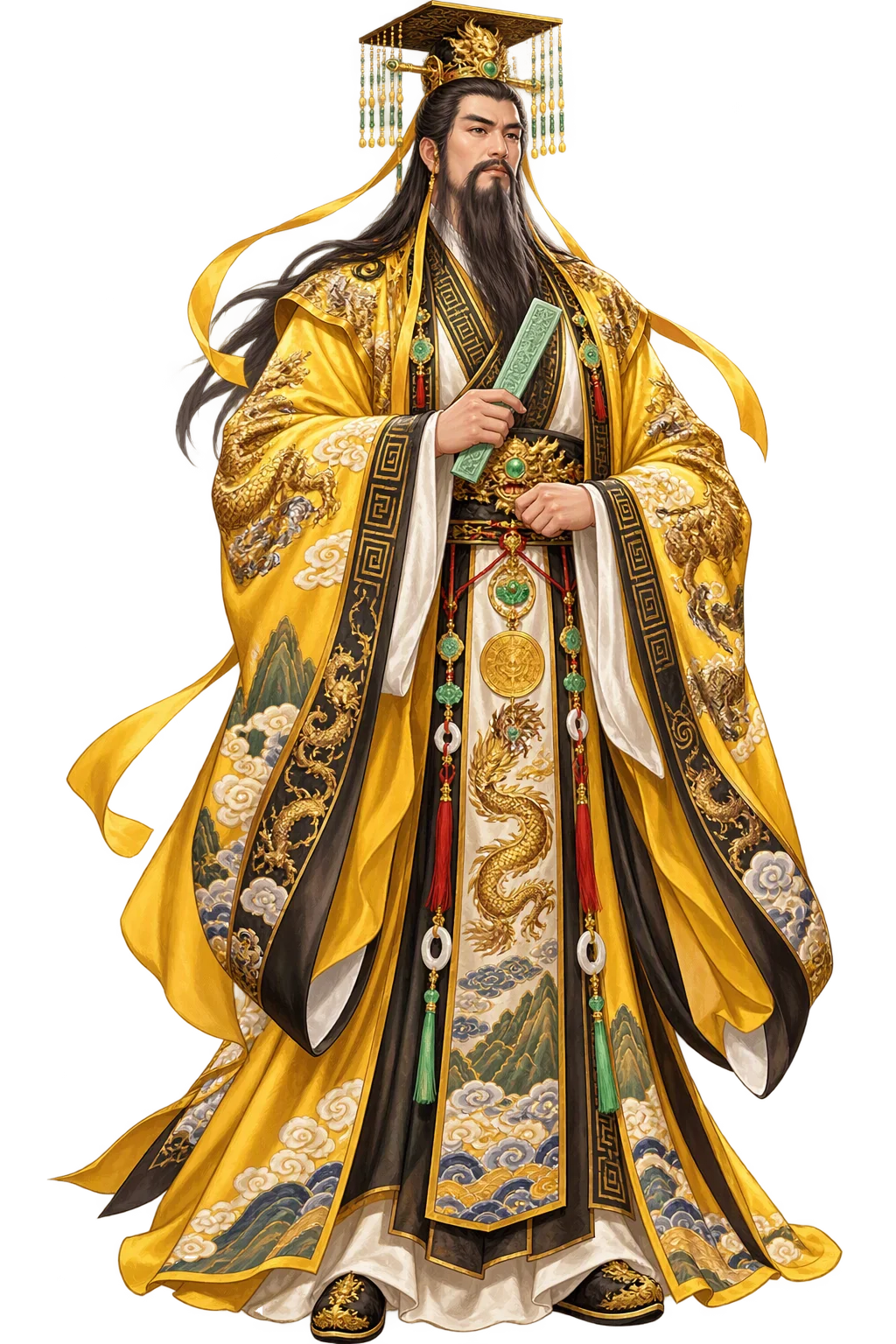
The hidden history behind Huángdì
Behind the modern ASCII form huangdi hides a much longer story. Huángdì reaches back through manuscripts, inscriptions, and oral tradition long before it ever touched a keyboard, and every mark in the restored spelling is a receipt from that journey. In what follows we trace the name from its Chinese characters attestations through its mythology, its cult, its symbols, and its afterlife in other cultures — and we show how the PuniCodex project turned that philological record into a Unicode domain that resolves today. The history was never lost. It was only waiting for the infrastructure to catch up.
At a Glance
- Restored name: Huángdì
- ASCII form: huangdi
- Meaning: "Yellow emperor"
- Domain of influence: Yellow Emperor, Ancestor
- Pantheon: Chinese
- Classification: Tier 1
- Original script: 黄帝 (Chinese characters)
- Live domain: huángdì.com
Overview
Huángdì (huangdi) — The Yellow Emperor · Lord of the Center — belongs to the Chinese tradition, where it is catalogued under the domain "Yellow Emperor, Ancestor". The name means "Yellow emperor".
Huángdì — the Yellow Emperor, Xuānyuán of the Bear clan — is the founding ancestor the Chinese tradition gave itself: the sovereign who won the land at Banquan and Zhuolu, ordered the calendar and the script, and rode a yellow dragon up to Heaven when his work was done. A culture-hero of the late Warring States imagination, he became what the Shiji made him: the first of the Five Emperors, ancestor of all who call themselves children of Yán and Huáng.
PuniCodex restores the name as Huángdì and serves its temple at huángdì.com. The restoration preserves at least one distinctive feature — a diacritic or a distinctive letter — that the ASCII form loses, and exactly one historically valid Unicode restoration exists, which places the name in Tier 1. The plain ASCII form huangdi survives as a modern convenience imposed by the early domain-name system; the restoration, not the fallback, is the form the project defends as philologically complete.
The Name
The name is attested in Chinese characters as 黄帝. Etymologically it means "Yellow emperor".
The ASCII form huangdi survives only because the early domain-name system could not carry diacritics; it is a technological compromise, not an ancient spelling. The Unicode restoration Huángdì recovers the stress accent of the original directly in the address bar. The restoration preserves at least one distinctive feature — a diacritic or a distinctive letter — that the ASCII form loses, and exactly one historically valid Unicode restoration exists, which places the name in Tier 1.
The letter-by-letter transformation runs:
- h → H — Same, capitalized
- u → u — Same
- a → á — Stress on a
- n → n — Same
- g → g — Same
- d → d — Same
- i → ì — Stress on i
The project holds the domain huángdì.com (xn--hungd-yqa4f.com) as the canonical home of this name.
The Original Script
The name is written in Chinese characters as 黄帝. This original script is the form against which the ASCII fallback huangdi and the PuniCodex restoration Huángdì are measured: the restoration preserves its pitch accent of the written form, so that a reader typing the modern address still speaks the ancient name.
Pronunciation
The reconstructed pronunciation of the name is /xua˧˥ŋ. ti˥˩/ — Modern Standard Mandarin (Pinyin).
Phoneme by phoneme:
- Huáng — The pinyin h is the velar fricative [x] — the 'ch' of Scottish 'loch', not an English h; the diphthong glides [u→a] into the velar nasal [ŋ], 'ng' as in 'sing', all on the second tone: a rising glide, ˧˥.
- Dì — Voiceless unaspirated [t] — the 't' of 'stay' — on high front [i]; the fourth tone falls hard through the register, ˥˩, like a door closing: apt for 帝, 'sovereign, thearch.'
For the modern speaker, the closest approximation is: 'HWAHNG-dee' — 'hwang' rising as though the syllable itself were climbing, 'dee' dropping decisively: rise, then fall.
Kindred and historical forms of the name:
- Traditional — 黃帝 Huángdì — 黃 'yellow' + 帝 'sovereign'; not 皇帝 huángdì 'emperor,' a modern homophone, a different word.
- Personal name — 軒轅 Xuānyuán, 'Chariot-Axle' — the name the Shiji gives him, later a byword for the Yellow Emperor.
- Clan name — 有熊氏 Yǒuxióng shì, the Bear clan of which he was born head; the Shiji also gives him the surname 公孫 Gōngsūn.
- Paired ancestor — 炎帝 Yándì, the Flame Emperor — his defeated rival at Banquan, afterward his twin in 炎黃子孫, 'descendants of Yán and Huáng.' A pair, never one figure.
Huángdì is Tier 1 because tone is lexical: the acute á and the grave ì carry the second and fourth citation tones, and in Mandarin tone is meaning — mā 'mother,' má 'hemp,' mǎ 'horse,' mà 'scold.' The plain ASCII 'huangdi' flattens both contours to silence. (And 黃帝 'Yellow Emperor' and 皇帝 'emperor' romanize identically — only the characters keep them apart.)
Mythology
The Yellow Emperor is the archaeologist's dream of a beginning: warlord, inventor, lawgiver, and immortal in one. Sīmǎ Qiān's Shǐjì (ch. 1) gives him his biography; the Zhuāngzǐ gives him his soul. Between the two stands the mythic sovereign — victorious at Banquan and Zhuolu, ordering all the arts of life, and refusing to die in the ordinary way.
Xuānyuán of the Bear Clan (The Origins)
“The Yellow Emperor was a son of Shǎodiǎn, surnamed Gōngsūn, and his name was Xuānyuán.” So the Shiji opens the first reign of Chinese history (ch. 1): born head of the Yǒuxióng, the Bear clan, praised in the formula of sage-birth legend — “born divine, he spoke early, and as an infant was quick-witted” — and handed an army, not a cradle. Modern scholarship reads the story plainly: not an excavable biography but a Warring States and Han construction, its earliest layers barely older than the fourth century BCE. The tradition never asked to be believed as chronicle, only honored as charter.
Banquan and Zhuolu (The Two Wars)
The founding required two victories. First, three battles at Banquan, after which “the hosts of the world gave allegiance to him where the Flame Emperor was concerned” (Shiji 1): Yándì, defeated, became not an enemy but the first subject — and, in time, the twin ancestor beside him. Then the great battle: Chīyóu of the Jiǔlí raised a fog over the field at Zhuolu, and the army lost its way — later tradition answered with the south-pointing chariot that always faced south, however the carriage turned. The Shiji compresses the war into one sentence of terrible calm: he “waged battle with Chīyóu at Zhuolu and captured and killed him.” Banquan made him sovereign of the willing; Zhuolu made him sovereign of the wild.
The Charter of Civilization (The Ordering)
What the Shiji celebrates most is not conquest but administration — a single reign made to carry the list of inventions. “He took the clouds as his emblem and named his officers from the clouds” — the first bureaucracy. He obtained the precious tripod and “calculated the sun with counting-rods”; his chronologer Dà Náo fixed the sixty-year cycle of stems and branches that still names traditional years. His music-master Líng Lún tuned the twelve pitch-pipes in the valley of Xiédù; his wife Léi Zǔ taught the rearing of silkworms, and silk clothed an empire. His historian Cāng Jié invented writing — and the Huáinánzǐ attaches to the deed one of the most haunting sentences in Chinese myth: “when Cāng Jié invented writing, grain rained from Heaven and the ghosts wailed at night.” The Shiji's list is the charter every guild of inventors shared.
The Dragon at Jīngshān (The Ascent)
No hero of this size is allowed an ordinary death. Tradition credits him with a century of rule; then, the Shiji says (ch. 28), he cast a great cauldron from Shǒushān copper beneath Mount Jīng — and when it was finished, a dragon descended, beard trailing low, to carry him up. He mounted with seventy of his officers and households; those who could not climb seized his bow and his robe, and the dragon rose anyway. The bow and clothes they buried at Mount Qiao — which, the Shiji explains, is why the tomb on Qiaoshan stands though no body lies in it. The myth is the hinge of his cult: a sovereign who ascends is a sovereign who watches. Every dynasty that offered at his tomb was filing a report with the founder.
Guǎngchéngzǐ of Mount Kōngtóng (Zhuangzi 11) (The Philosopher's Emperor)
The Zhuāngzǐ keeps a second, older Yellow Emperor — not the inventor of everything but the man who had to be unmade. Desiring to govern all under Heaven well, Xuānyuán went up Mount Kōngtóng to ask Guǎngchéngzǐ about the essence of the great Way. The first interview failed: “you govern all under Heaven, and see that the clouds do not gather before they should rain, the trees shed their leaves before they turn yellow, the sun and moon give light more and more dimly — a mind like yours is unfit to speak of the great Way.” The Emperor went away, gave up the throne, built a solitary hut, and fasted from inquiry for three months. When he returned, Guǎngchéngzǐ taught him: keep the essence of your complete being, guard the One, live twelve hundred years without decline. The story is the Daoist canon at its most subversive: the sovereign must shed sovereignty to find what sovereignty is for — the maker of the state taught by the man who refused it.
Xuānyuán and the Dark Pearl (Zhuangzi 12) (The Lost Pearl)
In another Zhuangzi parable (ch. 12) Xuānyuán, wandering north of the Red Waters, lost his dark pearl — the xuánzhū, the mysterious pearl of the Way. He sent Knowledge to find it; Knowledge could not. He sent keen-eyed Sight; Sight could not. He sent quick-tongued Discourse; Discourse could not. At last he sent Formless-and-Actionless, xiàngwǎng — and xiàngwǎng found it. The parable is the whole Zhuangzi in miniature: the man whose reign organized knowledge, sight, and words into instruments of state learns that the pearl of the Way is recovered only by the one who stops grasping. The emperor who named every office bows to the nameless.
Symbols & Iconography
The iconography associated with Huángdì concentrates in a small set of recurring attributes, each a compressed statement about the name:
- The Yellow Dragon — At the end of his reign a dragon descended to carry him to Heaven (Shiji 28) — the animal that is China itself, come to fetch the man who made it; 'descendants of the dragon' is the people's other name.
- The color yellow and the Center — In five-phase cosmology yellow belongs to the Earth phase and the center of space — the axis he holds among the Five Emperors; dynasties claimed imperial yellow as his inheritance.
- The clouds as emblem — The Shiji says he 'took the clouds as his emblem and named his officers from the clouds' — Heaven's weather turned into a ministry, the first charter of bureaucracy.
- The south-pointing chariot — Later tradition credits him with the zhǐnánchē, the compass cart said to have led his army out of the fog Chīyóu raised at Zhuolu — a magnetic legend, whatever its date.
- Bears, tigers, and the war-beasts — For Zhuolu he 'tamed bears, brown bears, leopards, and tigers' to fight for him (Shiji 1) — the culture-hero as master of the wild; his clan name is the Bear (Yǒuxióng).
- The precious tripod — He 'obtained the precious tripod and calculated the sun with counting-rods' (Shiji 1), and cast a great cauldron from Shoushan copper (Shiji 28) — the dǐng as emblem of legitimate rule, carried on by the nine tripods of Yǔ.
- Mount Qiao (橋山 Qiáoshān) — His tomb in Huangling County, Shaanxi — the First Tomb Under Heaven — said to hold not his body, snatched up by the dragon, but his bow, cap, and clothes.
Archaeology & Evidence
Mount Qiao in Huangling County, Shaanxi, is the material anchor: a tomb-mound said to hold only the Yellow Emperor's bow, cap, and robes, honored as the First Tomb Under Heaven. The earliest secure state visit recorded is Emperor Wu of Han's northern tour of 110 BCE, when the Shiji (ch. 28) has him pause to offer at the tomb on Qiaoshan — though the same chapter shows the age already puzzled by how a man who ascended on a dragon came to have a grave. The honest caveat is essential: no archaeological culture can be securely identified with the Yellow Emperor, and identifications of his people with this or that Neolithic horizon — Yangshao and its cousins — are conjectures driven by the myth more than by the trowel. What is genuinely ancient is the address of the cult: a real mountain in the loess of Shaanxi, pointed at by texts two thousand years old.
Realm & Domain
Huángdì — the Yellow Emperor, Xuānyuán of the Bear clan — is the founding ancestor the Chinese tradition gave itself: the sovereign who won the land at Banquan and Zhuolu, ordered the calendar and the script, and rode a yellow dragon up to Heaven when his work was done. A culture-hero of the late Warring States imagination, he became what the Shiji made him: the first of the Five Emperors, ancestor of all who call themselves children of Yán and Huáng.
The Founder at Arms
Three victories at Banquan over the Flame Emperor Yándì, then the great battle at Zhuolu where Chīyóu fell — the two wars by which the Shiji says the realm was first united (Shiji 1).
First Ancestor
炎黃子孫 yánhuáng zǐsūn, 'descendants of Yán and Huáng' — the name a fifth of humanity calls itself; his tomb at Qiaoshan is honored as the ancestral root of the entire people.
Giver of the Arts
Writing by his scribe Cāng Jié, the sixty-year cycle by Dà Náo, the twelve pitch-pipes by Líng Lún, silk by his wife Léi Zǔ, medicine in his dialogues with Qí Bó — civilization chartered in one reign.
The Model of Rule
The golden-age sovereign: 'he made the officials by the clouds and the hosts by the signs' — the template every dynasty measured itself against, the face on the Huáng-Lǎo school's banner.
Across Cultures
Huángdì's true temple is a library — the most syncretic figure in the Chinese canon, claimed by every school that needed a founder. The Zhuāngzǐ made him the philosophical sovereign who must unlearn rule; the early Han made him a political program: the Huáng-Lǎo 黃老 school, “the Yellow Emperor and Lǎozǐ,” which guided the recovered economy of Emperors Wén and Jǐng, and whose lost scriptures — the Four Classics of the Yellow Emperor, recovered from the Mawangdui silk library in 1973 — show how literally the school took him as lawgiver. The medical tradition made him a student: the Huángdì Nèijīng casts its whole science as his interrogation of the physician Qí Bó. And the people made him a pair: with the Flame Emperor he forms the twin root 炎黃 — rivals at Banquan, brothers in the bloodline.
Kindred figures in the PuniCodex cross-tradition index include Gilgameš, Hēraklēs, Perseús, and Thēseus, each linked through mythic hero / monster-slayer / city-founder.
Cultural Legacy
The name 炎黃子孫 — “descendants of Yán and Huáng” — is his living monument: the self-designation of the Chinese people in the twentieth century and beyond. His second is the Huángdì Nèijīng 黃帝內經, the Inner Canon of the Yellow Emperor: a Han compilation in the Suwen and Lingshu books, cast as dialogues between the sovereign and Qí Bó, and still the foundational text of traditional Chinese medicine — perhaps the only medical classic framed as debate between ruler and physician. Imperial yellow — reserved to the throne from Tang times onward — took its sanction from his name. Modernity keeps re-engraving him: 軒轅 Xuānyuán is a personal name again, and the Xuānyuánjiàn 軒轅劍 game series carries the founder's name into global entertainment.
The Scholarly Record
The account of Huángdì given in this edition rests on the witnesses and reference works listed below. Lexica and etymological dictionaries secure the form and meaning of the name; the literary and religious texts supply the narrative evidence.
- Sima Qian, Shiji 1, “Basic Annals of the Five Emperors” (Wudi benji).
- Sima Qian, Shiji 28, “Treatise on the Feng and Shan Sacrifices” (the ascent at Jingshan).
- Zhuangzi, chapters 11 (Guangchengzi of Mount Kongtong), 12 (the Dark Pearl), 13 (Xuanyuan asks about the Dao).
- Huangdi Neijing Suwen (Inner Canon of the Yellow Emperor, Basic Questions).
- Huainanzi (the omen of Cang Jie's writing).
- Hanyu Da Zidian (characters 黃 and 帝); Unihan Database readings.
- Michael Puett, The Ambivalence of Creation: Debates Concerning Innovation and Artifice in Early China (2001).
A Meditation
Every civilization invents its own beginning; the Chinese invention is unusually honest about what it is doing. The Yellow Emperor is not a memory of a man — the scholarly consensus is firm — but a theory of what a beginning should be: a single reign in which war was won, writing invented, the calendar fixed, music tuned, silk taught, and the ruler carried to Heaven on a dragon rather than buried like the rest of us. The Shiji's chapter on him is a constitution disguised as a chronicle.
It is fitting that his name is exactly where Mandarin's distinctive feature lives. Tone is not decoration on Huángdì; it is the difference between the Yellow Emperor and a noise. The tradition that credits him with the invention of writing knew what this project also knows: orthography is the foundation of the Way. To write Huángdì — rising á, falling ì — is to keep the founder's name the way the Shiji kept his reign: completely, and on purpose.
The Unicode Restoration
Huángdì is classified as Tier 1: the restoration preserves at least one distinctive feature — a diacritic or a distinctive letter — that the ASCII form loses. The ASCII fallback huangdi still resolves everywhere, but it is the restored form that carries the name's full information. Across the 7 characters of the name, the restoration adjusts 2: 2 marks of stress (á, ì). That is the whole thesis of this temple: the marks are the message.
The Domain Name
The restored name is live as a working domain: huángdì.com, which the DNS carries in punycode form as xn--hungd-yqa4f.com — an ASCII-compatible encoding that lets a non-ASCII name travel the global network without breaking older infrastructure. The visitor sees Huángdì; the machines see the encoding. That duality is the engineering compromise on which the entire restoration rests, and it is why a name written the way its own tradition wrote it in Chinese characters can now be typed into any browser on earth.
Why This Restoration Matters
The story of Huángdì did not end in antiquity; it changed medium. Names that survive for millennia do so because each generation finds a new carrier for them — clay, papyrus, print, and now DNS. The PuniCodex restoration simply makes the carrier honest: the spelling that resolves is the spelling the evidence supports. If this post showed anything, it is that huangdi and Huángdì are not the same name with different styling. They are a summary and the text it summarizes. The web can now serve the text.
Explore Further
This post is one doorway into the temple. The home page carries the full character breakdown and the ambient canvas; the lore page tells the myths in long form; the Scholarly Edition preserves the sources, pronunciation data, and revision history; and the patron wall supports the restoration directly. For the wider map, browse the Lexicon, explore the Pantheon, or return to the PuniCodex blog.
Related Names
- Dà Yǔ
Sources
The full scholarly apparatus — every citation, revision, and review — lives in the Scholarly Edition. Key references for this post:
- Sima Qian, Shiji 1, “Basic Annals of the Five Emperors” (Wudi benji).
- Sima Qian, Shiji 28, “Treatise on the Feng and Shan Sacrifices” (the ascent at Jingshan).
- Zhuangzi, chapters 11 (Guangchengzi of Mount Kongtong), 12 (the Dark Pearl), 13 (Xuanyuan asks about the Dao).
- Huangdi Neijing Suwen (Inner Canon of the Yellow Emperor, Basic Questions).
- Lexicon authorities for this entry: Shiji, Chinese classics.