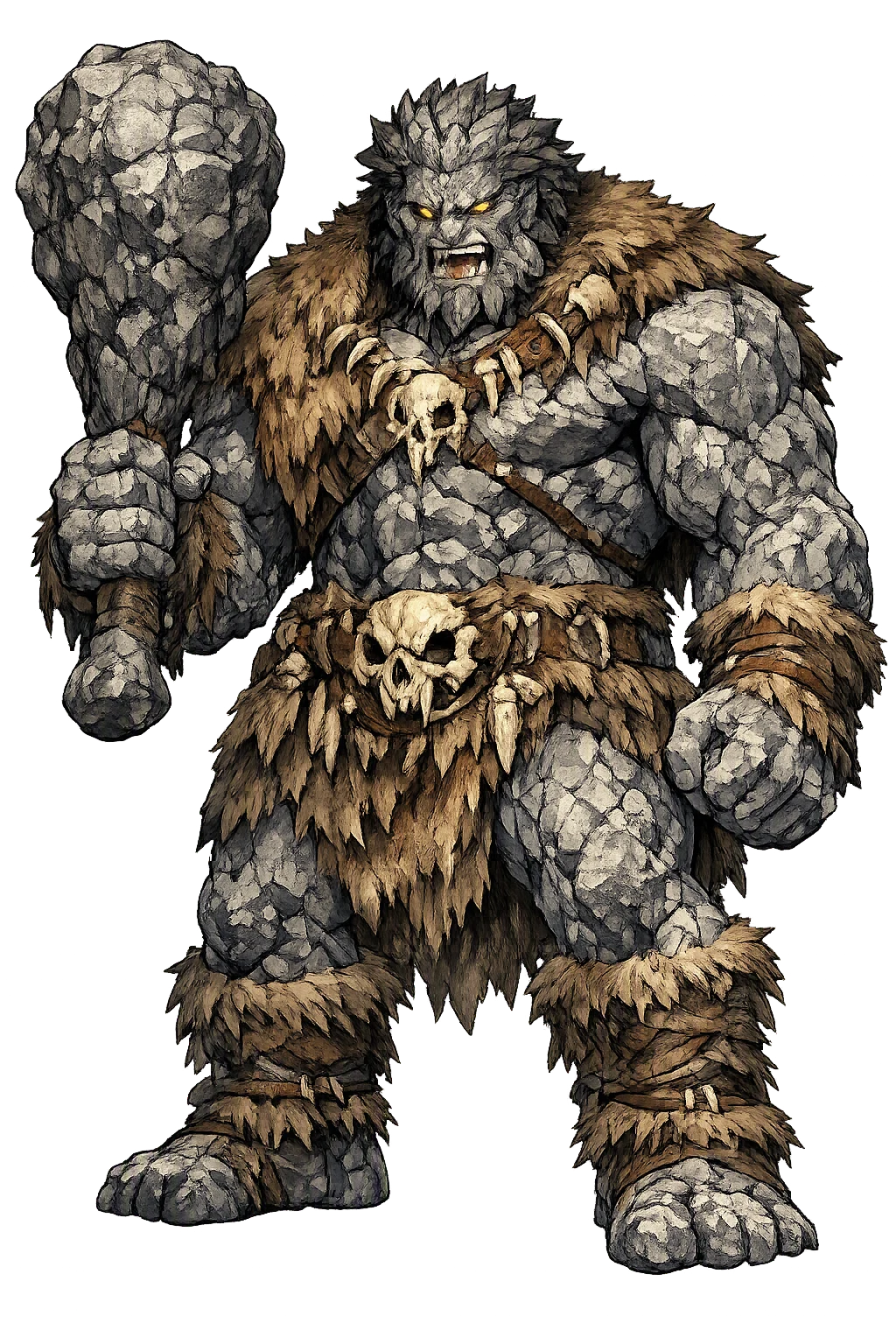
Stories of Hrungnir
Hrungnir has essentially one story, and it is the greatest fight in the Edda: the wager, the drunken boasting in the hall of the gods, the appointed duel at Grjótúnagarðar, the shattered whetstone, and the fall that left even victorious Thor pinned beneath his enemy's leg. Snorri tells it in Skáldskaparmál, and the skald Þjóðólfr of Hvin had carved it into verse three centuries earlier.
It begins with a boast Óðinn could not keep to himself. Riding Sleipnir through Jötunheimr, he met the giant Hrungnir, who asked who this man was with the golden helmet, riding so well over sea and air, and praised the horse. Óðinn answered with the stake that decides everything after: he wagered his head that no horse in Jötunheimr was Sleipnir's equal. Hrungnir sprang to his own stallion Gullfaxi, the gold-maned, and gave chase in a fury. The race ran to the very gates of Ásgarðr — and Hrungnir, carried past his own turning, galloped through them and in among the gods.
The Æsir received him with the hospitality due an uninvited guest: they set before him the great horns Thor himself drank from, and Hrungnir emptied them one after another. Drunk, he let the boasts out — he would take Valhǫll up and carry it off to Jötunheimr, he would sink Ásgarðr, he would kill all the gods, save only Freyja and Sif, whom he would carry home; and the mead, he said, he would drink up all by himself. The Æsir, tired of the noise, named Thor; and Thor came in swinging his hammer, demanding who had given jötnar leave to drink in Valhǫll. Hrungnir, looking at him with anything but friendly eyes, answered that Óðinn had invited him and he stood under Óðinn's protection — then claimed his rights: Thor would gain little honour from killing him unarmed. It would be a greater trial of courage, he said, if Thor dared meet him in single combat at the frontier, at Grjótúnagarðar. And Thor, Snorri says, would by no means refuse a challenge to single combat.
The giants made much of the appointment, for Hrungnir was the strongest of them and they expected one outcome or the other to be decisive. For his second they built a champion of clay: Mǫkkurkálfi, nine leagues tall and three leagues broad across the chest, with no heart big enough for the frame — so they gave him a mare's heart, and it quaked within him when Thor came. Hrungnir stood with his heart of stone, three-cornered and sharp-edged, his head of stone, and his broad shield of stone, holding his hone — the whetstone — before him. Þjálfi ran ahead and called out that Thor was coming from below, and Hrungnir, fearing a strike through the earth, set the shield beneath his feet and stood on it.
Then Thor came in an ásmegin-fury, lightning running before him, and hurled Mjǫllnir from afar. Hrungnir threw the hone with both hands, and the weapons met in the air. The hone burst in two: one half fell to earth, and from it come all the whetstone rocks in the world; the other half drove into Thor's head, and he fell forward. But Mjǫllnir did not stop — it struck Hrungnir's head and crushed the skull to small pieces, and the giant fell forward across Thor, his foot lying on Thor's neck. Þjálfi went at Mǫkkurkálfi, and the clay giant fell with little glory.
Then the strangest aftermath in the corpus: Thor lay pinned, and neither he nor Þjálfi could shift the giant's foot from his neck. All the Æsir came, when they learned, and together they could not lift it. At last came Magni, son of Thor and the giantess Járnsaxa — three nights old — and threw Hrungnir's foot off his father, saying it was a pity he had come so late: he thought he would have struck the giant dead with his fist. Thor gave him Gullfaxi for the deed, and Óðinn objected that he had given the fine horse to a giantess's son rather than to his own father. The hone stayed in Thor's head. The völva Gróa, wife of Aurvandill the Bold, came to sing it loose with her spells, and the stone was already working free — until Thor, to please her, told how he had carried Aurvandill in a basket out of Jötunheimr, and how the man's frozen toe, broken off and thrown into the sky, became the star called Aurvandill's Toe. Gróa rejoiced so greatly at the news that she forgot her spells; the hone stirs in Thor's head to this day. Therefore, Snorri warns, whetstones must never be thrown across the floor.
Snorri quotes his sources, and for this myth the source is Þjóðólfr of Hvin's Haustlöng — a shield-poem composed in the early tenth century, among the oldest mythological verse we have. Þjóðólfr tells the whole combat in dense dróttkvætt: the 'defier of the gods' who rode to the fight, the earth shaking beneath the giant's host, the whetstone bitten from the hard stone of the heart, the hammer answering. That a skald within living memory of the Viking Age's pagan courts could assume his hearers knew the whetstone, the clay giant, and the fall proves the story was not Snorri's construction: it was already old, already fixed, already the standard account of the hardest fight Thor ever fought.
The Stone Heart, the Golden Mane, and the Wager of a Head
Hrungnir is the strongest of the jötnar — the stone-hearted giant who rode his gold-maned stallion Gullfaxi into Ásgarðr on a wager of heads, drank Thor's liquor from the god's own horns, boasted he would carry off Valhǫll, and met Mjǫllnir at Grjótúnagarðar with nothing in his hand but a whetstone. His duel is the most fully narrated single combat between god and giant in the Old Norse corpus.
'Golden mane' — the stallion Óðinn envied aloud, whose speed Hrungnir wagered his head against Sleipnir to disprove.
His weapon of stone — hurled against Mjǫllnir, it shattered in mid-air; one shard fathered every whetstone rock on earth, one lodged in Thor's skull.
Three-cornered, sharp-edged, and hard — the Edda says his heart, head, and shield were all of stone, a giant made of his own weapon's material.
The 'stone-fence-yard' at the edge of heaven and giantland, where the single combat was appointed — the oldest named duelling-ground in the myths.
From the original script to the living URL
ᚼᚱᚢᚾᚴᚾᛁᚱ
The name in its original Norse form. Hrungnir (ᚼᚱᚢᚾᚴᚾᛁᚱ) is attested in the source tradition — “Brawler”. Its original diacritics and script distinctions carry the full phonetic and orthographic weight of the source tradition.
hrungnir
The plain hrungnir form is identical to the Unicode restoration. Because this name is already written in Latin letters, no diacritics, stress, or script information were lost — only capitalization differs.
Hrungnir
The Unicode restoration does not need to recover lost marks for Hrungnir. Its value is canonical spelling and consistent cataloguing, not the reconstruction of erased orthography. The domain is readable as-is to both DNS and humanity.
Hrungnir.com
This restoration is written entirely in ASCII letters — no Punycode encoding stands between Hrungnir and the DNS. The domain reads identically to machines and to human eyes.
Owned, ideal, and ASCII forms of Hrungnir
Hrungnir
Restores ᚼᚱᚢᚾᚴᚾᛁᚱ. The full Unicode restoration. hrungnir.com is not in the PuniCodex collection — it is watched for release; if it drops, this temple upgrades to an owned flagship.
How Hrungnir was spoken
How Hrungnir travels from ancient script to the modern URL
The lore you have read is the living myth. Extended Lore opens the scholarly vault beneath it: the cult and its material remains, a history of the image, the name after antiquity, a meditation on what the name still means, and the full scholarly apparatus — etymology, orthography, sources.
Enter Extended Lore