Stories of Ḥꜥpy
ḥp has no adventures because he is not a character but an event: the flood. His mythology is hydrology made sacred — the river's rhythm given a face, a hymn, a nilometer, and a table of offerings. What the Greeks would later read as myth, Egypt experienced as the annual audit of its own survival.
The great Hymn to Hapi — copied by schoolboys for a thousand years, its finest witnesses New Kingdom papyri (Lichtheim, Ancient Egyptian Literature, vol. 1) — is the flood's own voice. It calls him 'lord of fish and fowl, maker of barley, creator of wheat,' and praises the land's dependence in the plainest economics ever put into verse: when he rises, 'the whole land rejoices'; when he fails or arrives thin, 'the whole land is in panic' and the granaries stand empty. The hymn lists what every Egyptian saw with his own eyes: the water turning black with silt, the fields greening in days, the tax assessors waiting on the bank. No temple was ever his — the river was the temple — and no statue could be more present than the water itself. The hymn means that ḥp was worshipped the way weather is feared: not in a shrine but at the water's edge, where plenty and famine were decided on the same bank.
On temple walls from Karnak to Dendera, ḥp appears doubled: one figure crowned with the papyrus of the Delta, one with the lotus of the south, the two of them knotting the plants around the hieroglyph of the windpipe — sema-tawy, 'the uniting of the Two Lands.' The image is everywhere because it says everything: Egypt is not two countries with a god each but one body with one flood. The device is already Old Kingdom; it climbs onto royal thrones, onto the sides of ceremonial footstools, into the ground-plans of temples, until the nation's founding act — the union of Upper and Lower Egypt — is performed annually by the rising water. The two ḥp-figures do not fight, as the Two Lands' emblematic plants sometimes do elsewhere in Egyptian art; they tie the knot together. The myth means that the flood was Egypt's constitution written in vegetation: sovereignty, like the river, flowed from south to north and had to be re-knotted every year.
Where did the flood come from? Egyptian geography said the First Cataract at Elephantine, and Egyptian imagination supplied the rest: subterranean caverns beneath the island where the ram-headed potter Khnum sat at his wheel, shaping the flood and with it the bodies of kings — the tale of Khnum's claim is enshrined on the Ptolemaic Famine Stela at Sehel Island. ḥp dwelt in those cavern-waters with the earth-god and the abyss; the cataract's granite roar was the sound of the flood's door opening. Later geographers pushed the source farther south, to fabulous 'Mountains of the Moon,' but the theology mattered less than the observation it framed: the river rose at the solstice as Sirius returned, and every calendar, tax roll, and liturgy bent to its timing. The myth means that the Egyptians did not need to see the source to know it was sacred: the regularity itself was the miracle, and regularity is the oldest form of theology.
Greek witnesses saw deeper into the flood than measurement. Plutarch, in On Isis and Osiris (32–36), reports the Egyptian doctrine that the Nile itself was the god: its waters called the 'efflux of Osiris,' its life-giving rise the murdered god's generative return, its failure and muddy retreat the work of Typhon. The flood that made the fields fertile was thus, in the late theology, the same event as the god's resurrection — Osiris's body dispersed and recomposed as water. This is why the mourning of Isis and the rising of ḥp could be read as one story told in two registers, and why tomb walls pair the two so comfortably. Plutarch wrote five centuries after the last native pharaoh, and scholars rightly caution that his account blends philosophy with reportage; but the identification had Egyptian roots, not merely Greek ones. The myth means that the Egyptians did not separate agriculture from resurrection: the black silt of June was a god coming back to life on schedule.
The Inundation, Abundance, and the Fat of the Land
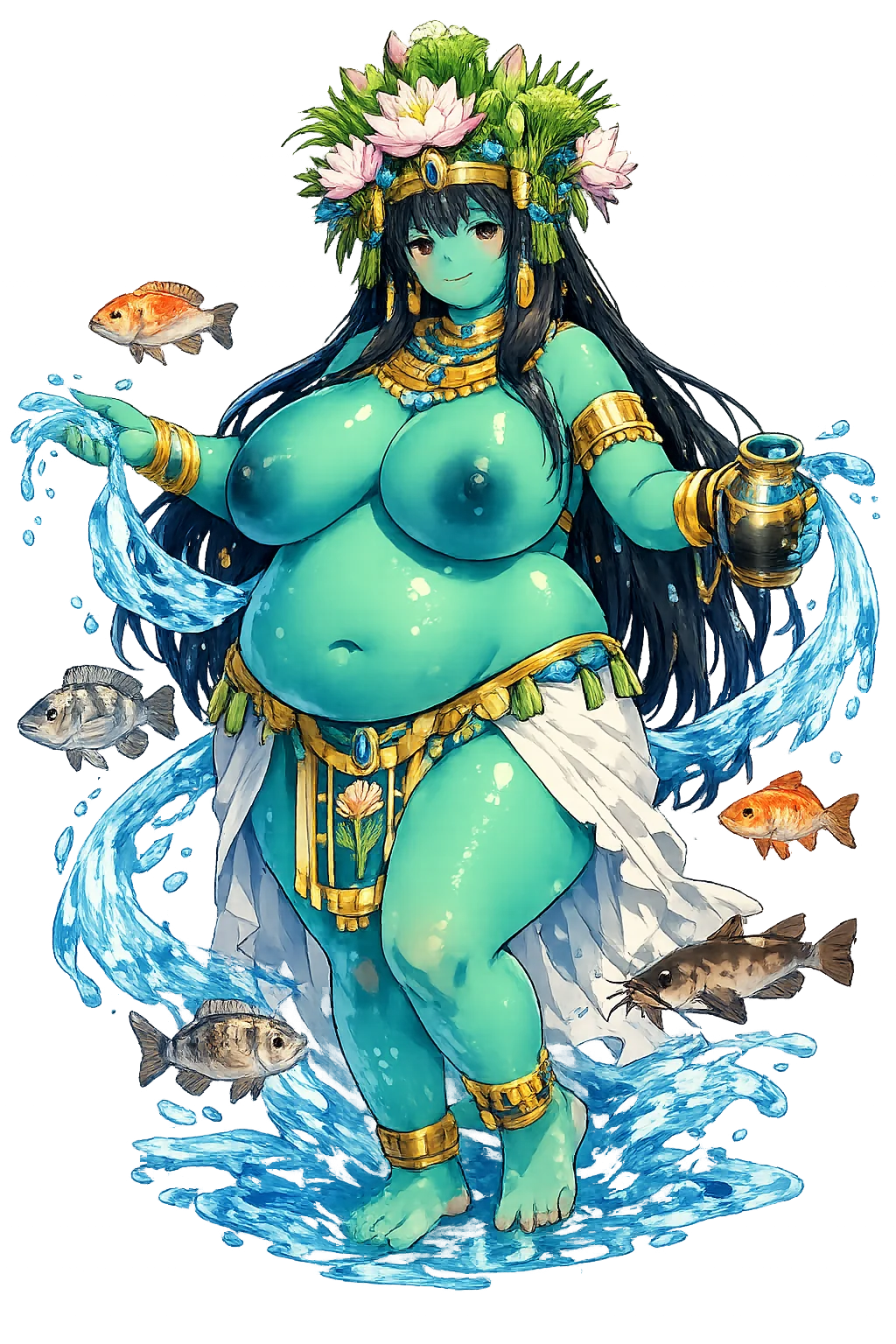
ḥp is the Nile flood personified: the annual miracle on which all of Egypt hung, arriving as a blue-green, androgynous, heavy-bellied bringer of plenty. No temple was built to him — he needed none; the river was his temple, and its rising his epiphany.
The akhet season: the river rising to feed the black land — Egypt's single most sacred event.
He bears trays of fish, fowl, and produce — the land's abundance carried in his own arms.
The double Hapi tying papyrus and lotus around the windpipe-sign: the Two Lands knotted into one.
His measure at Elephantine: cubits of rise that set the year's tax and the year's hope.
From the original script to the living URL
𓎛𓂝𓊪𓏭𓈘
The name in its original Egyptian form. Ḥꜥpy (𓎛𓂝𓊪𓏭𓈘) is attested in the source tradition — “The Nile flood god Hapi; from ḥꜥpj”. Its Egyptological ain and alef letters and emphatic consonants carry the full phonetic and orthographic weight of the source tradition.
hp
Reduced to plain hp, the name loses everything that made it specific: Egyptological ain and alef letters and emphatic consonants. What remains is an ASCII string that machines can parse but that no longer speaks with its original voice.
Ḥꜥpy
The Unicode restoration recovers what ASCII flattened. Ḥꜥpy restores Egyptological ain and alef letters and emphatic consonants, returning the name to its original written dignity. The domain encodes to Punycode, but the browser displays the truth.
Ḥꜥpy.com → xn--py-rus6609e.com
The non-ASCII characters in Ḥꜥpy are encoded while the ASCII remains visible. To the DNS, it is Punycode. To humanity, it is Ḥꜥpy.
Owned, ideal, and ASCII forms of Ḥꜥpy
Ḥꜥpy
Restores 𓎛𓂝𓊪𓏭𓈘. The live temple domain — ḥꜥpy.com.
ḥp
Restores 𓎛𓂝𓊪𓏭𓈘. A second live spelling — ḥp.com.
hp
Flattens 𓎛𓂝𓊪𓏭𓈘. The plain ASCII fallback — what DNS and legacy systems see.
How Ḥꜥpy was spoken
How Ḥꜥpy travels from ancient script to the modern URL
Egyptian Ḥꜥpy; the original vocalisation is unknown. The name denotes the inundation and the Nile-god.
The lore you have read is the living myth. Extended Lore opens the scholarly vault beneath it: the cult and its material remains, a history of the image, the name after antiquity, a meditation on what the name still means, and the full scholarly apparatus — etymology, orthography, sources.
Enter Extended Lore