
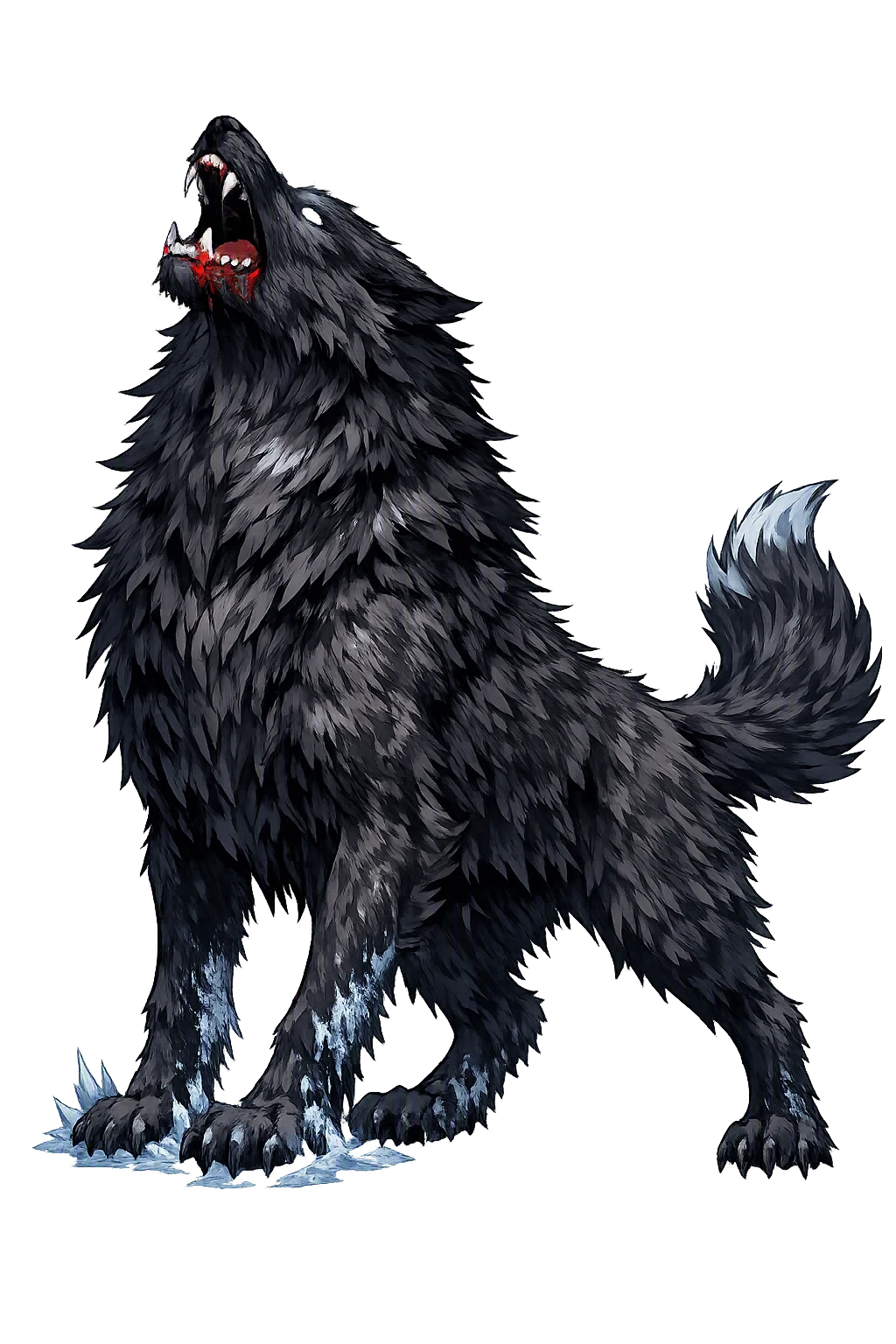
The hidden history behind Hati
Behind the modern ASCII form hati hides a much longer story. Hati reaches back through manuscripts, inscriptions, and oral tradition long before it ever touched a keyboard, and every mark in the restored spelling is a receipt from that journey. In what follows we trace the name from its Younger Futhark attestations through its mythology, its cult, its symbols, and its afterlife in other cultures — and we show how the PuniCodex project turned that philological record into a Unicode domain that resolves today. The history was never lost. It was only waiting for the infrastructure to catch up.
At a Glance
- Restored name: Hati
- ASCII form: hati
- Meaning: "The hater"
- Domain of influence: Moon-Chaser, Chaos
- Pantheon: Norse
- Classification: Tier 2
- Original script: ᚼᛅᛏᛁ (Younger Futhark)
Overview
Hati (hati) — Moon-Chaser, Chaos · The Hater, Son of the Fame-Wolf — is the wolf the Edda sets running after the moon: Hati Hróðvitnisson, son of the fame-wolf Fenrir, who runs before the sun and at the heels of Máni, and who is fated to seize his quarry out of the sky when Ragnarǫk comes.
His name is one of the most transparent theonyms in the corpus: Old Norse hati is the ordinary agent noun 'hater, enemy', from the verb hata, 'to hate' — the wolf is called, simply, 'the Hater'. His dossier is thin and exact: one verse of Grímnismál names him and his father, Snorri's Gylfaginning gives him his quarry and his foreknown success, and Völuspá supplies the Ironwood kennel he springs from, where the old giantess breeds Fenrir's brood and 'from all of them comes one in particular, a snatcher of the moon in a troll's skin'.
PuniCodex restores the name as Hati — identical to the ASCII input, because normalized Old Norse writes no diacritic in this name; the mechanical rule therefore places it in Tier 2, a statement about orthography and never about the figure. The project holds no domain for this name: the plain-ASCII hati.com is registered to a third party outside the collection and is watched for release.
The Name
The name is attested in Old Norse as Hati, always with the patronymic Hróðvitnisson, 'son of Hróðvitnir'. It is the ordinary Old Norse masculine agent noun hati, 'hater, enemy', formed on the verb hata, 'to hate' — the same Proto-Germanic word (hatōjan-) that gives English hate. The etymology is not disputed; the name means what it says. The patronymic fixes his pedigree: Hróðvitnir*, 'fame-wolf', is a poetic heiti of Fenrir, so the verse that names Hati names him as the bound wolf's son.
The ASCII form is not a compromise here: normalized Old Norse Hati is already written in plain ASCII letters. There is no diacritic, no thorn or eth, no vowel-length mark for the early domain-name system to have stripped. The name is classified Tier 2 by the project's mechanical rule — the restoration preserves nothing the ASCII form loses. Note also what the name lacks: unlike most Old Norse masculine theonyms (Baldr, Hermóðr), it carries no nominative -r, because it is a weak-declension agent noun ending in a stem vowel.
The letter-by-letter transformation runs:
- h → H — Same, capitalized
- a → a — Same
- t → t — Same
- i → i — Same
The project holds no domain for this name: hati.com is held by a third party outside the PuniCodex collection and is watched for release; this temple claims no domain.
The Original Script
The name is preserved in medieval Icelandic manuscripts in the Latin alphabet as Hati — Old Norse (North Germanic), attested 13th c. CE in the Codex Regius (Grímnismál) and the Codex Regius of the Prose Edda (Gylfaginning), recording material centuries older. Before the Latin bookhand, Old Norse names were carved in the Younger Futhark; no runic attestation of this name survives, so the manuscript form is the primary witness.
The scholarly rendering proceeds step by step:
- The name is the agent noun hati 'hater', formed on the verb hata 'to hate' — a weak-declension masculine, hence the final stem vowel and the absence of the nominative -r.
- In the Younger Futhark it would have been carved ᚼᛅᛏᛁ (h-a-t-i), four runes with no ambiguity.
- Normalized Old Norse orthography writes no diacritic in this name: the vowels are short, and every letter is plain ASCII.
- The Unicode restoration Hati therefore differs from the ASCII input only by capitalization — Tier 2 by the mechanical rule.
Pronunciation
The reconstructed pronunciation of the name is /ˈhɑ.ti/ — Old Norse Reconstruction.
Phoneme by phoneme:
- H- — Voiceless glottal fricative [h], as in English hat; Old Norse initial h is fully sounded
- -a- — Short open back unrounded [ɑ], held brief — Old Norse short a, not the long á
- -ti — Voiceless dental stop [t] and short front [i]; the second syllable is unstressed and clipped
For the modern speaker, the closest approximation is: 'HAH-tih' — two short syllables, stress on the first, with plain short vowels and no final nominative -r.
Kindred and historical forms of the name:
- Old Norse — Hati Hróðvitnisson, the moon-chasing wolf of Grímnismál and Gylfaginning
- Common noun — hati, 'hater, enemy', the agent noun of hata, 'to hate'
- English cognate — hate, the same Proto-Germanic word, *hatōjan-
- Modern Icelandic — Hati, unchanged in spelling since the medieval manuscripts
Hati is Tier 2 because the restoration preserves nothing ASCII cannot carry: no diacritic, no thorn or eth, no length mark. The name's distinctiveness is semantic, not orthographic — it is the verb 'to hate' given legs and set after the moon.
Mythology
Hati's mythology is a single image carried by a handful of verses: a wolf, a moon, and a chase that ends only with the world.
The Pair Before Heaven (Grímnismál 39)
The name's one poetic attestation comes in Óðinn's great catalogue of the cosmos in Grímnismál: 'Skǫll is the name of the wolf who follows the bright-faced god to the sheltering wood; but the other is Hati, Hróðvitnir's son, who runs before the bright bride of heaven.' The bright bride of heaven is Sól; the wolf who runs before her is on the heels of the moon that travels ahead of her. In four lines the Edda converts the machinery of the sky into a hunt.
Snorri's System (Gylfaginning 12)
Snorri systematizes the verse. When Gangleri asks why the sun hurries so — 'she speeds as if she were afraid' — High One answers that the one who seeks her is right behind her. Two wolves do the work of the heavens: Skǫll chases the sun and will catch her, and 'the other wolf is called Hati Hróðvitnisson; he runs in front of her and wants to catch the moon — and that is what will happen.'
Mánagarmr, the Moon-Hound
In the same chapter Snorri names the mightiest of the brood: Mánagarmr, 'moon-hound' — 'he will be filled with the flesh of all who die, and he will swallow the moon and spatter the sky and all the air with blood.' Whether Mánagarmr is Hati under a second name or a third wolf beside the pair, the manuscripts leave open; Simek and Lindow record the identification as probable but unprovable.
The Brood of the Ironwood (Völuspá 39–40)
The seeress supplies the kennel: 'In the east sat the old one in the Ironwood and bred there Fenrir's brood; from all of them comes one in particular, a snatcher of the moon in a troll's skin. He gorges on the life of doomed men, reddens the gods' dwellings with red blood; the sunshine turns black in the summers after.' The poem names no name — but the tungls tjúgari, the 'snatcher of the moon', is the role Grímnismál and Snorri assign to Hati.
The Catch (Gylfaginning 51 · Völuspá)
The ending is shared by every witness: when Ragnarǫk comes, the running stops — Skǫll takes the sun, Hati takes the moon, Fenrir swallows Óðinn, and the bright stars vanish from the sky. The Edda's cosmology is built so that the nightly order of the heavens is only an interval: the long meanwhile between the start of the chase and its foreknown end.
Symbols & Iconography
The iconography of Hati is narrative and celestial — the corpus gives him no regalia, but the chase itself fixed a small set of images:
- The running wolf — pursuit without rest: the sky itself read as a hunt that has never once paused
- The fleeing moon — Máni's measured course reinterpreted as flight: what astronomy calls a path, the poem calls terror
- Járnviðr, the Ironwood — the eastern forest where the old giantess breeds Fenrir's brood: chaos with an address, growing older by the year
- The darkened sky — Völuspá's 'the sunshine turns black in the summers after': the eclipse and the world's ending written in one image
- The troll's skin — the seeress's phrase for the moon-snatcher's guise: the wolf-shape worn as a monster's garment over a name the poem withholds
Archaeology & Evidence
Hati is a wholly textual figure: no runestone names him, no votive deposit invokes him, and no image can be securely assigned to him. Wolf iconography is plentiful in the Viking-Age record — the wolf-riders and great-wolf scenes on the Gotland picture stones have been argued over since Lindqvist, and Úlfr Uggason's Húsdrápa (c. 983) proves that wolf-mounted figures of myth were carved in pre-Christian halls — but no carving carries an inscription that ties a wolf to the moon-chase. The stones are witnesses to a world that knew wolves of myth, not to this wolf.
The name's true witnesses are the manuscripts: Grímnismál in the Codex Regius (c. 1270) and AM 748 I 4to, Völuspá in the Codex Regius and Hauksbók, and Gylfaginning in the Codex Regius of the Prose Edda and its sister codices, all recording material centuries older. The þulur of Skáldskaparmál preserve Hati and Hróðvitnir among the poetic heiti for 'wolf' — the tradition's own file of the name.
Realm & Domain
Hati is catalogued under the domain 'Moon-Chaser, Chaos' — and the sources earn both terms of it.
The Moon-Chaser
His sole function in the corpus is pursuit: Grímnismál sets him running before the sun, Snorri assigns him the moon as his quarry, and Völuspá's 'snatcher of the moon in a troll's skin' is the role the handbooks read as his. The chase is his whole mythology.
Chaos
He belongs to the forces the gods cannot bind: bred in the Ironwood from Fenrir's own line, he is one of the certainties of Ragnarǫk — the catch Snorri says simply 'will happen'. His chaos is not randomness but inevitability: order pursued.
The Eclipse-Wolf
The handbooks read the chase as the sky's own etiology: when the wolf draws close to his quarry, the moon darkens — the medieval North's explanation of the lunar eclipse, and the reason the figure endures in every account of the northern sky-myths.
The Fenrir-Complex
Hati never acts alone in the tradition: he is one face of the apocalyptic wolf-complex that also includes Skǫll, Mánagarmr, Garmr, and Fenrir himself — the kennel of the world's ending.
Across Cultures
Hati has no cult, no continental cognate, and no existence outside the Eddic record: he belongs to the North's own eschatological machinery. Scholars have long noted that the doubling of the apocalyptic wolf — one chasing the sun, one the moon — is probably a secondary systematization of the older single figure, the bound Fenrir who breaks loose at the world's end; Simek and Lindow treat Skǫll and Hati as elaborations within the Fenrir-complex rather than as independent tradition, and Garmr, the blood-caked hound of Gnipahellir who bays loose at Ragnarǫk, belongs to the same kennel.
What the pair does uniquely well is etiology. The devouring-monster account of eclipses is a comparative commonplace across cultures; the Norse version is distinctive for giving its monsters names, a pedigree, and a date. The chase gives the sky a reason for its haste — Sól hurries because Skǫll is behind her — and the wolf drawing near gives the medieval North its explanation of the eclipse: when the pursuer closes on Máni, the moon darkens.
Cultural Legacy
Hati's afterlife is the eclipse-wolf's: wherever the Ragnarǫk story is retold, the pair Skǫll and Hati run in the sky above it. The nineteenth-century myth handbooks that introduced Norse cosmology to English readers made the chase a set-piece of mythological explanation — the sky's motions as a hunt, the eclipse as the moment the wolf gains — and every modern retelling of Ragnarǫk, from children's mythologies to novels and games, keeps the two wolves as the ending's outriders.
In scholarship the name is the standing example of the Edda's transparent theonymy: a figure called, without ornament, 'the Hater'. Unlike Baldr or Freyja, the name never entered the living Scandinavian name-pool; it survives where it was born, in the poetry and its commentaries, doing the one job it was given.
The Scholarly Record
The account of Hati given in this edition rests on the witnesses and reference works listed below. The Eddas supply the chase and the ending; the lexica secure the name's etymology; the handbooks arbitrate the Fenrir-complex and the eclipse etiology.
- Grímnismál 39 (Hati, Hróðvitnir's son, before the bright bride of heaven), trans. Carolyne Larrington, The Poetic Edda, 2nd ed. (Oxford: Oxford University Press, 2014).
- Völuspá 39–40 (the Ironwood brood; the snatcher of the moon), trans. Larrington (2014).
- Snorri Sturluson, Edda, Gylfaginning 12 (Skǫll and Hati; Mánagarmr) and 51 (Ragnarǫk), ed. and trans. Anthony Faulkes (London: Everyman, 1987).
- Snorri Sturluson, Edda, Skáldskaparmál, þulur (wolf-heiti), ed. and trans. Faulkes (1987).
- Cleasby, Richard, and Guðbrandur Vigfússon, An Icelandic-English Dictionary, 2nd ed. (Oxford: Clarendon Press, 1957), s.v. hati, hata, Hróðvitnir.
- Zoëga, Geir T., A Concise Dictionary of Old Icelandic (Oxford: Clarendon Press, 1910), s.v. hati.
- de Vries, Jan, Altnordisches etymologisches Wörterbuch, 2nd ed. (Leiden: Brill, 1962), s.v. hata.
- Simek, Rudolf, Dictionary of Northern Mythology, trans. Angela Hall (Cambridge: D. S. Brewer, 1993), s.v. Hati, Skǫll, Mánagarm, Garm.
- Orchard, Andy, Dictionary of Norse Myth and Legend (London: Cassell, 1997), s.v. Hati, Sköll.
- Lindow, John, Norse Mythology: A Guide to the Gods, Heroes, Rituals, and Beliefs (Oxford: Oxford University Press, 2001), s.v. Sköll, Fenrir.
- Gordon, E. V., An Introduction to Old Norse, 2nd ed. rev. A. R. Taylor (Oxford: Clarendon Press, 1957).
A Meditation
Hati is the Edda's most economical idea: take the verb 'to hate', give it legs, and set it running after the light. There is no malice-scene, no dialogue, no character beyond the name — only pursuit. And that is the point. The Norse imagination looked at the most orderly thing in the world, the clockwork of sun and moon, and read it as flight: the lights hurry because something hates them and is coming.
Time itself becomes the distance still left between the wolf and the moon — every night Máni escapes is a night the world continues. Hati asks the uncomfortable question the whole Ragnarǫk cycle asks: how do you keep the light moving, knowing exactly what follows it? The Edda's answer is the one it gives everywhere. You keep running. The chase is the world.
The Unicode Restoration
Hati is classified as Tier 2: the restoration needs no distinctive letters or diacritics its ASCII form would lose. The ASCII fallback hati still resolves everywhere, but it is the restored form that carries the name's full information. That is the whole thesis of this temple: the marks are the message.
Why This Restoration Matters
The story of Hati did not end in antiquity; it changed medium. Names that survive for millennia do so because each generation finds a new carrier for them — clay, papyrus, print, and now DNS. The PuniCodex restoration simply makes the carrier honest: the spelling that resolves is the spelling the evidence supports. If this post showed anything, it is that hati and Hati are not the same name with different styling. They are a summary and the text it summarizes. The web can now serve the text.
Explore Further
This post is one doorway into the temple. The home page carries the full character breakdown and the ambient canvas; the lore page tells the myths in long form; the Scholarly Edition preserves the sources, pronunciation data, and revision history; and the patron wall supports the restoration directly. For the wider map, browse the Lexicon, explore the Pantheon, or return to the PuniCodex blog.
Related Names
Sources
The full scholarly apparatus — every citation, revision, and review — lives in the Scholarly Edition. Key references for this post:
- Snorri Sturluson, Edda, Gylfaginning 12 (Skǫll and Hati; Mánagarmr) and 51 (Ragnarǫk), ed. and trans. Anthony Faulkes (London: Everyman, 1987).
- Grímnismál 39 and Völuspá 39–40 (Poetic Edda), trans. Carolyne Larrington, The Poetic Edda, 2nd ed. (Oxford: Oxford University Press, 2014).
- Cleasby, Richard, and Guðbrandur Vigfússon, An Icelandic-English Dictionary, 2nd ed. (Oxford: Clarendon Press, 1957), s.v. hati, hata.
- Cleasby, Richard, and Guðbrandur Vigfússon, An Icelandic-English Dictionary, 2nd ed. (Oxford: Clarendon Press, 1957), s.v. hati, hata, Hróðvitnir.
- Lexicon authorities for this entry: Poetic Edda, Cleasby-Vigfusson.