
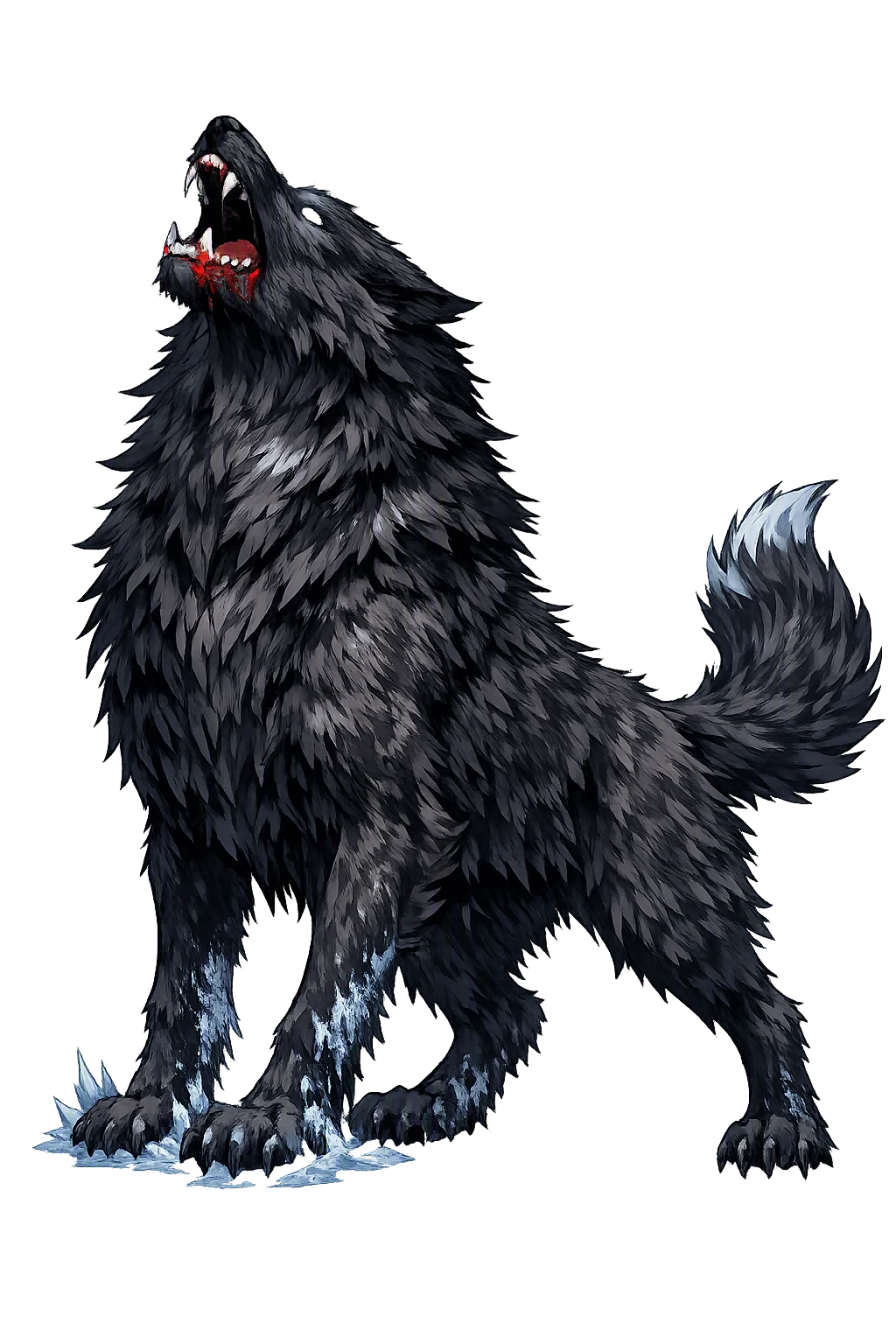
The hidden history behind Hati
Behind the plain ASCII spelling hati stands a much longer record. Hati reaches through manuscripts, inscriptions, oral transmission, and scholarly convention long before it reaches a keyboard. No lost marks are being invented here. Instead, this post traces why the tradition's sources support this exact form, how the name sounds, what its myths preserve, and how the digital temple keeps that evidence open for review.
At a Glance
- Canonical name: Hati
- ASCII form: hati
- Meaning: "The hater"
- Domain of influence: Moon-Chaser, Chaos
- Pantheon: Norse
- Restoration: ASCII-equivalent form
- Reconstructed form: ᚼᛅᛏᛁ (Younger Futhark)
Overview
Hati (hati) — Moon-Chaser, Chaos · The hater — belongs to the Norse tradition, where it is catalogued under the domain "Moon-Chaser, Chaos". The name means "The hater".
Hati Hróðvitnisson is the wolf who runs before the sun and after the moon: son of the fame-wolf Fenrir, bred in the Ironwood, and fated to seize Máni out of the sky — the chase on which the Edda hangs its explanation of the darkened moon and one of the certainties of Ragnarǫk.
PuniCodex records the canonical scholarly spelling Hati and serves its temple at its temple. The displayed form is ASCII-equivalent — a description computed from the displayed form itself. The plain ASCII form hati contains the same letters: no recovered diacritics or special encoding is claimed. The work here is consistent citation, capitalization, provenance, and cultural context.
The Name
The name is attested in Younger Futhark as ᚼᛅᛏᛁ. Etymologically it means "The hater".
The canonical spelling Hati matches the conventional scholarly romanization. The plain ASCII form hati contains the same letters, so no lost diacritics or encoding transition is claimed. The editorial work is to fix one reviewed reference spelling, preserve capitalization and provenance, and keep the original evidence visible. The displayed form is ASCII-equivalent — a description computed from the displayed form itself.
The letter-by-letter transformation runs:
- h → H — Same, capitalized
- a → a — Same
- t → t — Same
- i → i — Same
The Original Script
The name is preserved in Younger Futhark as ᚼᛅᛏᛁ.
The scholarly transliteration is hati.
The rendering proceeds step by step:
- ᚼ (hagall) writes /h/
- ᛅ (ár) writes /a/, /á/ and /æ/
- ᛏ (Týr) writes both /t/ and /d/
- The spelling hati is a normalized phonetic reconstruction; Younger Futhark does not distinguish voiced/voiceless stops or separate short and long vowels
The normalized Old Norse form is Hati — already plain ASCII, with no diacritic or distinctive letter for the restoration to recover; in the Younger Futhark the name would have been carved ᚼᛅᛏᛁ (h-a-t-i, four runes with no ambiguity). Because the name is pure ASCII, its domain was registered long ago in the ordinary way: hati.com is held by a third party outside the PuniCodex collection and is watched for release — no form of the name is currently owned, and this temple claims none.
Pronunciation
The reconstructed pronunciation of the name is /ˈhɑ.ti/ — Old Norse Reconstruction.
Phoneme by phoneme:
- H- — Voiceless glottal fricative [h], as in English 'hat'; Old Norse initial h is fully sounded.
- -a- — Short open back unrounded [ɑ], held brief — Old Norse short a, not the long á.
- -ti — Voiceless dental stop [t] and short front [i]; the second syllable is unstressed and clipped, as in modern Icelandic.
For the modern speaker, the closest approximation is: 'HAH-tih' — two short syllables, stress on the first; the vowels are short and plain, with no diphthong and no final nominative -r, for the name ends in a stem vowel, not an ending.
Kindred and historical forms of the name:
- Old Norse — Hati Hróðvitnisson, 'Hati, son of Hróðvitnir' — the fame-wolf's son of Grímnismál and Gylfaginning.
- Common noun — hati, 'hater, enemy' — the ordinary Old Norse agent noun, from the verb hata, 'to hate'.
- English cognate — hate — the verb hata and English hate descend from the same Proto-Germanic word, *hatōjan-.
- Modern Icelandic — Hati, unchanged in spelling since the medieval manuscripts.
Hati is a plain restoration by the mechanical rule: the normalized Old Norse form is already plain ASCII — there is no diacritic and no distinctive letter for the ASCII alphabet to lose. Unlike most Old Norse masculine theonyms it carries no nominative -r, since the name is the agent noun hati ('the hater') with a weak-declension stem vowel. The name's transparency is its whole story: the wolf is called, simply, 'the Hater'.
Mythology
Hati's mythology is a single image carried by a handful of verses: a wolf, a moon, and a chase that ends only with the world. The Poetic Edda names him once, Snorri gives him his quarry and his ending, and Völuspá's seeress supplies the brood he springs from.
The Pair Before Heaven (Grímnismál 39)
The name's one poetic attestation comes in Óðinn's great catalogue of the cosmos in Grímnismál, where the disguised god enumerates the heavens for the torture-bound Geirrøðr: 'Skǫll is the name of the wolf who follows the bright-faced god to the sheltering wood; but the other is Hati, Hróðvitnir's son, who runs before the bright bride of heaven.' The bright bride of heaven is the sun; the wolf who runs before her is on the heels of the moon, which travels ahead of her. In four lines the Edda converts the machinery of the sky into a hunt: what astronomy calls a course, the poem calls a chase.
Skǫll After the Sun, Hati After the Moon (Gylfaginning 12)
Snorri systematizes the verse. When Gangleri asks why the sun hurries so — 'she speeds as if she were afraid' — High One answers that she has good cause: 'the one who seeks her is right behind her, and she has no other way out than to run.' Two wolves do the work of the heavens: Skǫll chases the sun and will catch her, and 'the other wolf is called Hati Hróðvitnisson; he runs in front of her and wants to catch the moon — and that is what will happen.' Snorri's gloss fixes the reading the poem left compressed, and with it the moon's doom is put on the schedule of things foretold.
Mánagarmr, the Moon-Hound (Gylfaginning 12)
In the same chapter Snorri names the mightiest of the wolf-brood: Mánagarmr, 'moon-hound' — 'he will be filled with the flesh of all who die, and he will swallow the moon and spatter the sky and all the air with blood; from this the sun will lose its brightness.' Whether Mánagarmr is Hati under a second name or a third wolf beside the pair, the manuscripts and the handbooks leave open; Simek and Lindow record the identification as probable but unprovable. What is certain is the image: the moon taken, and the blood of the swallowed light staining heaven.
The Brood of the Ironwood (Völuspá 39-40)
Völuspá's seeress supplies the kennel. 'In the east sat the old one in the Ironwood and bred there Fenrir's brood; from all of them comes one in particular, a snatcher of the moon in a troll's skin. He gorges on the life of doomed men, reddens the gods' dwellings with red blood; the sunshine turns black in the summers after, and all weathers run hostile.' The poem names no name — but the tungls tjúgari, the 'snatcher of the moon', is the role Grímnismál and Snorri assign to Hati, and the handbooks read the figures together: the Ironwood breeds the chase, and the chase ends the world.
The Catch at Ragnarǫk (Gylfaginning 51 · Völuspá)
The ending is shared by every witness. When Ragnarǫk comes, the wolves' running stops: Skǫll takes the sun, Hati takes the moon, Fenrir himself swallows Óðinn, and 'the sun turns black, earth sinks into the sea, the bright stars vanish from the sky.' The Edda's cosmology is built so that the nightly order of the heavens is only an interval — the long meanwhile between the start of the chase and its foreknown end. Hati never fails of his quarry; he simply has not caught it yet.
Symbols & Iconography
The iconography associated with Hati concentrates in a small set of recurring attributes, each a compressed statement about the name:
- The running wolf — Pursuit without rest: the sky itself read as a hunt that has never once paused
- The fleeing moon — Máni's course as flight — the measured path of the heavens reinterpreted as terror
- Járnviðr, the Ironwood — The eastern forest where the wolf-brood is bred: chaos with an address, growing older by the year
- The darkened sky — Völuspá's 'the sunshine turns black' — the eclipse and the world's ending written in one image
Archaeology & Evidence
Hati is a wholly textual figure: no runestone names him, no votive deposit invokes him, and no image can be securely assigned to him. Wolf iconography is plentiful in the Viking-Age record — the wolf-rider and great-wolf scenes on the Gotland picture stones have long been argued over, and Hyrrokkin's wolf-mount at Baldr's funeral was carved in Óláfr pái's hall (Húsdrápa, c. 983) — but no carving carries an inscription that ties a wolf to the moon-chase. The name's witnesses are the manuscripts: Grímnismál in the Codex Regius (c. 1270) and AM 748 I 4to, Völuspá in the Codex Regius and Hauksbók, and Gylfaginning in the Codex Regius of the Prose Edda and its sister codices (Codex Wormianus, Codex Upsaliensis), all recording material centuries older. The þulur of Skáldskaparmál preserve Hati and Hróðvitnir among the poetic heiti for 'wolf' — the tradition's own file of the name.
Realm & Domain
Hati Hróðvitnisson is the wolf who runs before the sun and after the moon: son of the fame-wolf Fenrir, bred in the Ironwood, and fated to seize Máni out of the sky — the chase on which the Edda hangs its explanation of the darkened moon and one of the certainties of Ragnarǫk.
The Chase
Grímnismál's picture: Hati runs before the bright bride of heaven — ahead of the sun, at the heels of the moon that flees before her.
Hróðvitnir's Son
The patronymic names his father: Hróðvitnir, 'fame-wolf', a heiti of Fenrir himself — the apocalyptic kennel's own lineage.
Járnviðr, the Ironwood
Völuspá's forest east of the world, where the old giantess breeds Fenrir's brood — and from them all comes the one who takes the moon.
The Seized Moon
The catch Snorri says must come: the moon swallowed, the sky spattered with blood, and the light of the world going out at Ragnarǫk.
Across Cultures
Hati has no cult, no continental cognate, and no existence outside the Eddic record: he belongs to the North's own eschatological machinery. Scholars since the nineteenth century have noted that the doubling of the apocalyptic wolf — one chasing the sun, one the moon — is probably a secondary systematization of the older single figure, the bound Fenrir who breaks loose at the world's end; Simek and Lindow treat Skǫll and Hati as elaborations within the Fenrir-complex rather than independent tradition. What the pair does uniquely well is etiology: the chase gives the sky a reason for its haste, and the wolf drawing near gives the North its explanation of the eclipse — when the pursuer closes, the moon darkens. The devouring-monster account of eclipses is a comparative commonplace across cultures; the Norse version is distinctive for giving its monsters names, a pedigree, and a date.
Kindred figures in the PuniCodex cross-tradition index include Angrboða (chaos / primordial / world serpent), ꜥꜣpp (chaos / primordial / world serpent), Ártemis (moon / lunar), Chángé (moon / lunar), Cháos (chaos / primordial / world serpent), and Hekátē (moon / lunar).
Cultural Legacy
Hati's afterlife is the eclipse-wolf's: wherever the Ragnarǫk story is retold, the pair Skǫll and Hati run in the sky above it. Victorian and later handbooks of Norse myth made the chase a set-piece of cosmological explanation — the sky's motions as a hunt, the eclipse as the moment the wolf gains — and modern retellings, novels, and games keep the two wolves as Ragnarǫk's outriders. In scholarship the name is the standing example of the Edda's transparent theonymy: a god-figure called, without ornament, 'the Hater'. The name never entered the living name-pool as Baldr's did; it survives where it was born, in the poetry, doing the one job it was given.
The Scholarly Record
The account of Hati given in this edition rests on the witnesses and reference works listed below. Lexica and etymological dictionaries secure the form and meaning of the name; the literary and religious texts supply the narrative evidence.
- Poetic Edda: Grímnismál 39 (Hati, Hróðvitnir's son, before the bright bride of heaven) and Völuspá 39-40 (the Ironwood brood; the snatcher of the moon).
- Snorri Sturluson, Prose Edda: Gylfaginning 12 (Skǫll and Hati; Mánagarmr) and 51 (Ragnarǫk); Skáldskaparmál þulur (wolf-heiti).
- Cleasby-Vigfusson, An Icelandic-English Dictionary, s.v. hati, hata, Hróðvitnir.
- Zoëga, A Concise Dictionary of Old Icelandic, s.v. hati.
- Simek, Dictionary of Northern Mythology, s.v. Hati, Skǫll, Mánagarm; Orchard, Dictionary of Norse Myth and Legend; Lindow, Norse Mythology: A Guide — on the Fenrir-complex and the eclipse etiology.
A Meditation
Hati is the Edda's most economical idea: take the verb 'to hate', give it legs, and set it running after the light. There is no malice-scene, no dialogue, no character beyond the name — only pursuit. And that is the point. The Norse imagination looked at the most orderly thing in the world, the clockwork of sun and moon, and read it as flight: the lights hurry because something hates them and is coming. Time itself becomes the distance still left between the wolf and the moon — every night the moon escapes is a night the world continues. Hati asks the uncomfortable question the whole Ragnarǫk cycle asks: how do you keep the light moving, knowing exactly what follows it? The Edda's answer is the one it gives everywhere. You keep running. The chase is the world.
The Canonical Spelling
Hati is the canonical spelling used by this temple. The plain ASCII form hati contains the same letters, so there are no lost diacritics to recover and no special encoding transition to explain. What the temple preserves is the reviewed reference form: capitalization, conventional romanization, original evidence, and a stable place to inspect them. The value here is not added decoration; it is fidelity to the attested record.
Character by Character
The canonical form Hati and the plain ASCII form hati share the same letters. The character list therefore documents continuity rather than recovery: every character is carried forward deliberately, with capitalization serving as the proper-noun convention. No additional mark is inserted merely to make the restoration appear more elaborate.
The Norse Pantheon
Hati is one of 101 entries the PuniCodex lexicon catalogues under the Norse pantheon. The Pantheon page gathers the tradition's major figures in one place, and the Lexicon lets you filter all 983 restorations by tradition or script — the fastest way to see where this name sits among its kin.
Frequently Asked Questions
What does Hati mean? The traditional gloss is "The hater."
Which tradition does Hati belong to? Hati is catalogued in the Norse pantheon of the PuniCodex lexicon.
Does this name need recovered diacritics? No. Hati is already an ASCII-form canonical spelling. The scholarly work is to preserve the attested convention and its evidence, not to add marks.
Can I use Hati in a normal browser? Yes. The spelling works directly in an ordinary browser, and the type tool can confirm and copy the canonical form.
Where does the scholarly information come from? The entry is built from lexica, inscriptional evidence, and reviewed scholarly sources listed in the Scholarly Edition.
Why This Record Matters
The story of Hati did not end in antiquity; it changed medium. Names survive because each generation finds a new carrier for them — clay, papyrus, print, and now the digital temple. The carrier is honest when the spelling that resolves is the spelling the evidence supports. Hati and hati contain the same letters; what the project adds is not ornament but provenance, review, and a permanent home for the record.
Explore Further
This post is one doorway into the temple. The home page carries the full character breakdown and the ambient canvas; the lore page tells the myths in long form; the Scholarly Edition preserves the sources, pronunciation data, and revision history; and the patron wall supports the restoration directly. For the wider map, browse the Lexicon, explore the Pantheon, or return to the PuniCodex blog.
Related Names
Sources
The full scholarly apparatus — every citation, revision, and review — lives in the Scholarly Edition. Key references for this post:
- An Icelandic-English Dictionary, 2nd ed. with supplement, 1874.
- Poetic Edda (Eddukvæði), ed. Neckel-Kuhn; trans. Carolyn Larrington, Oxford World's Classics (2014), 1270.
- Snorri Sturluson, Prose Edda, trans. Anthony Faulkes, Everyman / Viking Society for Northern Research, 1220.
- Poetic Edda: Grímnismál 39 (Hati, Hróðvitnir's son, before the bright bride of heaven) and Völuspá 39-40 (the Ironwood brood; the snatcher of the moon).
- Snorri Sturluson, Prose Edda: Gylfaginning 12 (Skǫll and Hati; Mánagarmr) and 51 (Ragnarǫk); Skáldskaparmál þulur (wolf-heiti).
- Cleasby-Vigfusson, An Icelandic-English Dictionary, s.v. hati, hata, Hróðvitnir.
- Zoëga, A Concise Dictionary of Old Icelandic, s.v. hati.
- Lexicon authorities for this entry: Poetic Edda, Cleasby-Vigfusson.