
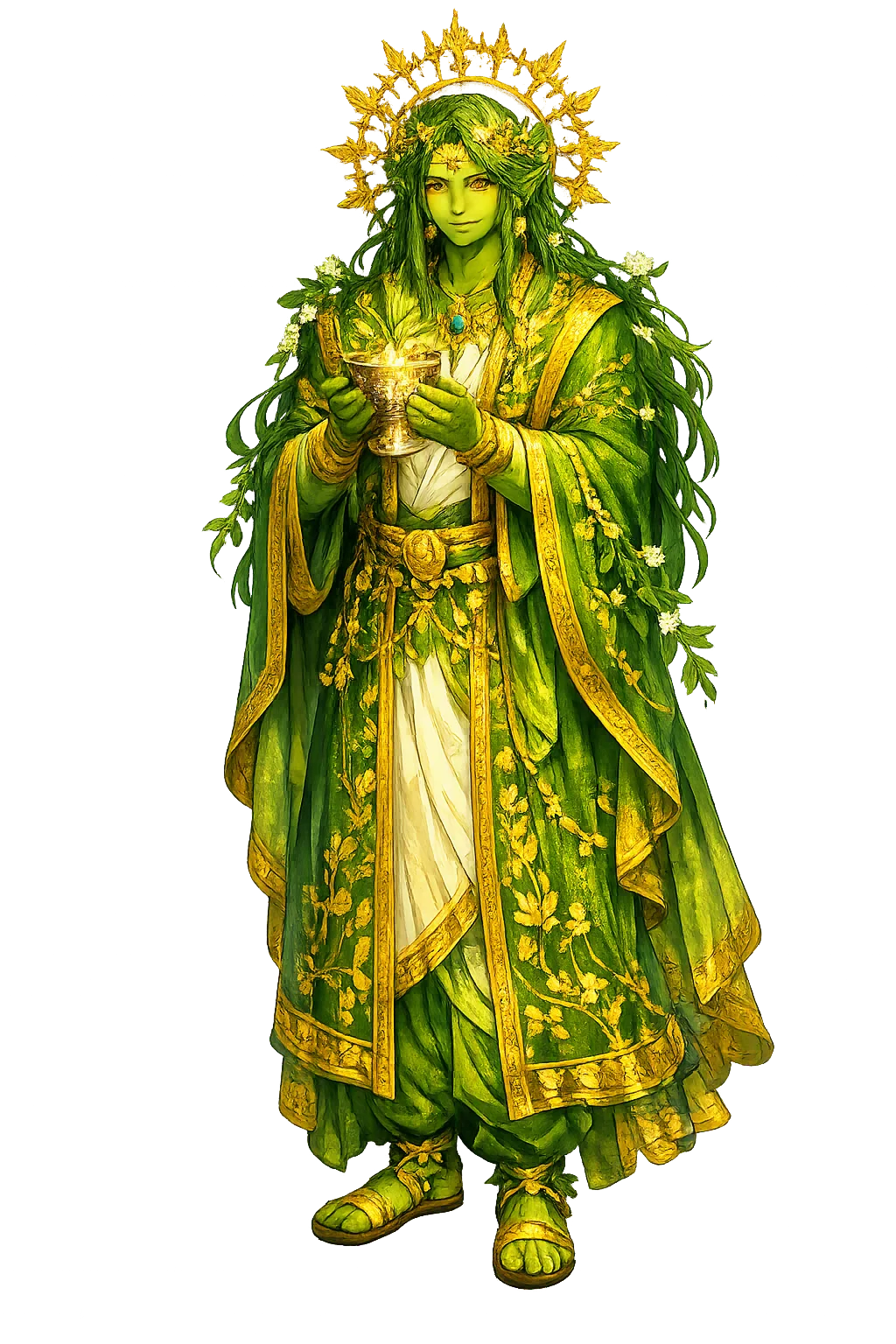
Haoma walks into a agriculture, food & harvest firm
The agriculture, food & harvest world does not cite Haoma in its documentation. It does not need to — it performs the archetype daily, unbilled.
Before the Office, the Story
Haoma Who Was First Pressed. The ninth Yašt is the hymn of the plant made god: Haoma, green and with golden eyes, who was first pressed on the heights of Hara (Yašt 9. 16, 19). The Avesta remembers him as both herb and yazata — the only deity of the Iranian pantheon who is simultaneously the offering itself, pounded fresh on the pestle each night in the Yasna.
Zarathustra's Reproach and the Roll of the Righteous. The most human scene in the Avesta opens the ninth chapter of the Yasna. Zarathuštra reproaches the plant: the karpans and the kavis — the sacrificial guilds he condemns — pressed you, Haoma, for the stupefying draught, and the plant stands accused by its own prophet (Yasna 9. 1–3).
At a Glance
- Temple: Haoma
- Pantheon: Zoroastrian
- Domain of influence: Sacred Plant, Immortality
- Pattern seats: 4
- Sectors touched: Energy & Natural World · Home & Lifestyle
- Strongest seat: Agriculture, Food & Harvest
- Series: The Resonance Files, No. 190 of 548
The Reveal, Seat by Seat
Agriculture, Food & Harvest
Primary seat: Haoma embodies sacred plant, immortality — the core of agriculture food. Nobody in that trade worships at this temple. They just keep its hours.
Environmental & Climate Services
Resonant seat: Haoma shares symbolic territory with environment climate. Nobody in that trade worships at this temple. They just keep its hours.
Forestry, Conservation & Outdoor Industries
Resonant seat: Haoma shares symbolic territory with forestry conservation. Nobody in that trade worships at this temple. They just keep its hours.
Home, Hearth & Real Estate
Resonant seat: Haoma shares symbolic territory with real estate home. Nobody in that trade worships at this temple. They just keep its hours.
Not the First Rebrand
Haoma's double is the Vedic soma — the same root, the same deified press, the same golden-eyed herb sung as a god in the Rigveda's ninth maṇḍala. The parallel is so close that some verses translate almost line for line, and it anchors the soma–haoma problem: which plant? The office is only the latest translation.
The Method, Stated Plainly
The atlas is not a horoscope. Seats are earned from the sources — argued, weighted, published — and every one of them can be challenged at the methodology page. A match that cannot survive an argument does not survive review. That is the whole trick: the patterns are claims, and claims can be tested.
For the Ones Who Work There
For a sponsor in agriculture, food & harvest, the fit here is not adjacency — it is inheritance. Your trade already tells this story every working day; the temple simply holds the original. The patron tier and the advertising terms carry the mechanics; the myths above carry the reason.
The File Continues
This is one of 548 Resonance Files — the third dispatch from every flagship temple, where the myths meet the markets. The temple's founding dispatch tells the name's story; its Restoration File tells the spelling's; the blog index holds the whole archive.
Continue the series — previous: Hanumān (read it) · next: Hati (read it).
The Resonance Files are argued from the same canonical record as the pattern atlas itself: the lexicon, the lore catalog, and the cited sources. Every seat can be challenged at the methodology page — and the challenge is the point.