Stories of Haoma
Haoma's mythology is liturgical before it is narrative: a plant so holy it became a god, hymned in his own Yašt, interrogated by Zarathuštra, granted to kings for victory, and pressed fresh every night of the year. His stories cluster around the mortar — the one altar that has never been abandoned.
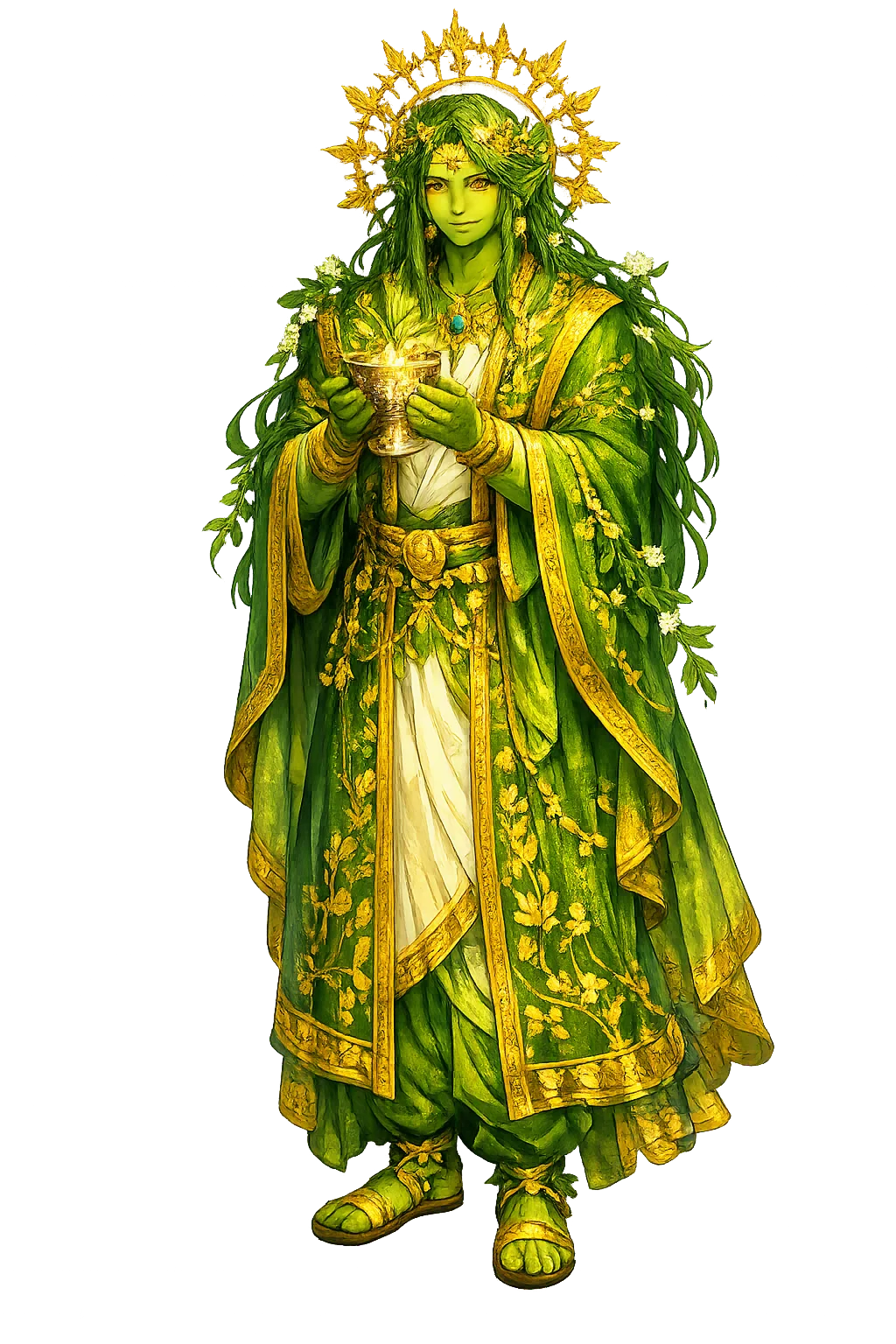
The ninth Yašt is the hymn of the plant made god: Haoma, green and with golden eyes, who was first pressed on the heights of Hara (Yašt 9.16, 19). The Avesta remembers him as both herb and yazata — the only deity of the Iranian pantheon who is simultaneously the offering itself, pounded fresh on the pestle each night in the Yasna. His first-pressing on Hara Berezaiti, the Alborz, the axis of the world, is the same mountain where Mithra keeps his thousand-eared, thousand-eyed watch (Yašt 10.13) — sacrament and covenant share one summit. His color and eyes passed into iconography: the golden-green plant appears on Sasanian silver among the emblems of the consecrated banquet. Haoma collapses the distance between altar and deity: the offering does not merely represent the god — it is the god, crushed to give life.
The most human scene in the Avesta opens the ninth chapter of the Yasna. Zarathuštra reproaches the plant: the karpans and the kavis — the sacrificial guilds he condemns — pressed you, Haoma, for the stupefying draught, and the plant stands accused by its own prophet (Yasna 9.1–3). Haoma answers with a catalogue of the righteous who pressed him rightly: Yima, who won the sun; Thraētaona, who struck down the three-mouthed Aži Dahāka; Kərəsāspa, who slew the horned dragon Gandarəβa; and Vīštāspa, who first confessed the good religion (Yasna 9.3–8). The exchange is unique — a prophet interrogating his own sacrament — and its verdict is exact: The scene gives the tradition its own charter myth of ritual reform, rare in the ancient world. the plant is holy; the abuse is in the pressing. Ritual ethics, not chemistry, decides what a sacrament does to the soul.
For King Vīštāspa, Haoma was oracles and victory. In Yašt 9 the king offers the plant the sacrifice of a hundred stallions, a hundred oxen, a hundred rams, and a hundred loads of grain — and the hymn says Haoma grants him what armies could not buy: the most fortunate of thoughts and the most victorious of weapons, with foreknowledge of the coming war against the Turanians and their daeva-worshipping king Arjāsp (Yašt 9.26–30). When Vīštāspa drank the pressed haoma, his spirit was illumined and his enemies' devices laid bare; the same hymn remembers the plant's gifts of swift horses and vanquishing glory. The myth dignifies strategy as piety: the visionary draught makes foresight itself a weapon, and the patron king who drinks it fights with wisdom before he fights with armies.
The living pressing survives in the Yasna itself. Chapters 9 to 11 preserve the rite: the parahōm, the water of the spring, the milk, the pounding of the twigs while the priest sings the very stanzas of the ninth chapter; then the consecration, the offering to fire, and the sip shared by priest and congregation. Parsi priests perform a form of this liturgy daily to this day, pounding ephedra where the mountain plant of the hymns no longer grows — a substitution the tradition itself treats as legitimate, since the Avesta praises the plant pressed with purity, whatever its species. Where even one family of a village keeps the rite, the tradition counts the night as won for the good creation. A sacrament four thousand years old still rises, nightly, from a mortar — among the oldest continuously performed rituals on earth.
Sacred Plant
Haoma is the deified sacred plant of Zoroastrianism, pressed at the dawn liturgy into the draught that grants vigor, wisdom, and a share in immortality. Green and golden-eyed, hymned as a yazata in his own right, he is the tradition's living sacrament — god, offering, and medicine crushed in a single mortar — and the Iranian double of the Vedic soma.
On the heights of Hara the green, golden-eyed plant was first pressed — the primordial sacrament of the Avesta (Yašt 9.16).
Zarathuštra reproaches Haoma for the draught of the false priests; the plant answers with a roll of righteous pressers (Yasna 9.3–8).
For King Vīštāspa's hundredfold sacrifice, Haoma grants foreknowledge of the war and 'the most victorious of weapons' (Yašt 9.26).
The nightly pounding of twigs with water and milk — performed for millennia, and still performed today (Yasna 9–11).
From the original script to the living URL
𐬵𐬀𐬊𐬨𐬀
The name in its original Zoroastrian form. Haoma (𐬵𐬀𐬊𐬨𐬀) is attested in the source tradition — “The pressed one”. Its original diacritics and script distinctions carry the full phonetic and orthographic weight of the source tradition.
haoma
The plain haoma form is identical to the Unicode restoration. Because this name is already written in Latin letters, no diacritics, stress, or script information were lost — only capitalization differs.
Haoma
The Unicode restoration does not need to recover lost marks for Haoma. Its value is canonical spelling and consistent cataloguing, not the reconstruction of erased orthography. The domain is readable as-is to both DNS and humanity.
Haoma.com
This restoration is written entirely in ASCII letters — no Punycode encoding stands between Haoma and the DNS. The domain reads identically to machines and to human eyes.
Owned, ideal, and ASCII forms of Haoma
Haoma
Restores 𐬵𐬀𐬊𐬨𐬀. The full Unicode restoration. haoma.com is not in the PuniCodex collection — it is watched for release; if it drops, this temple upgrades to an owned flagship.
How Haoma was spoken
How Haoma travels from ancient script to the modern URL
The lore you have read is the living myth. Extended Lore opens the scholarly vault beneath it: the cult and its material remains, a history of the image, the name after antiquity, a meditation on what the name still means, and the full scholarly apparatus — etymology, orthography, sources.
Enter Extended Lore