
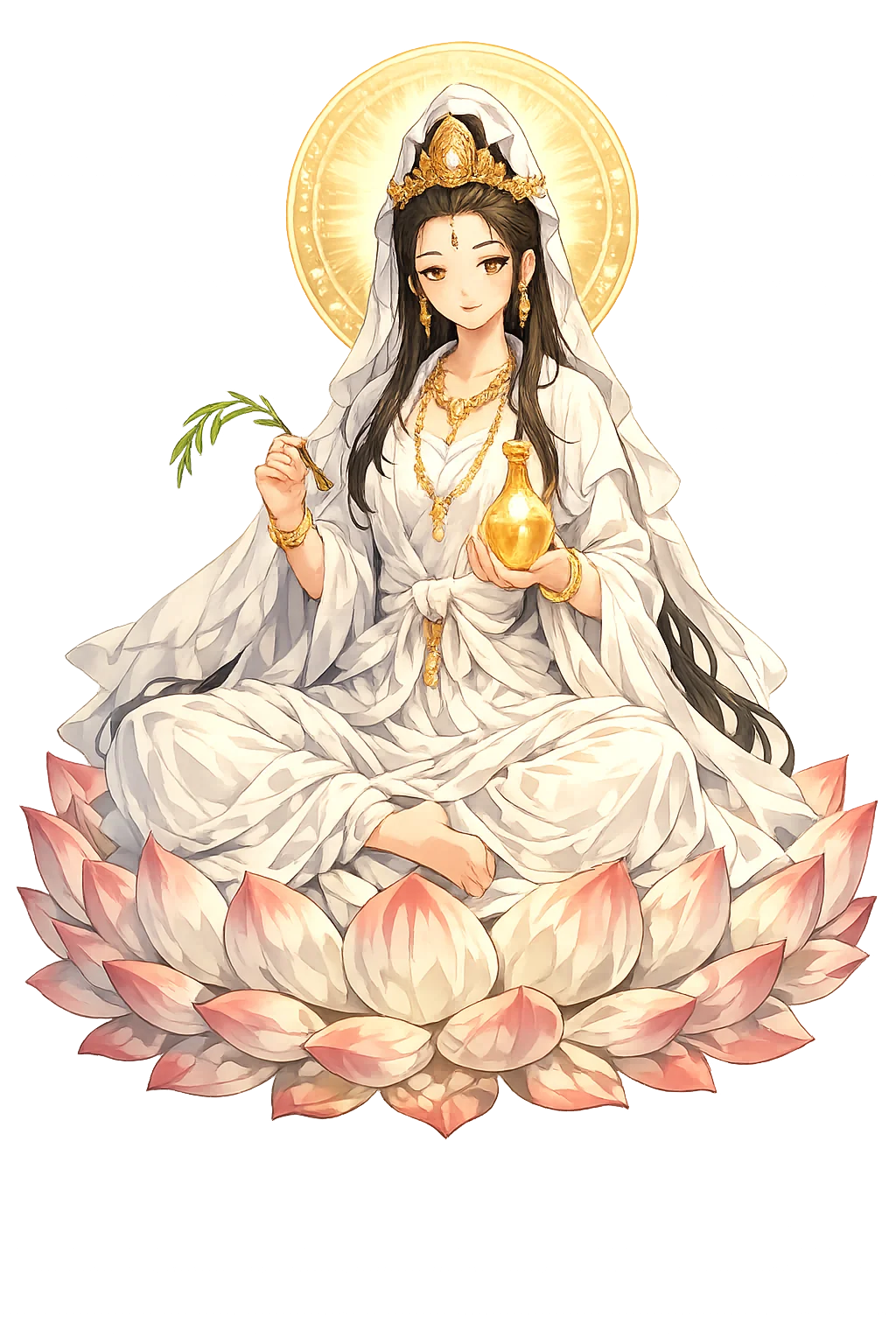
How Guānyīn was rebuilt, mark by mark
The workshop file for Guānyīn. Every rejected form is recorded here too — that is the point of keeping notes.
What We Found
The attestation, as Saddharmapuṇḍarīka (Lotus) Sūtra, ch. 25 — Kumārajīva's translation, 406 CE and Xiangshan Baojuan (Precious Scroll of Fragrant Mountain), 12th–13th c. record: 觀音. Meaning: "Perceiver of sounds".
The figure behind the name: Guānyīn's "myths" are vows and legends of response: the sūtra promises that whoever calls her name in danger will be heard, Chinese legend supplies the daughter who keeps the promise, and the great novels make her the patron of every journey.
What the Name Carried In
The Universal Gateway. Chapter 25 of the Lotus Sūtra — Kumārajīva's Chinese translation of 406 CE, so widely copied on its own that it became the independent Guānyīn Jīng — makes the vow explicit: if beings caught in fire, flood, storm, demon-lands, or the executioner's blade "call in one voice upon the name of Guānshìyīn, the bodhisattva will immediately perceive the sound and free them. " The chapter names the perils one by one and then multiplies the rescue: Guānyīn appears in thirty-three forms — monk, king, celestial, even demon-queller — going wherever beings are.
Miàoshàn of Fragrant Mountain. The legend that made her a daughter is preserved in the Xiangshan Baojuan, a precious scroll of the twelfth–thirteenth centuries: Princess Miàoshàn refuses marriage to pursue awakening, and her enraged father commits her to a convent and then burns it down around her. Executed at last, she descends to the underworld — where her compassion turns hell into a garden of flowers, and the kings of death hasten to restore her to life.
A spelling that has to carry stories like these is not a label. It is equipment.
Where It Stood Before Us
Putuoshan's three great monasteries (Puji, Fayu, Huiji) preserve her island cult from its 10th-century founding, when a Japanese monk's Kannon image refused to sail on and stayed. Dunhuang's Mogao caves hold her earliest Chinese icons — the guide-of-souls Guānyīn leading the dead, the thousand-armed forms of the Tang. The Northern Song colossal bronze thousand-armed Guānyīn of Longxing Monastery in Zhengding, China, cast in 971 CE, and the Song-dynasty polychrome "Water-Moon Guānyīn" figures — of which the Nelson-Atkins example is the most celebrated — mark her iconography's golden age. The bench inherits all of it — the web temple is the newest site, not the first.
What We Kept
The evidence, mark by mark — 2 features the keyboard form guanyin cannot hold:
- a → ā — Long vowel. Kept.
- i → ī — Long vowel. Kept.
What We Rejected
The plain ASCII guanyin — admissible as a fallback, never as the primary. A wrong accent would have been worse: the rulebook is explicit that a misplaced mark is worse than none.
What We Set Down
Guānyīn — The restoration preserves more than the ASCII form can express — stress, length, or a letter the Latin keyboard lost — which places it, mechanically, in Tier-1.
For the voice: gwahn-yin, high level tone on both syllables.
The temple stands at /guanyin/ — the notes above are public in its Scholarly Edition, sources and all.
At a Glance
- Restored name: Guānyīn
- ASCII form: guanyin
- Meaning: "Perceiver of sounds"
- Domain of influence: Compassion, Mercy
- Pantheon: Chinese
- Classification: Tier 1
- Original script: 觀音
- Series: The Restoration Files, No. 181 of 546
The File Continues
The temple's founding dispatch tells the name's story; its Resonance File reads the myths into the industries; the blog index holds the whole archive.
Continue the series — previous file: Guāndì (read it here) · next file: Gula (read it here).
The Restoration Files are written from the same canonical record as the temples themselves: the lexicon, the lore catalog, the pattern atlas, and the cited scholarly sources. If a file ever disagrees with its temple, the temple is right — tell us, and the file will be corrected.