
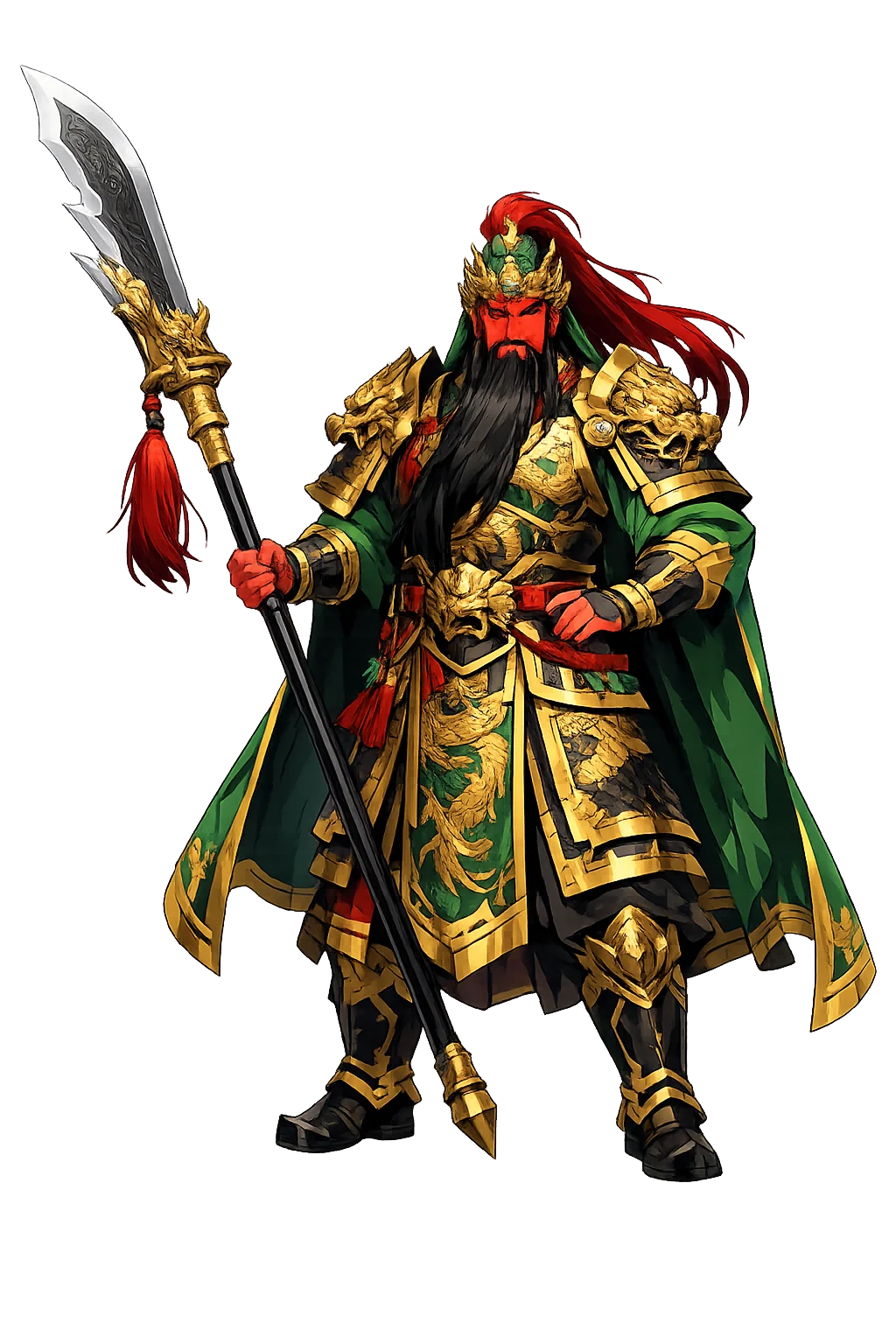
Guāndì: the stories first, then the spelling
You cannot weigh an accent without knowing what it carries. Here is what Guāndì has been carrying.
The Stories That Carry the Name
The Peach Garden. The Romance of the Three Kingdoms (ch. 1) opens not with a battle but with an oath: in the blossom of Zhang Fei's peach garden, the three — Liu Bei the petitioner, Guan Yu the bearded giant, Zhang Fei the hot-tempered butcher — kneel before heaven and earth: "We ask not to be born on the same day, but we beg to die on the same day. " The history behind the novel, the Sanguozhi (ch.
Three Conditions, One Horse. Captured with Liu Bei's household when Xiapi fell, Guan Yu dictated his own terms of surrender (Romance, ch. 25): he would yield only to the Han emperor, not to Cao Cao; the two sisters-in-law must be guarded with full propriety; and the moment his brother was found he would leave. Cao Cao tested the terms with gifts — gold, silks, ten beauties, and finally the Red Hare, the empire's finest horse.
From General to Emperor. The historical Guan Yu died badly in 219 CE — abandoned by allies, surrounded at Maicheng, captured at Linju and executed by Sun Quan's men (Sanguozhi, ch. 36). His head was sent to Cao Cao at Luoyang and buried with the honors of a prince — the grave at Guanlin that is still his shrine — while Wu buried the body at Dangyang in Hubei, where his cult first took root.
And Here Is What the Spelling Preserves
Against those stories, the attestation: 關帝, on the evidence Chén Shòu, Sānguózhì (Records of the Three Kingdoms), "Guan Yu zhuan" (ch. 36) and Luó Guànzhōng (attrib.), Sānguó Yǎnyì, ch. 1, 25–27 set down. The name means ""Emperor Guan" — the deified general Guān Yǔ, god of war, loyalty, and righteousness".
At a Glance
- Restored name: Guāndì
- ASCII form: guandi
- Meaning: ""Emperor Guan" — the deified general Guān Yǔ, god of war, loyalty, and righteousness"
- Domain of influence: War, Loyalty, Protection
- Pantheon: Chinese
- Classification: Tier 1
- Original script: 關帝
- Series: The Restoration Files, No. 180 of 546
The Name Travels
He is the one deity all three teachings claim: Taoism's Guān Shèng Dì Jūn (Holy Emperor), Buddhism's Sānghārāma, Confucianism's co-Sage. The diaspora carried him everywhere — his altar stands in Yokohama's Kanteibyō, in San Francisco's oldest Chinatown temples, and in every Hong Kong police station, where officers and triads bow to the same red face: the god both sides trust because both sides fear to lie before him.
The Address It Earned
The temple of Guāndì stands at /guandi/ — lore, scholars, patterns — because a name carrying this much story deserves more than a parking page. What survives here cannot be shown in ASCII: a feature of the original that the fallback alphabet flattens. That is the Tier-1 test, and this name passes it without argument.
The Sources Are Open
The myths above are retold from the temple's record; the primary voices are in the Sacred Texts: Tao Te Ching. Nothing in this file outranks them.
The File Continues
Read the founding dispatch for the name's full story, the Resonance File for the archetype at work — or the whole archive in one sitting.
Continue the series — previous file: Gravitas (read it here) · next file: Guānyīn (read it here).
The Restoration Files are written from the same canonical record as the temples themselves: the lexicon, the lore catalog, the pattern atlas, and the cited scholarly sources. If a file ever disagrees with its temple, the temple is right — tell us, and the file will be corrected.